How a Data-Driven, Charging-First Approach revolutionises Passenger Experience in Airports while reducing OpEx.

Author: Ian Hobson
Managing Director, ChargeBox®
Airports are microcosms of modern life. They are high‑stakes environments where millions of passengers converge, carrying not just luggage but an entire digital ecosystem: smartphones, tablets, laptops and wearables. In an era where travellers expect seamless digital experiences, a dead battery can be more than an inconvenience—it can disrupt plans, increase stress and even reduce spend in the terminal. Yet despite the importance of keeping devices powered, most airports still fail to provide a robust, customer‑centric charging solution.
This comprehensive guide explains why passenger charging often goes wrong, why it matters now more than ever, and how a charging‑first, data‑driven approach can transform passenger experience scores while reducing operational costs. Drawing on research insights, real‑world examples and lessons from years of industry experience, we’ll unpack the common pitfalls that undermine airport charging and reveal the strategies to build a resilient, future‑proof infrastructure that satisfies travellers and stakeholders alike.
Key Takeaway
ChargeBox’s research across 55 major international airports found that only 2 had a higher Skytrax score for charging than their overall passenger satisfaction score, while 13 airports scored two stars or less on charging. This highlights a systemic failure to treat charging as a core service rather than a commodity and underscores the opportunity for airports to differentiate by prioritising a charging‑first data-driven strategy. Charging is not a furniture problem - it is an experience design problem.

Introduction – Why Airport Passenger Charging Matters Today
Imagine arriving at an unfamiliar airport after a long journey. You need to access your digital boarding pass, confirm transport arrangements and communicate with family—all tasks dependent on a functioning smartphone. You scan the gate area for an outlet, only to discover they’re all occupied or broken. Stress rises, and your first impression of the airport plummets.
This scenario is familiar to many travellers and is emblematic of a broader challenge. According to Airport Dimensions’ 2024 Airport Experience Research, global airport experience satisfaction has dipped to 70%, the first decline since their research began. The report attributes this decline in part to shifting expectations among younger travellers, who want their time at airports to be more inspiring and rewarding and for their digital devices to access everything they need. In other words, connectivity and device readiness are no longer optional perks; they are core components of the passenger journey.
Passenger surveys consistently highlight the importance of digital convenience. For example, travellers ranked comfortable seating (83%), reduced queuing (79%) and the availability of a single app for smoother journeys (71%) as top experience improvements. These findings reflect a desire for efficiency and reliability across the travel journey—and staying connected through a charged device is integral to that.
Despite these clear signals, airports continue to overlook charging infrastructure as a strategic asset. Many treat it as a simple product—install a few sockets into the wall and tick the box. As a result, most charging solutions suffer from poor availability, inconsistent maintenance and outdated technology. In our analysis of 55 major airports with three stars and above, we found that nearly 90% provide lower passenger charging scores than their average airport rating. Only two airports outperformed their averages, and 13 scored two stars or less.
As airports embark on ambitious digital initiatives—ranging from biometric boarding to personalised retail offers—the reliability of passengers’ devices becomes a critical enabler. Without power, digital products and services fail. A data‑driven, charging‑first approach solves this bottleneck, fostering customer satisfaction, operational efficiency and new revenue opportunities. This article explores how to get there.
Charging’s importance stretches far beyond convenience. Mobile devices have become digital passports, wallets, entertainment hubs and boarding cards. Travellers rely on them for real‑time flight updates, translation tools and communication. When these devices lose power, the ripple effect touches every aspect of their trip. Airlines spend additional time processing paper boarding passes, security queues slow as travellers fumble with printouts and retail opportunities are missed when passengers can’t pay via mobile. Even simple conveniences like ordering coffee from an app or scanning a QR code for lounge access hinge on a charged battery.
The psychological impact of an low-battery device should not be underestimated. A low or dead battery can elicit panic, especially for passengers travelling alone, unfamiliar with the local language or dependent on digital health or wellness apps. Conversely, the reassurance of a fully charged device allows travellers to explore the terminal, shop, dine and interact with digital experiences without worrying about losing power at a critical moment. When an airport invests in charging, it isn’t just offering a plug; it’s delivering peace of mind and freedom to engage with the airport environment.
Throughout this article, we will return to the theme that charging is not an isolated amenity but a foundation for modern airport experiences. From the moment a passenger leaves home until they arrive at their destination, power availability influences their ability to navigate, transact and enjoy their journey. As digital transformation accelerates, airports that fail to acknowledge this fundamental truth will fall behind those that adopt charging as part of their core infrastructure strategy.
What This Article Covers
We’ll examine the root causes of poor passenger charging and why they persist. You’ll learn why it’s essential to treat charging as a service rather than a product, how data illuminates the true state of your infrastructure and the ways to future‑proof your charging offering through a charging‑first mindset. We’ll also share insights from real‑world deployments, discuss the role of new charging standards like USB Power Delivery (USB‑PD) and outline actionable steps for airports to adopt a data‑driven charging strategy. Finally, we’ll discuss how this approach can improve passenger experience scores, support digitalisation initiatives and deliver long‑term cost savings.
Ready to see why airports get passenger charging wrong—and how to fix it? Let’s dive in.

Industry Context & Insight – The Bigger Picture Behind Airport Charging
Understanding the passenger charging challenge requires acknowledging the broader context in which airports operate. Travel volumes continue to surge, but passenger expectations are evolving even faster. The modern traveller carries multiple devices, uses mobile boarding passes, orders food via apps and expects seamless connectivity from curb to gate. Charging infrastructure has to keep pace with these changes—yet it rarely does.
Rising digital expectations. Data from the IATA Global Passenger Survey 2024 shows that travellers’ satisfaction with airport experiences is heavily influenced by digital accessibility. Younger travellers in particular want airports to be more inspiring and convenient and rely on their mobile devices to access everything they need. However, the same research indicates that 21% of travellers do not engage with the airport through any digital channel. This gap suggests that there’s still significant room to improve digital experiences—and reliable charging is a prerequisite.
Experience satisfaction slipping. Airport Dimensions’ research found that satisfaction with airside facilities has dipped to 54%. Passengers cite comfortable seating, reduced queuing and digital service integration as their most valued improvements. Poor charging exacerbates stress and friction: when travellers cannot power their devices, they struggle to navigate airports, engage with digital services and make purchases. As the customer experience article on CX Dive notes, airports can mitigate stress by addressing “minor needs” such as providing ample outlets and charging stations.
The cost of uncharged devices. Beyond passenger discomfort, uncharged devices can impact airport revenues. Research indicates that travellers spend over one‑third of their time at airports on revenue‑generating activities such as shopping, dining and going online. When devices die, passengers are less likely to engage with digital interfaces that drive these spend opportunities, leading to lost ancillary revenues. For airlines, uncharged devices mean more manual interventions at boarding gates when digital boarding passes are inaccessible.
Underinvested infrastructure. Many airports are still using outdated charging solutions—unmanaged power outlets or furniture with built‑in sockets that were never designed for high‑traffic environments or modern high power devices which demand fast charging. When charging is treated like a one‑time purchase rather than a long‑term service, sockets break, cables disappear and the solution quickly falls into disrepair. Staff are tasked with manual inspections that are often infrequent and inefficient. Passengers might stumble upon a cluster of working outlets, but many more will face non‑functional or crowded charging points and leave the airport with a negative impression.
Airports’ digital transformation initiatives. Meanwhile, airports are investing heavily in digital experiences—biometric boarding, touchless check‑in, dynamic wayfinding, parking, transport access and personalised retail offers. These initiatives rely on passengers having charged devices. Without power, passengers cannot access digital boarding passes, pay via mobile or use the airport’s app to navigate or shop. A robust charging infrastructure thus becomes the foundation on which other digital initiatives are built.
In summary, the industry context reveals a clear gap between passenger expectations and the charging experience most airports provide. Recognising charging as a strategic enabler rather than an afterthought is essential to closing this gap.
The Global Adoption of Digital Travel Technologies
The airport experience is increasingly digital. Recent studies on passenger technology adoption show that 60% of travellers now use mobile boarding passes and 35% have experienced biometric verification during their journeys. When these digital tools work well, satisfaction rates soar—85% of passengers using mobile boarding passes report positive experiences and 78% feel the same about biometrics. However, these tools depend entirely on a functioning device and a charged battery. Without power, the benefits of mobile check‑in, biometric gates or contactless payments are lost.
Despite this growing adoption, a significant minority remain sceptical: 45% worry about data privacy, 30% believe digital tools aren’t reliable, and 25% lack awareness of digital solutions. Reliable charging can help alleviate these concerns by ensuring that when passengers do choose to use digital services, the technology works flawlessly. A dead device or one that dies mid‑transaction can reinforce the perception that digital tools are unreliable. Conversely, a consistently charged device encourages repeat use, helping airports move more passengers to digital channels where operations can be streamlined and data collected to improve services.
Charging and the Passenger Journey
To understand why charging matters, we need to follow the passenger journey from curb to gate. Consider pre‑travel: travellers use mobile devices to check in, choose seats, pay for extras and download digital boarding passes. At the airport entrance, digital wayfinding apps help them navigate security and locate check‑in desks. Once past security, passengers often explore shopping and dining opportunities or head to lounges—all via smartphone. When boarding begins, digital notifications alert them to gate changes or upgrades; when they fly, they may want to sync entertainment or order food via an app. Each step hinges on a charged device.
Passenger charging touches nearly every metric airports care about: dwell time, retail spend, operational efficiency and overall satisfaction. Studies from various airport authorities show that when passengers are engaged via digital platforms, dwell time increases and so does spend on retail and food. However, if a phone dies while a passenger is browsing an airport’s duty‑free catalog or mobile order platform, that revenue opportunity vanishes. In the worst case, passengers will avoid digital services entirely, limiting airports’ ability to collect data and personalise experiences.
Why Charging Infrastructure Has Lagged
If the need for charging is so clear, why have airports been slow to act? The reasons are multi‑faceted. First, capital budgets often prioritise visible infrastructure—new terminals, seating or lounges—over the less glamorous upgrades like wiring and power management. Second, many airports rely on third parties or concessions to provide amenities, leading to inconsistent quality and accountability. Third, because charging doesn’t directly generate revenue in the same way that retail or parking does, it’s easy to overlook the indirect revenue impact of a poorly charged passenger base.
In addition, airports often underestimate the engineering complexity of providing reliable, safe and future‑proof charging at scale. The electrical environment in airports is complex, with numerous stakeholders responsible for maintenance and safety. It can be tempting to install consumer‑grade solutions that look sleek but fail under high usage, or to deploy AC outlets with no monitoring, leaving them prone to faults. The assumption that charging is simple prevents airports from investing in the design and data systems needed for long‑term success.
Core Messages – Why Airports Get Passenger Charging Wrong
It’s easy to view passenger charging as a procurement problem: buy enough power outlets, install them and move on. But this mindset fails because it overlooks the factors that make charging usable, available and sustainable at scale. Based on our experience and industry research, there are three major misconceptions that cause airports to miss the mark.

Poor User Experience, lowering CX Scores

Unregulated devices and cables causing potential issues

Unmonitored sessions, without reporting
Misconception 1: Charging Is a Product, Not a Service
Too many airports think of charging stations as a capital expenditure—a piece of furniture with sockets that solves the problem forever. In reality, providing high‑availability charging is an ongoing service that requires proactive management, maintenance and data insights. Treating charging like a one‑off purchase leads to rapid degradation of service levels. Sockets break, cables disappear and no one is accountable for fixing them. Passengers quickly learn that charging is unreliable and stop using it altogether.
ChargeBox® advocates a “charging‑first” approach where charging infrastructure is designed, deployed and managed with the same rigour applied to other essential services. This includes using commercial‑grade hardware, built‑in fault detection and a centralised monitoring platform. A charging‑first mentality also means considering how charging interacts with furniture, signage and passenger flow. Charging points should be easy to find, easy to use and integrated into the airport’s aesthetic—not an afterthought tucked away in a corner.
Misconception 2: More Sockets = Better Service
A common reaction to poor charging feedback is to install more outlets. While increased capacity is important, quantity alone doesn’t ensure quality. Without good design and management, more sockets can exacerbate the problem by introducing more points of failure. Additionally, many outlets are AC sockets requiring passengers to bring their own chargers and adapters. This not only burdens travellers with more equipment but also increases the risk of using incompatible or unsafe chargers.
Modern devices all charge through USB Power Delivery (USB‑PD), a standard that delivers higher power using low-voltage DC and supports a range of devices from smartphones to laptops. By installing high‑power USB‑PD charging points with built‑in cables and fast charge wireless pads, airports can eliminate the need for travellers to bring chargers. This simplifies the passenger experience, increases charging speed and reduces maintenance headaches caused by passenger equipment. One top airport we worked with eliminated AC outlets for passenger charging and saw a dramatic drop in faults and dangerous incidents while also eliminating costly inspection overhead.
It’s also essential to consider that faster charging increases throughput. When devices charge more quickly, passengers occupy charging points for less time, freeing capacity for others and reducing crowding. This can reduce the total number of points required, saving on installation and maintenance costs while improving availability. Passengers also have more time to enjoy other airport amenities leading to additional spend and satisfaction.
Misconception 3: Maintenance Is Optional
Charging infrastructure—like any high‑use system—degrades over time. Without active maintenance, performance will inevitably decline, leading to broken sockets, frayed cables and frustrated passengers. Some airports attempt to manage this through manual inspections, sending staff to test every point periodically. But with thousands of sockets, this process is unsustainable. For example, we know of an airport with 20,000 sockets that tries to inspect each one weekly. That requires an unrealistic rate of one test every eight seconds over a 40‑hour workweek, not including repair time. Manual inspection is not only expensive, but it also misses intermittent faults and leads to long periods where charging points remain out of service.
By contrast, a data‑driven approach treats charging points like IoT devices that report on their own status. Each port—whether socket, cable or wireless pad—communicates usage, fault status and power delivery metrics. This data flows into a monitoring platform where faults are flagged in real time and maintenance can be prioritised based on impact. Instead of testing everything manually, maintenance teams can focus on fixing actual issues, drastically reducing downtime and labour costs. This also allows airports to track overall service availability, plan upgrades and demonstrate accountability for their charging service.
Real‑World Consequences of Getting Charging Wrong
When airports neglect these realities, the consequences ripple through the entire passenger journey. Uncharged devices leave travellers unable to access digital boarding passes, mobile wallets or itineraries. Stress and anxiety rise, harming overall satisfaction. Crowded charging areas become hotspots for frustration, with passengers arguing over limited sockets or leaving their devices unattended. Broken or unsafe chargers create electrical hazards and potential reputational damage.
What’s more, the mismanagement of charging can have real financial impacts. Reduced passenger dwell times and lower spend on retail and dining directly erode non‑aeronautical revenue streams. Airlines are forced to intervene when mobile boarding passes fail at gates, causing delays and manual processing. In worst‑case scenarios, passengers may take to social media to complain about poor charging, tarnishing the airport’s brand and driving travellers to competitors.
Practical Examples & Mini Case Studies – Charging Success Stories
To illustrate how a charging‑first, data‑driven approach works in the real world, let’s explore a few examples. Each demonstrates how reliable, fast and monitored charging can improve customer satisfaction while reducing costs.
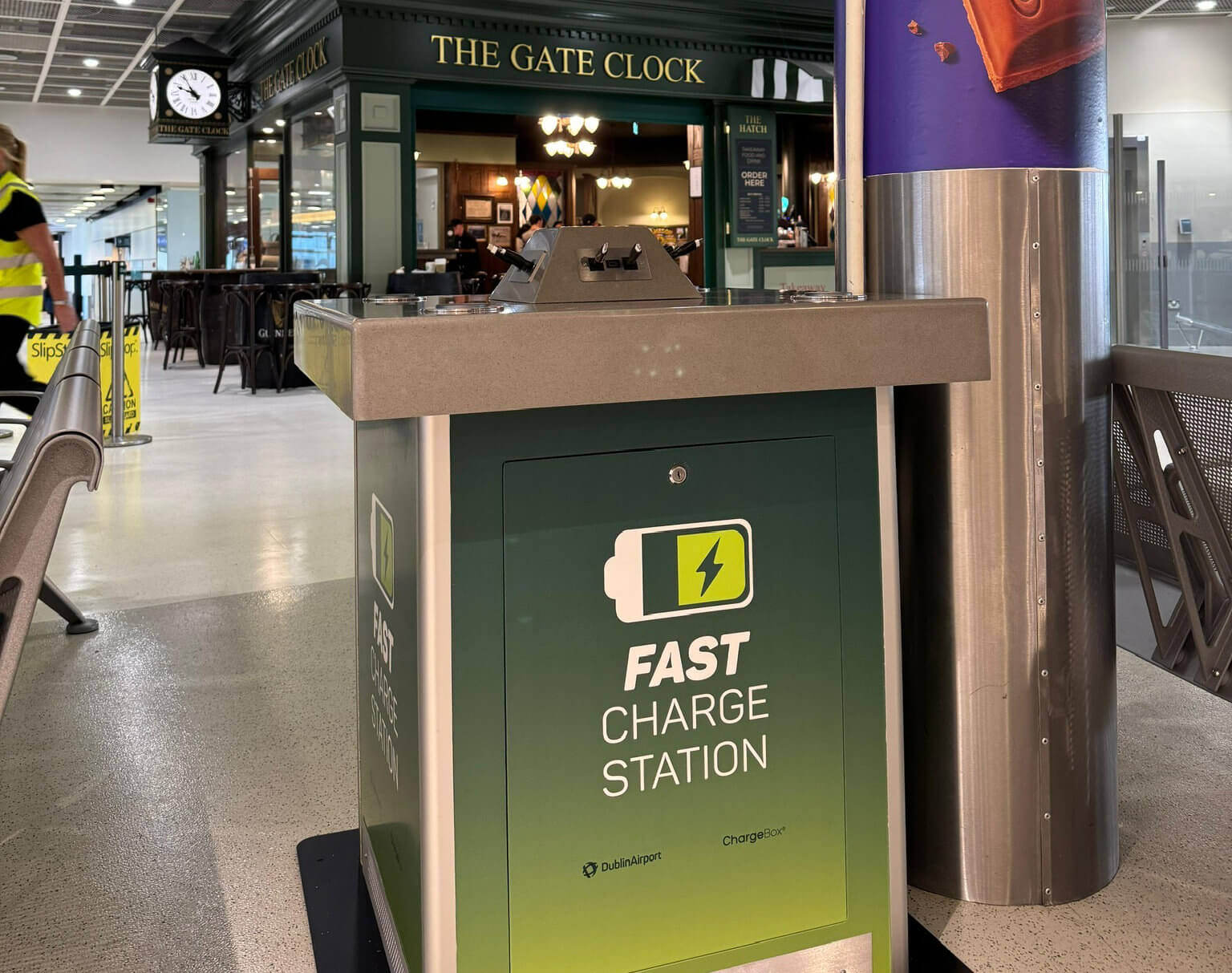
Airport Reduces Frustration and Increases Passenger Satisfaction
A major international airport partnered with ChargeBox® to explore how a charging-first, data-driven solution could significantly increase passenger satisfaction. The airport had long-ago - and ahead of their time - installed a large number of poles with AC outlets. These were iconic designs with excellent aesthetics and discovery features, already had power and high structural integrity.
Working with the airport, we intentionally repurposed the poles and implemented a data‑driven charging-first solution featuring low-voltage USB Power Delivery with direct-to-device cables, fast wireless charging using Qi2 and fast charge USB-C sockets with standard charge USB-A sockets. Before the upgrade, passenger complaints about charging were common and the airport’s internal passenger satisfaction metrics were disappointing. With just 6 poles repurposed and 96 ports of charging, capacity, availability and passenger satisfaction were transformed in a terminal serving around 20 million passengers per year.
A few months later, ChargeBox® began work on adding 35 more units across the remaining 3 terminals which were installed over a 2 month window in the summer or 2025 - resulting in capacity of 656 charging end points. Service availability is above 99% (previously below 70%) partly due to elimination of AC, and the fact that serious faults are identified in almost real-time and appropriate action can be taken. Passengers spend less time charging their devices with the high power USB PD charging, which also helps to stretch the capacity further. Engineering call-outs dropped to close to just one or two per month instead of over 25. Most of these related to other issues on the power circuit. Even without complete airport coverage, the 41 units are estimated to charge 2.7m passenger devices annually.

Heathrow Airport, one of the world’s busiest and most prestigious airports, recognised the growing demand for high-quality, reliable passenger charging…
Major Sporting Venue Improves Visitor Experience and Player Experience
For more than 12 years ChargeBox® has supplied the best public charging solutions to one of the most iconic sporting events in the international calendar. This includes fast charging locker stations for use by both players and debenture holders, charging devices in a fraction the time of power banks or older USB sockets. With full connectivity, the stations ensure the highest levels of availability are maintained throughout the two-week event despite being used at the very highest levels. Visitors can enjoy the tournament without anxiety about their device battery level and whether they can get home at the end. The world’s best players can focus on their game and not their battery level.
Airport Receives Rave Reviews of New Charging Provision
Working in partnership with another major international European airport serving around 40 million passengers per year, a small 3-unit trial proved incredible demand showing usage rates of over 300 device charges per day for each furniture unit. Using QR code stickers on the unit to explain the service and solicit feedback produced positive responses in 83% of replies. Negative responses were highly correlated to specific instances such as power being removed from the unit due to external factors.
Examples of some responses
"Amazing service, thanks"
"Merci beaucoup, Many thanks”
Ottimo “Excellent”
"This is great. Can we please have more, lots more!"
Todo genial "Everything is great”
"Great Service"
Great idea!! I had just bought new headphones in the airport and the charging station was a great convenience
More info here: The Irish Sun >
Prestigious Car Brand Improves Visitor Experience to Showrooms
Working with Porsche Gmbh and its showroom operations we/ChargeBox® installed charging first, data-driven solutions into 3 dealerships so that key customer touch points were enhanced with charging. Service availability is critical in such situations, with particular focus on the configurator rooms where potential customers select from the myriad of options. A charged device reduces anxiety and leads to higher spend on the options that individualise the vehicle for that customer.


Leading Department Store Brand Sees 100x ROI from Charging
Working with the leading UK department store chain (John Lewis) over 10 years, a joint research study showed that visitors using the ChargeBox services spent £35/€40/$45 than those who did not use ChargeBox®. High dwell time was correlated with use of ChargeBox®, and users indicated they expected to spend further time with more purchases in store (non-users were interviewed only at exit, whereas users were interviewed at point of use).
Solutions, Insights & Future Trends – Designing Charging for the Next Decade
Now that we’ve examined why airports get charging wrong and what happens when they do, let’s explore how to design a charging solution that works today and remains relevant for years to come. Key principles include a charging‑first design; data‑driven service management; safety, security and robustness; future‑proof technology choices; and customer‑centric thinking.
Adopt a Charging‑First, Data‑Driven Mindset
To achieve sustained success, airports must approach Charging‑as‑a‑Service (CaaS). This means making charging part of their operating model, with clear accountability, performance metrics and regular service reviews. Start by selecting hardware designed for high‑traffic environments: commercial‑grade chargers with protected power delivery cables and tamper‑resistant designs.
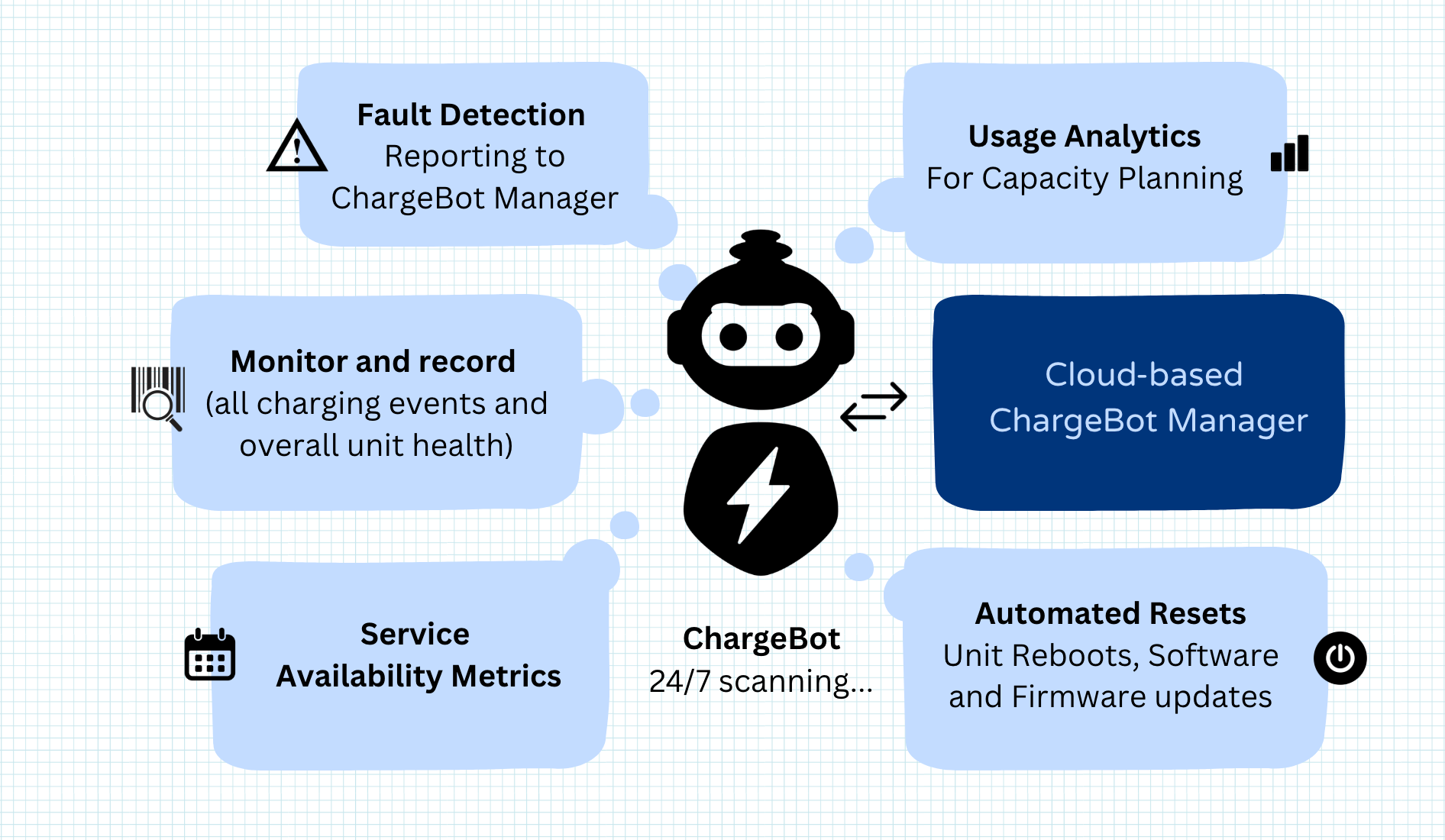
Pair hardware with a connected management platform that collects real‑time usage and fault data from every port. The platform should provide dashboards for capacity planning (identifying busy stations, peak times and heavily used ports) and fault management (prioritising repairs and tracking resolution). Data can also inform strategic decisions such as where to add new units, which technologies to support and when to retire outdated infrastructure.
Insight
ChargeBot Manager provides all the tools to fully manage the charging service including fault detection and ticket management. Usage analytics including date/time, cable/socket used, power delivered support passenger experience metrics and allow capacity planning, placement and adjustment. Easy QR feedback per unit solicits passenger input on the service.
Design for Speed, Safety and Simplicity
Modern devices charge over USB‑PD, the worldwide all-manufacturer standard that supports higher power and can charge phones, tablets and laptops through one connector. This is also the foundation for optional faster wireless charging. By deploying fast USB‑PD chargers with built‑in cables, airports can ensure that passengers achieve a meaningful charge quickly—as much as 50% in 20 minutes—maximising dwell time and relieving crowding. Fast charging also reduces the risk of travellers using outdated or counterfeit chargers, which can pose safety hazards.
Removing AC sockets from public areas eliminates the risk of electric shock and prevents passengers from using incompatible or unsafe adapters. It also simplifies operations: there is no need to have multiple socket types or worry about tampering/damage to AC circuits. Airport engineering teams will appreciate the reduction in faults and electrical incidents.
Beyond safety and simplicity, the design of charging points influences passenger behaviour and perceptions. Modern chargers should feature accessible placement at different heights to accommodate passengers with reduced mobility and clear signage so travellers know where to find them. In premium areas or lounges, custom finishes can blend charging seamlessly into furniture, creating a more relaxed atmosphere. In general seating areas, rugged materials and visible branding can signal that the airport cares about passenger comfort and convenience.
Insight
Eliminating AC outlets and deploying high‑power USB‑PD chargers improved passenger satisfaction and safety while reducing maintenance interventions to a fraction of what they were before at one major international airport.
Maintain Service Availability Through Automation
Manual inspection is a relic of the past. A data‑driven maintenance workflow ensures that charging points communicate their status continuously. Real‑time fault detection allows staff to prioritise repairs based on the severity and location of issues. Critical faults (e.g., power outages or liquid spills) can trigger immediate call‑outs, while minor issues (like a worn cable) can be grouped for routine maintenance. Passengers become part of the monitoring system: with QR codes or digital surveys, they can report issues directly, providing additional context to the maintenance team.
This approach also facilitates accountability. Service level agreements can be tied to service availability metrics (e.g., “charging stations will be operational 98% of the time; individual ports at 95% of the time”). Performance dashboards can be shared with stakeholders, demonstrating the value of charging as a service and supporting budget allocations for upgrades and maintenance.
Airports adopting data‑driven maintenance can even predict when components are likely to fail. By correlating usage patterns, environmental factors and past fault data, predictive models can forecast spare parts needs as well as stations more likely to suffer degradation from high usage. Maintenance teams can schedule repairs proactively, avoiding downtime during peak periods. This predictive approach reduces the cost of emergency repairs and extends the life of charging equipment. It also provides an audit trail for compliance and reporting, showing how well the airport is meeting its promised service levels.
Prepare for Future Charging Needs
Technology never stands still. Batteries are getting larger, devices are becoming more power‑hungry and new charging standards are emerging. USB PD continues to evolve and will support future device needs, even if some upgrades are necessary. Today, 45W charging power is suggested as a minimum to support modern phones, most tablets, and with a good level of support for laptops. Power of 60W will give some future proofing and support laptops better.
Wireless charging will continue to play a role, especially for convenience in lounges and waiting areas. However, wireless technology remains slower and less efficient than wired charging, and is not applicable for todays tablets and laptops. A mixed deployment—wired USB‑PD for fast charging and wireless pads for casual use—can satisfy various needs. As wireless standards like Qi2 mature, they may deliver faster speeds, but airports should monitor real‑world adoption before fully committing.
Finally, airports should anticipate integrating charging with wider digital ecosystems. For example, charging stations could display personalised content or advertising when a device is plugged in, or integrate with loyalty programmes to reward passengers who use the airport app. As Internet of Things (IoT) and artificial intelligence technologies advance, charging infrastructure will become part of a connected ecosystem that informs operational decisions and enhances passenger experiences.
The next decade will also bring regulatory and sustainability considerations. Governments and aviation bodies are increasingly focusing on energy efficiency and carbon reduction. Airports will need charging solutions that minimise energy waste—such as smart power management that reduces standby consumption—and incorporate renewable energy sources. Solar‑powered charging stations can reduce reliance on grid electricity and showcase an airport’s commitment to sustainability. Combined with data analytics, airports can measure the carbon footprint of charging infrastructure and communicate progress to passengers and regulators.
Cybersecurity is a vital part of the service provision. A software-based solution can help to identify potential Man-in-the-Middle attacks whereby elements of the service could be interfered with. Physical access control and tamper-proof components can further give confidence that cables and sockets are not at risk. Back-end systems should adhere to best-practice security protocols. However, TSA warnings of sockets interference at airports are basic click-bait techniques distracting users from the real issues on device security. Current Android and iOS versions offer very robust and significant protections against such attacks and passengers would be better advised to focus on public Wi-Fi and malware on sites - here’s looking at you, Meta . Airports offering fast-charging wireless solutions can give passengers with tin-foil hats an alternative option at the expense of slightly slower charging (and no support for laptops and tablets).

Conclusion – Charging Is Core Infrastructure, Not an Amenity
Charging no longer belongs in the category of “nice to have.” It is a critical enabler of the digital airport—a foundation on which biometric boarding, mobile payments, real‑time wayfinding and personalised retail depend. Yet most airports still deliver charging experiences that frustrate passengers, degrade operational efficiency and waste resources.
By adopting a charging‑first, data‑driven strategy, airports can transform this challenge into a competitive advantage. The benefits are clear: higher passenger satisfaction, stronger NPS scores, increased dwell time and retail spending, reduced maintenance costs and a flexible infrastructure that adapts to future technology.
Research shows that the gap between what travellers expect and what airports deliver continues to widen. Only a handful of airports score better on charging than their overall experience scores, while many underperform on a metric they can easily control. The winners in the next decade will be those who treat charging as core infrastructure, design it intentionally and manage it through data. These airports will empower passengers to stay connected, enabling digital initiatives to succeed and unlocking new revenue opportunities.
Final Thought
Charging might seem like a minor detail, but it signals whether an airport truly understands how people travel in a digital world. A charging‑first, data‑driven solution transforms charging from a reactive amenity into a proactive contributor to comfort, efficiency and trust.
If you’re ready to deliver a charging service that delights passengers, boosts your experience scores and lowers your operating costs, contact us at ChargeBox®. We’ll help you design a bespoke, future‑ready charging strategy and guide you every step of the way.