How Sustainable Are Public Phone Charging Solutions?
In pursuit of sustainability, we’ve embarked on a profound journey to determine the environmental footprint of our business operations and the life cycle of our charging solutions. Collaborating with expert third parties, we’ve analysed and dissected the carbon emissions of our entire operation. The result? We have already taken significant strides toward achieving our goal of NetZero emissions by 2030. Contact us for our latest report which shows over a 30% reduction compared with 2019 on a constant revenue basis.
For a long time, we’ve championed the belief that alternative solutions simply can’t match the sustainability performance of ChargeBox. It’s this unwavering conviction that propelled us to dig deeper into the sustainability (or otherwise) of rented power banks.
While the term “sustainability” is scattered across the websites of providers offering such solutions, you’ll also notice a distinct lack of details with more in-depth reading. The mere presence of a “sustainability officer” doesn’t inherently drive meaningful change. So, we’ve decided to pull back the curtain and reveal our research and findings for a comprehensive understanding.
Remember first of all, that power banks have a limited lifecycle. Given the amount of valuable materials in them together with the effort to mine, refine and produce battery packs, we wanted to see what the lifecycle emissions of a power bank solution would be.
We have included references to scientific literature and other sources of data for our calculations and to show full transparency but are happy to share our calculations or even amend them, if better data can be provided.
What we found truly shocked us! Our data and calculations are shown below but first, let’s summarise what we have used as relative comparisons before looking at the results.
Comparing ChargeBox Charging Stations With Power Bank Charging Stations
Our own charging stations with 6 lockers can charge well in excess of 100 devices a day – and frequently do. So, we have compared a large 40-power bank charging solution with our ChargeBox FAST6. Here’s what we included for this analysis as well as what we didn’t include:
- We have included the embedded carbon in the respective machines – a recent model ChargeBox FAST6 6-locker USB Fast charge station and a 40 power bank charging machine (which we have estimated). We have assumed a 5 year operating life for both solutions (most ChargeBox stations go on considerably longer).1
- We have included the emissions from expected electricity consumption during that 5 year lifetime if operated in the UK using our typical emissions per unit of electricity. Here we have assumed similar electricity usage, though power banks introduce an extra level of loss that we have assumed conservatively at 10%.2
- We have not included emissions involved in installation and service activities for both solutions, though these are expected to be similar.
- For the power bank solution, we added in the embedded carbon to produce each Lithium-Ion battery based on a scientific paper with such metrics. We did not include embedded carbon in casing and cables, or for transportation from Asia.3
- We estimated the number of power banks that would be required over the 5 year lifecycle based on expected failure rates as well as losses due to other factors such as customers keeping the devices.4
- We did NOT factor in end-of-life recycling and re-use.5
- We ran our numbers both with an equivalent number of charges provided over 5 years, as well as using a much lower number for the power bank rental solutions which is our expectation of real usage.6
Power Banks Produce 26 Times More Carbon Emissions Than ChargeBox
If a power bank rental solution provides the same number of charges as a ChargeBox over a 5 year cycle, then we calculated the emissions of that solution to be over 33 tonnes of CO2 compared with just 1.2 tonnes for ChargeBox. This is both in total and per charge (since the charges given are equal).
In the case that the power bank solution provides just 1/5 the number of charges of a ChargeBox (which of course means just 1/5 the number of satisfied users), then the power bank CO2 emissions drops to around 8 tonnes – still 6 times more than ChargeBox with just 20% of the service given.
| Usage Scenario | Same Usage | Power Bank 1/5 of ChargeBox Usage |
| ChargeBox emissions (tonnes of CO2) | 1.2 | 1.2 |
| Power Bank rental emissions (tonnes of CO2) | 33 | 8 |
| Comparison | ChargeBox emits 26 times less carbon | ChargeBox emits 6 times less carbon but charges 5 times more devices |
| Carbon per charge | Power Banks 26 times more | Power Banks 31 times more |
We also varied our assumptions to see if battery loss/failure rates were much lower than what we believe to be the case. Even here, power banks solutions emit 12 times the emissions per charge given in the scenario of a 1/5th usage (over 3 tonnes total) ; and 7 times for equivalent usage (over 9 tonnes).
We will happily re-work our model if credible alternatives are presented to us for any of our assumptions. Climate calculations are very difficult to do accurately and we would always caution about differences of as much as 50%. But when the differences represent at least an order of magnitude, there is little doubt that such solutions are not comparable on a sustainability basis.
Is 33 tonnes of CO2 emissions a lot?
It’s equivalent to:
- 39 seats on a flight from London to New York
- 6 years of a single person’s carbon emissions across all their activities (average UK person)
Remember also (if you read the footnotes) we have not factored in extra embedded carbon from machine manufacture in China, and freight emissions for both machines and batteries. Both of these would result in additional emissions for power bank solutions but do not apply to UK-manufactured ChargeBox.
Of course, you might argue that both solutions are worse than charging at home. In the case of the power banks, it almost certainly is, but with ChargeBox it would be similar to charging at home. While we are at the mercy of our hosts in terms of how they procure their energy, we encourage all to use 100% renewable – as we do in our own operations.
If you’d like to know more about a sustainable way to keep your visitors, guests, students and patients’ devices charged, drop us a line – we’d love to hear from you.
Thanks for reading!
1 We have used our own embedded carbon as a reasonable estimate of embedded carbon in the power bank charging machine. The reasoning is that it is a similar size metal box, with similar types of electronics, screens and other components. We have NOT allowed for the fact this is produced – most likely – in China which has carbon emissions relating to electricity in production at more than 2x the UK where ChargeBox is manufactured (and even here, our metal fabricator uses extensive solar energy installed on its buildings which was not factored into our calculations). We have also NOT allowed for emissions due to shipment of the units from China to the UK.
2 We have calculated both the base level electricity to keep each machine functioning and the electricity used to charge either the power banks (power bank solution) or devices directly (ChargeBox) during a 5 year lifetime in the UK and then used the UK’s electricity emissions number (which was 181g.CO2/KWh in 2020 and is probably a bit lower now). The electricity for both will be similar per use, though the power banks introduce an additional efficiency loss and we included a figure of 10% in our calculations. The amount of electricity consumed by either solution was not hugely material or different. With the scenario for 20% usage of power banks compared with ChargeBox that would translate into lower electricity emissions – but obviously producing less charged devices.
3 We added in the embedded carbon we calculated is in every power bank based on a scientific paper outlining such a figure for any type of Li-ion battery. This did not include extras such as cases or cables. The paper estimated the embedded energy required to make a battery, and we then used the figure for China’s electricity emissions per kWh as stated here
4 We varied our assumptions on these figures to see the impact, but in every scenario, there was still a significant impact. Our base level estimates were taken from the experience of one of our international partners who also operates a power bank rental solution
5 With ChargeBox we responsibly recycle all metalwork and after re-test, we will re-use some electronic components and wiring. Power bank rental companies may or may not recycle their failed batteries, but for those that are lost or kept by customers, there is likely a significant carbon cost. It is our expectation many of these end up in drawers and eventually landfill.
6 Most ChargeBox usage is free so is at very high levels; most power bank usage is charged for, so usage is lower. We ran numbers for both equal levels of high use, and 20% use for power bank solutions – so just 1/5th the number of devices charged. We used 50 uses/day for ChargeBox – a typical value. We then compared 50 uses/day for the power bank rental as well as the scenario of just 10 uses/day. We have used values from both scenarios and also shown an equivalent number of emissions per charge.
The Apple Lightning cable is Dead, Long Live the Apple Lightning cable!
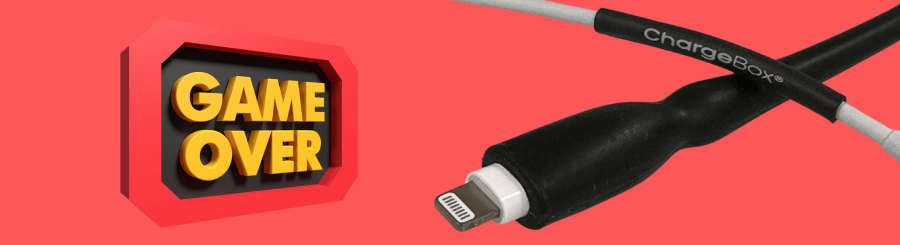
When Phil Schiller, then SVP at Apple, introduced the Lightning cable in 2012 with the launch of the iPhone 5, he said it was “the cable for the next decade”. Sure enough – and having exceeded that with 11 years under its belt – it has been a reliable cable and we can’t imagine using a non-reversible cable any more (even though the EU wanted to standardise around that stupid micro-USB plug). @ChargeBox we have found it to be the best cable (though not without our modification to the junction of cable and head which extended life from 300+ charges to 4,000+; more on that in a future post).
The actual ending is very reliable – far more so than USB-C which has a tendency to break off. You can occasionally get dirt or corrosion on the pins, but this can usually be cleaned off quickly.
With the introduction of USB-C to all iPhone 15 models, it was portrayed as the death knell for Lightning. Of course, in many ways it is – and over future years, will undoubtedly be. But in one clever move, Apple actually made the Lightning cables you already have MORE useful, not less ($29 purchase required!).
Indeed stay with me here while I explain, slightly tongue in cheek, that the Lightning cable has now become the only true Universal cable! There’s even something for Android users too.
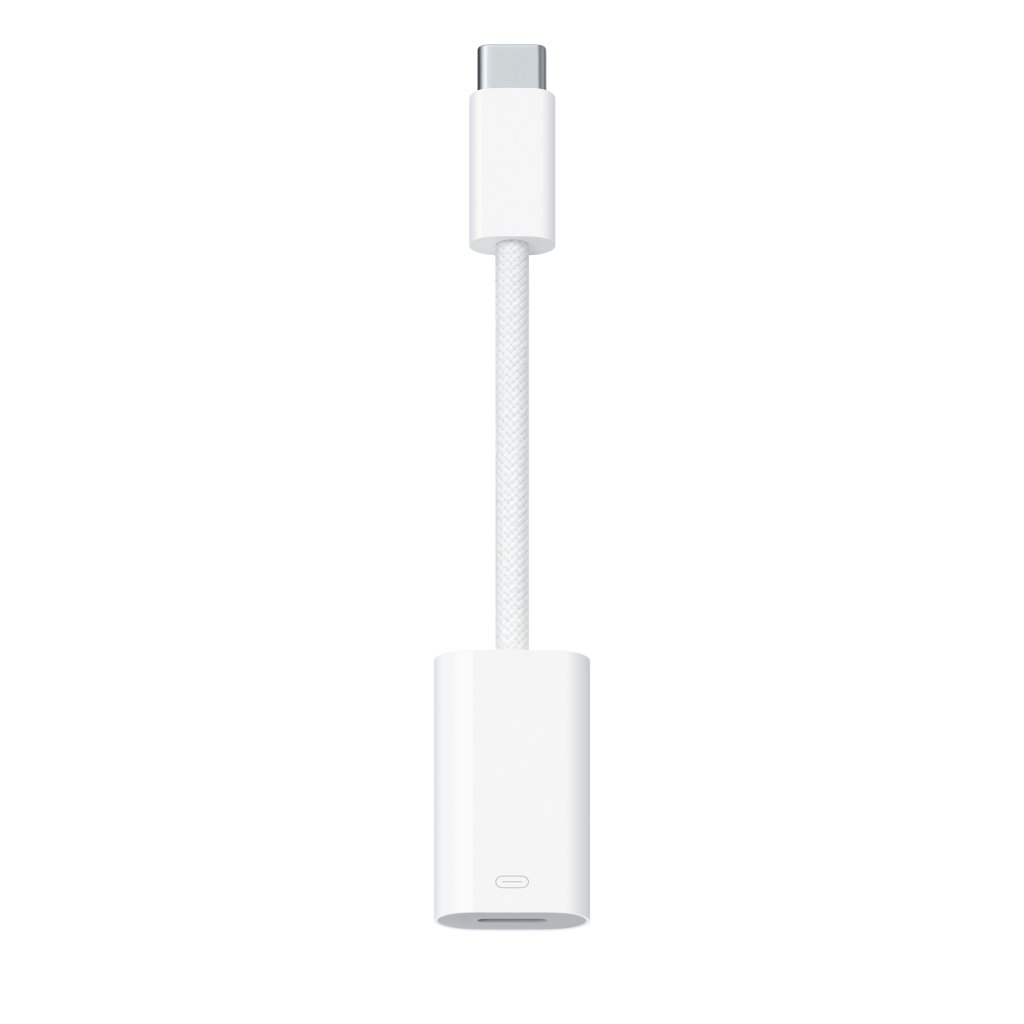
If you’re like me, you’ll have quite a few Lightning cables around the house and office – for charging phones, AirPods, older iPads, and even pencils and keyboards. I’ve got quite a few USB-C to Lightning as well as some older USB-A to Lightning.
With the release this week of the simple USB-C to Lightning dongle adapter you can now plug in a Lightning cable into a USB-C device. Ostensibly to protect investment in things such as music systems, car adapters etc, this little gem also has the added advantage of allowing you to use Lightning cables to charge not just iPhone 15 models, but also iPad Pros, and, wait for it, ANY recent MacBooks – Air and Pro varieties! (Hang on non-Apple users!)
I picked up my adapter at the local Apple Store yesterday – the person I spoke to didn’t know it existed but they found the stock. It has some useful benefits for our business in field testing which first brought it to my attention. I wondered if it would work with my iPad Pro? And of course, why wouldn’t it work? Indeed using it with my 11.9” M1 iPad Pro I was able to see around 26W charging at 9V with my 96W MacBook Pro charger and USB-C to Lightning cable. I have seen 15V charging when the iPad Pro starts at very low battery with up to 35W, so a limitation here is that I think 27W (9V/3A) is as far as this goes. But that’s almost full speed charging of a modern iPad (note it’s also higher than the 20W charger Apple have typically included if you have access to a higher power USB PD charger such as those with MacBooks).
So, then I thought if it can do this, it might also allow charging my new 15” MacBook Air. And, lo and behold, this also worked. Yes, charging a modern laptop with a Lightning cable! I was able to confirm these details through the “About this Mac” —> System Report —> Power.
It advertised to the MacBook Air as a 28W charger – specifically identifying as the Apple USB-C to Lightning Adapter. (I’m guessing it has a chip in it which probably contributes to the price and which converts the power signalling from Lightning protocol to USB-C). Obviously, it’s not as good as the 70W charger which is optional for this MacBookAir, but a good match for the 35W dual charger in a pinch and not far off the 30W charger included with the base MacBook Air. But, wait. There’s MORE!
Then I started wondering about all the old USB-A adapters out there. Amazingly these work too with 11W recorded into the MacBook Air using a 12W old iPad charger.
So, not only does this adapter allow you to continue using your Lightning cables with new phones, it also allows you to charge ANY other Apple USB-C devices with almost any USB based charger and any Lightning cable.
Ironically, Apple’s done more for sustainability with this one action than the EU’s “rule” about USB-C – which by itself is a big initial negative rendering lots of chargers and cables useless without such solutions.
If you had to take just one cable with you for all your Apple gear, the answer may turn out to be Lightning!
If you’re not one of the 1 billion+ Apple users, how does this help YOU?
Well, for Android users – though I haven’t tested this – it should also allow you to use Lightning cables to charge Android phones – including providing pretty good USB PowerDelivery charge to 27W. So, a cable for every situation! Right now, the only true Universal cable. How ironic, EU? But very much in-tune with Apple’s sustainability push at the announcement event.
Here’s a handy summary of what you can do:
- You’ll need the Apple USB-C to Lightning adapter for this £29/$29 at the Apple Store. You plug a Lightning cable INTO the adapter and then plug the adapter INTO a USB-C device.
- The faster the charger you use, the faster the charging experience, but any charger above 30W is not going to help any further
- If you’ve forgotten the USB-C to USB-C cable that came with your new iPhone15, you can charge with this setup at similar speeds to iPhone 14 models.
- You can charge a USB-C iPad using this setup at a good speed (depending on charger).
- You can charge any USB-C based MacBook using this setup at a decent speed (MacBook Air models and using a 30W charger) or an acceptable speed (MacBook Pro models). In a pinch even a USB-A charger and USB-A Lightning cable will charge these devices up but over a much longer period (USB-A limits of 12W are an absolute maximum). But this would be ok in an overnight situation.
- You should be able to charge almost any Android phone that has a USB-C input using this setup and with approximately 0-50% charge in 30 minutes using a 20W (or ideally 30W) charger.
- You should also be able to charge larger USB-C based tablets and laptops using this setup, with power dependent upon the charger available (again up to around 27W).
- Of course, this same setup (without the adapter) can continue to charge all of your Apple devices and peripherals.
- Taking the adapter with you (Android or Apple users) allows you to “hijack” any friends Apple Lightning configuration to charge your USB-C based device.
So, this little gem of a dongle is a real get-out-of-jail device for all sorts of situations, and useful for many road warriors to carry around. If you have any other situations you’ve found it useful or think it might be useful, let us know and we can update this post.
Thanks for reading!
What are the risks of public phone charging?

This month the FBI warned that using public charging may put your data at risk but what are the REAL risks of using public phone charging?
ChargeBox has provided secure charging solutions for public use since 2005. We are privileged to partner with many of the world’s best-known retail, education, public transport, healthcare and event organisations.
We have never experienced a breach of our users’ data in all that time with over 55 million charges provided!
So let’s look at what we know about public charging stations and the risks you need to be aware of when using one.
What is Juice-Jacking?
“Juice Jacking” is a cyber-attack where a hacker gains unauthorised access to a device such as a smartphone by compromising the USB port. Once malware is installed on a device, it can perform various malicious actions, such as stealing sensitive data, track user activity, or even give hackers remote access to the device.
OMG, that sounds scary. Does it happen a lot?
No, it doesn’t. It’s unclear how common these attacks are; any instances have not been widely publicised. The risk was first identified in 2011, so it’s not a new threat.
So, the risk of it happening is extremely low?
The risk of ‘Juice Jacking’ is infinitely small. However, your safety and access to essential phone capabilities are at risk if your battery is low or out of power. These risks are far higher than the danger of having your device hacked.
So are public charging solutions safe?
It’s not possible to say, with absolute 100% certainty, that ALL public charging solutions are safe but as with most things in life, it’s up to the individual to make informed decisions.
That makes sense. Can I limit the likelihood of this happening to me?
It’s important to practice good cybersecurity habits. Here’s what we recommend:
- Always keep your device up-to-date with software updates, especially security updates. This is your first level of protection against any form of attack on your device in any situation.
- Once software updates are no longer available due to the age of your device, you should consider getting a newer device.
- If you are using a public charging solution, where are you? If you’re in a location managed by a respectable company, you can expect that company to have procured a safe & secure solution that can’t be tampered with.
- If you’re unsure who is providing a solution, look for a name and a website. Check the origins of the equipment, the company, and its data and device security pledges.
What precautions does ChargeBox take to ensure the safest and most secure charging experience?
- Our charging solutions, including electronics and firmware, are designed and manufactured in the UK. We use our own software to control our solutions with the highest levels of security in mind.
- We are governed by national laws in the countries we operate, and our business depends on our end users having a great experience and our clients who host ChargeBox giving a great experience to their visitors.
- ChargeBox solutions are connected securely to our servers, giving us precise information about operational levels and recording the safety of the charge.
- The charging components and cable endings we use are all securely locked so they are not accessible to third-party agents without evidence of tampering.
Isn’t this all a storm in a teacup? Surely the FBI has got more significant cybersecurity concerns to deal with?
Yes! It distracts from device and data safety dangers for which the FBI has been notably absent – namely, the sophisticated malware attacks aided by systems such as Pegasus and others.
Finally, out of interest, what data does ChargeBox access?
Our users’ data privacy is a fundamental aspect of our business model and company ethics. For complete details of your data privacy with any interactions with our stations or our company please visit:
https://www.chargebox.com/your-data-privacy-with-chargebox/
Thanks for reading!
ChargeBox plays its part in the fight against Coronavirus
In the fight against COVID-19, three words, hands, face, space, are all imprinted on our minds, but there is one other invisible weapon against the virus that consumers might not be quite so familiar with – antimicrobial coatings.
Coronavirus can be transmitted through air particles, but common touchpoints such as ATM screens, self-service checkouts and mobile charging stations can be high-risk areas where the virus can be passed from one carrier to another. Consumers now expect these shared facilities to be scrupulously sanitised, and thankfully most retailers and business owners are committed to doing this to ensure their customers’ safety and improve their customer experience. However, this additional cleaning does add an extra cost and burden to business owners when times are already tough and may result in lost sales due to delays.
Are antimicrobial coatings a quick and simple solution to fighting viruses and bacteria?
Antimicrobial coating technology offers both piece of mind to consumers and reduces the responsibility of businesses having to deep clean high risk shared surfaces after each use.
Liquid Guard is an award-winning and innovative provider of antimicrobial technology. The effectiveness of the wipe-on coating has been independently verified and is proven to kill 11 viruses and bacteria including SARS-CoV-2, TGEV Coronavirus and Influenza A.
How easy is it to apply Liquid Guard?
ChargeBox have unreservedly implemented the use of Liquid Guard to all new sales of their mobile charging equipment in an effort to help fight the transmission of Coronavirus and offer greater peace of mind and a safer customer experience to consumers.
Every ChargeBox we manufacture has now been treated with the Liquid Guard antimicrobial coating in the following way:
- All areas are first thoroughly cleaned.
- A primer coating is then applied followed by a ‘buffing’ process.
- The Liquid Guard top treatment coat is applied and buffed again.
- The charging station is closed for use for a further 6 hours to allow the coating to fully cure.
It’s not just the exterior of the ChargeBox that is treated, each of the following parts are also cleaned, primed and protected to ensure maximum protection to ChargeBox users:
- Cable endings are one of the main touch points in any charging station, so these are all now thoroughly treated with Liquid Guard. Replacement cables, if needed, are pre-coated before installation.
- Locker mats, where consumers rest their devices, are pre-treated at the ChargeBox factory and then inserted onsite when lockers are being treated.
- Each key and key fob is fully coated. If we ever replace the lock and key/key fob we replace them with protected replacements.
- All edges, doors, screens and surfaces are treated with as much care and attention as the locker’s major contact areas.
Does an antimicrobial coating offer long-lasting protection?
One of the major concerns is the longevity of the treatment. The good news is that after application the coating is effective for more than one year. Standard regular cleaning does not hamper the effectiveness of the coating, in fact tests have proven that it actually enhances it.
Can the use of antimicrobial coatings offer another effective weapon in the fight against Coronavirus?
Although touching contaminated surfaces is not considered to be the main way the Coronavirus spreads, studies have shown that traces of it can linger on plastic surfaces for up to 72 hours. Many consumers are, justifiably, nervous of using shared facilities for fear of contracting Covid-19. The development of antimicrobial coatings and their application to shared devices such as ChargeBox charging stations is a game changer, offering extra protection and greater peace of mind for staff, consumers and business owners.

Is Apple Magsafe the future of phone charging?
When Apple announced the iPhone12 range in September 2020, the big focus was on 5G. However, at ChargeBox, we got excited about another new piece of technology now embedded in all the latest iPhones - MagSafe charging.
Could Apple MagSafe offer a more convenient solution for public mobile charging?
As a pioneer of out-of-home, public phone charging solutions, we’ve learned a great deal over the years about making our solutions easy to use, reliable, fast, safe and secure. Our research has shown that less than 20% of people carry a charging cable at any particular time, and even less have their charger. So, since the beginning, all our solutions have included manufacturer-approved cables, meaning that anyone can get a charge.
Will MagSafe mean it’s time to say a final farewell to cables?
The downside of using cables is the cables themselves.
- Cables evolve frequently.
- Cables can be fiddly to use.
- Cables have a finite life.
Cables are just not designed for high volume public use, so one of our biggest challenges has been keeping cables working reliably.
We have developed techniques to protect the cables. Our 3rd generation protection is a sophisticated moulding technique that we call X-Ten, because it extends a cables life by up to 10 times. But still, tips break, cables eventually wear and having to provide three cable types - Apple Lightning, Micro-USB and USB-C - contributes to higher component costs.
Wouldn’t it be great if we didn’t need cables at all? We could deliver a more reliable charging experience and at a lower cost to our customers. The resulting savings from increased reliability would mean more places would be able to offer their customers this essential service.
We believe that MagSafe will allow us to do that and presents the possible future of phone charging.
Is MagSafe the key to providing efficient, reliable wireless charging?
Before MagSafe, traditional wireless charging was unreliable and often inefficient. Most phones charged at speeds considerably lower than when connected with a cable. While you can forgive this experience at home overnight, putting this solution in public spaces, when time is of the essence, results in a less than satisfactory customer experience.
With MagSafe, the simple addition of magnets into the device and charger pad transforms wireless charging. The magnets reliably align the device and charging pad every time and in any orientation. Keeping the phone and charger connected throughout the charge, even if using the phone, or if the phone is vibrating with a call, is a game changer.
MagSafe converts an unreliable and inefficient wireless charging solution into an experience as dependable as a cable, and while not quite as fast as the fastest charging, it comes pretty close. In our tests, MagSafe adds 17% battery in just 10 minutes, compared with less than 7% using a standard 5W cable charger (a common default charger for most phones).
The reliability and speed of MagSafe are why it will be the future for out-of-home, public charging solutions. One day you’ll be able to say, ‘Remember needing a charging cable?’. We won’t need them anymore, or their propensity to deteriorate, or their high cost.
When will ChargeBox deliver its first charging solutions with MagSafe?
We already have! A world first! MTR Crossrail is our first customer providing both fast charge via cables and an incredible MagSafe experience for compatible phones.
We’ve always used the best and the most compatible products to make our solutions the safest experience. For that reason, we’re taking the MagSafe product and embedding it into our solutions. You’ll now find Apple’s MagSafe adapter protected within our wireless pad design. It’s powered by our USB-C based FastCharge system, which provides all the power that MagSafe needs to charge your phone fast.
MagSafe and ChargeBox – a new world for wireless charging.
We are super-excited by the opportunity for public charging solutions using MagSafe. It opens up so many more opportunities to put them where people need them and at a cost that is affordable to even more partners.
Go on, provide a free phone charging service for your customers, they’ll love you for it, and it’ll keep them returning again and again.
Learn more about the ChargeBox USB-C FastCharge Solution now with MagSafe

image from apple
A Blagger’s guide to fast charge – 10 questions answered.
If you’ve upgraded your iPhone in the last 2-3 years from Apple or bought a high-end Samsung or Google phone then the chances are it has the latest USB Fast charging standard included in the hardware. But what is fast charging and why should you care?

What is Fast Charging?
The technical name is USB 3.1 Power Delivery. The people friendly term is “Fast Charge” and makes it possible to charge devices at up to 100W. It means that you can charge your phone 2-4 times faster now. You’d expect to get 50% charge in 30 minutes.
So, if I’m stuck at an airport and think I’ll run out of battery before I need to get my electronic boarding pass out, I could get 10% battery in about 5 minutes?
Yes! But then no, because public places have yet to cotton on to this.
Do I need any specific equipment for fast charge?
Fast charge requires 3 components – a compatible phone/tablet/laptop or other device, a charger that supports USB Fast charge, and a compatible cable. The cable will have USB-C at least on the charger end, and either USB-C or Apple Lightning on the device end. The latest iPhone 11 Pro comes with these components. For public charging solutions you will need a Fast charge system or a USB-C socket branded as Fast charge and using your own cable.
So, can devices with Micro-USB use Fast Charge?
No, only devices with USB-C or Apple devices since 2017 with Lightning can use Fast Charge.
Isn’t wireless charging quick and better?
Wireless requires your phone to be placed precisely to get the best performance. Fast charge is still 2-4 times faster than this method and is more reliable. Wireless is better than nothing, and fine for overnight charging, but not ideal for public charging.
Is Fast charge safe?
All modern devices control the power input to suit the devices battery characteristics. Manufacturer testing ensures the device takes the right amount of power at different battery charge levels to maximise the safe charge rate while maintaining long-term battery health. You will notice when phones go beyond 80-90% charge, they charge much more slowly as this is when the phone will deliberately slow down the charge rate.
Is fast charge just on phones?
Many tablets (including all newly available iPad models) support a higher level of fast charging. iPads may use up to 30W, which is 3 times faster than the old base charger in the box, or 1.5 times faster than the charger that ships with iPad Pro. Lots of laptops also support fast charging using USB-C cables too.
I don’t have one of the big brand handsets but I thought I had a fast charge already.
You might do if it’s a less well-known Chinese brands, but it’s more than likely not using the international standard set by the USB Implementers Forum. That means you will not benefit from public fast charging systems, and the proprietary nature of the technology means it might not hit all the safety standards.
So where could I charge my phone in a hurry when I’m out and about?
Look for USB-C plug points and charging stations with fast charge installed. Public spaces like shopping centres and airports have special charging stations but few have adopted this technology. They will need to start investing in it soon because there will be demand from the public. If you find the charging facilities don’t cater for it then ask for it. In the meantime, all ChargeBox public charging solutions provide optimised USB charging at up to 10W per cable which will typically exceed most other public charging solutions.

All ChargeBox Solutions have the option to include Fast Charge for your visitors.