Our Sustainability Strategy
Sustainability and the Environment are dear to us all at ChargeBox. This page explains why these are not just words, and show the real actions we are taking to make our company sustainable, and to make the products and services we provide to our clients sustainable too.
In 2021, ChargeBox committed to NetZero by 2030, which can be seen on the SME Climate Hub.

Also, in 2021, ChargeBox was part of the first cohort of businesses to go through the BetterFutures+ programme developed by WestLondon Business and with the backing of the Mayor of London. This course included workshops developed by Imperial College Business School, a carbon calculator modelling tool and a consultancy project focused on embedded carbon inside ChargeBox products. This gave us unprecedented insight into not just our own emissions, but those created by our suppliers, and those taken on by our clients when they purchase or rent our ChargeBox solutions. Participation in this programme was at Managing Director level.
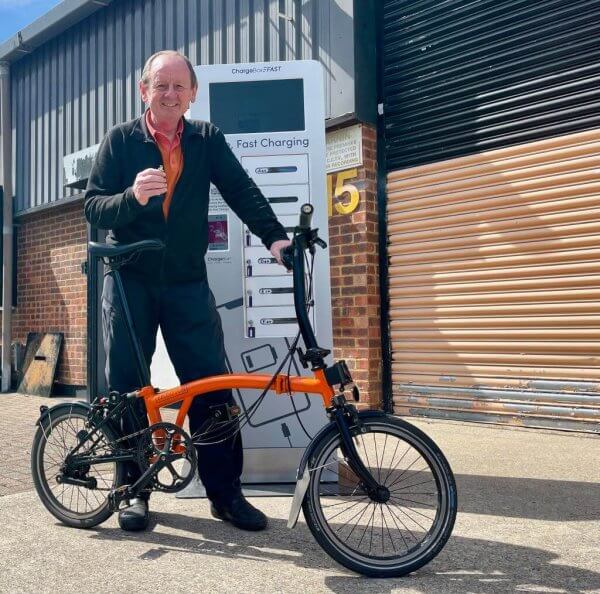
Our MD, in his domestic arrangements uses air source heat pumps, solar thermal hot water, and solar PV, and purchases 100% renewable energy such that family emissions for energy use are effectively zero. An EV purchased in 2023 accounts for 99% of annual car mileage. In addition, he invested in a cooperatively owned wind farm to produce 120% of the electricity consumed annually. He also cycles to work and back everyday.
We are especially delighted to work with clients committed to NetZero, and we will provide any information and mitigations to you to help you achieve your commitments and interim goals.
Like any business we have our own carbon emissions and waste. We have already taken significant steps to use renewable energy for our own premises, and to recycle everything we can and responsibly dispose of everything else with zero landfill. We have also adopted approaches and incentives for staff to use lower/zero carbon transportation for their commuting use or for work-related activities.
To provide the World's best charging solutions we have developed great designs and user experiences built around quality materials and leading-edge electronics. Materials (eg steel, stainless steel, aluminium) and computer boards, wiring, pcb's etc all have a sustainability impact and emissions impact. Because we control those designs, we have been able to calculate their impact in terms of embedded carbon at manufacture as well as lifecycle emissions during use. We are also able through supplier choice, component choice, design changes, and recycling/reuse to reduce those emissions and make our solutions more sustainable.
Here are the things we've already done since we signed up to the SME Climate Hub:
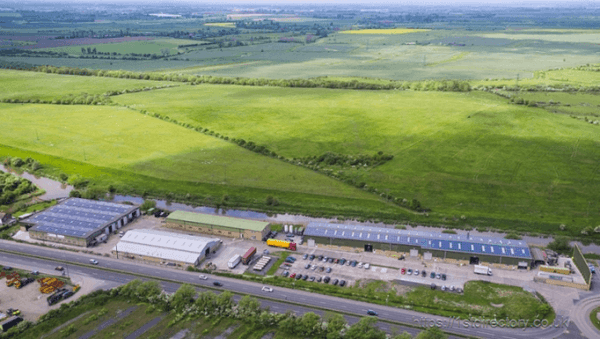
- Since 2019, we have manufactured all of our solutions at a factory in the UK, minimising long-distance logistics, and ensuring control of what goes into every ChargeBox. Our factory (see above image) has a solar PV system that generates over 0.5MW of electricity - larger than 150 home installations.
- Our primary manufacturer works with UK and European supplies to source the raw metals and is constantly looking at ways to choose lower emissions materials and/or more sustainable. In particular, looking for aluminium proceeded using renewable energy or newer processes for stainless and mild steel.
- Unlike most competitors who are sourcing equipment from China - a country with much higher energy emissions and with poor material sustainability, then adding significant shipping emissions to move the products to the UK - we are already miles ahead when we get our solutions into our warehouse.
- We have always strived for lower-power components, Our Raspberry Pi embedded computers (also made in the UK) have extremely low power usage, and other electronics means that when in idle mode and not charging any phones, ChargeBox will use just around 6W of electricity - less that 1/10th of an old lightbulb. The top screen on our larger units will add another 15-20W - still less than 1/3 of a lightbulb. Charging a phone uses comparatively little power, but 1 unit of electricity is enough to charge around 30-40 phones, 15 tablets or 5 laptops*.
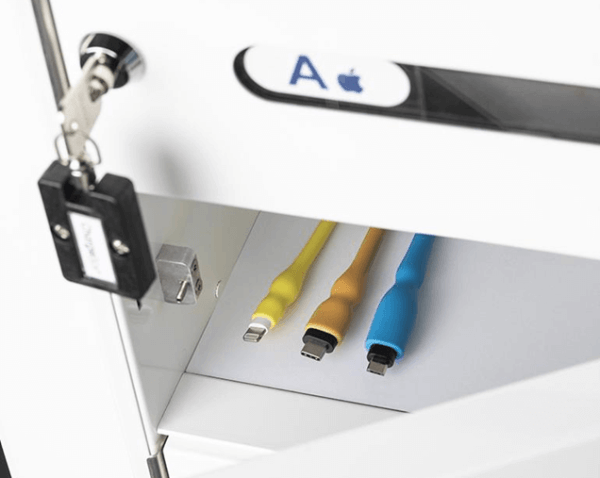
- We are on our 3rd generation of cable enhancement. A typical Apple iPhone cable may only last for 200-400 uses, but our cables last for over 5000 uses. Less cable changes saves materials, and reduces service visits to fix while also improving service availability.
- While our 3rd generation ChargeBox has the best and most reliable design ever, with almost everything changed, we have also recognised that some components from end-of-life solutions are still just as good and can be re-used. We give a lifetime warranty on these components and have reduced the embedded carbon in our latest stations by 15%. We will continue to iterate our designs and choice of materials suppliers to reduce this figure further.
- Our IT services are all cloud-based and we use a supplier that by 2024 used 80% renewables energy for electricity in its data centres and is committed to be at 100% by 2030.
- We continue to work with our primary suppliers to encourage their own NetZero journey.
- We continue to work with our end clients to encourage use of renewable energy. For example, we are delighted that all charges delivered to passengers at Heathrow Airport are from renewable energy.
- We attempt to be sensitive to the environmental impact of our products at client sites. For example, again at Heathrow Airport we were able to innovate and design a new charging podium that could repurpose and give new life to their older charging poles that were no longer fit for the role. Removing and disposing of these would have created waste and restoration works. Instead the poles have been given a new life of perhaps 15 years or more, and also required less materials in our own solution if the poles had not been repurposed.
- We offer to all our clients to responsibly recycle, retest and reuse and can provide appropriate guarantees to clients of this. You can therefore be sure that metals used in any ChargeBox will be recycled, and electronics and wiring either re-used, repurposed or responsibly disposed of. We are committed to incremental reductions in the embedded carbon of our solutions over their lifetime and will also ensure they are not a burden to our clients at end-of-life**.
- Many of our solutions are heavy and require complex logistics to ship across the UK or abroad. We outsource much of this to professional logistics and delivery companies. Right now, there are no suitable zero carbon methods for moving equipment long distances, but we will continue to work with suppliers to adopt such methods when they become available.
- When we do our own deliveries, we are now trying to source lower carbon or zero carbon transportation. This is easier around our base in London, but zero emissions logistics for moving our heavy items around even short distances is not there yet.
- In late 2025 we began working with a UK and European service partner who can attend most of our sites with a significant reduction in mileage than from our base in London. This will also reduce days/nights away for our staff reducing our emissions from both travel and sustenance. This will have a significant impact on our Scope 3 emissions beginning in 2026.
- We use a protective wrap on most ChargeBox solutions for permanent installation or events. This helps extend the life of the unit, but is also used for sponsorship and branding. We have sourced the most environmentally-friendly wrap solution from 3M - known as "Envision" - via a key supplier who is also strongly committed to sustainability. Instead of shipping panels off to be wrapped which has transport emissions, we now do this in-house.
- For waste and recycling we use a company who provide us reports annually on the weight of each type of waste and a certificate to show % recycled.
- We continue to monitor the emissions calculations from the climate model we use to explore improvements in accuracy. The model we use while comprehensive is quite blunt when it comes to how services such as insurance, accountancy, consultancy and IT are accounted for. We continue to work with the model provider to ensure evolution in calculations to reflect performances of upstream suppliers and service providers.
- In 2024 we became an accredited Good Business Charter member which we remain subscribed to. Apart from environmental responsibility, this accreditation also covers Real Living Wage, Employee Well-being, Equality, Diversity and Inclusion, Pay Fair Tax, Ethical Sourcing, Fairer Hours and Contracts, Employee Representation, Commitment to Customers, and Prompt Payment to Suppliers.
Progress Metrics
The following table summarises our calculated carbon emissions for each year since 2019 (excluding COVID 2020 year). Actions began in 2020 and continued with the Better Futures programme in 2021 and our own progress since. Note that the year is matched to our financial year. Therefore 2024 results cover the period 1st April 2024 to 31st March 2025.
Financial Year (Figures are in Kg/CO2) | 2019 | 2021-22 | 2022-23 | 2023-24 | 2024-25 |
|---|---|---|---|---|---|
Scope 1 | 5,472 | 1,787 | 1,117 | 354 | 720 |
Scope 2 | 9,963 | 228 | 202 | 93 | 152 |
Combined Scope 1 & 2 | 15,435 | 2,015 | 1,320 | 447 | 872 |
Scope 3 | 195,065 | 105,585 | 80,480 | 68,610 | 62,868 |
TOTAL | 210,500 | 107,600 | 81,800 | 69,057 | 63,740 |
Reduction from Baseline | 48.9% | 61.1% | 67.2% | 69.7% | |
Emissions restated as g/CO2/£1k of revenue for better comparison* | 134 | 120.3 | 94.1 | 90.5 | 89.6 |
Reduction from baseline for restated emissions | 10.2% | 29.8% | 32.5% | 33.1% |
*we believe this to be fairer measure of stating emissions so that business contraction or business growth do not exaggerate or hide progress towards our goals.
Future Actions
- To eliminate our Scope 1 and 2 emissions we must move our premises to a location that uses all electric heating perhaps augmented by solar PV or other on-premises generation as our current premises cannot be adapted and is beyond our influence. The earliest this can happen is 2028 when our current lease expires.
- Our scope 3 emissions include emissions due to the fact that we rent vehicles rather than own them. We do recognise the positive influence this has on our Scope 2 emissions, however we will take the same steps to reduce these with vehicle choice and alternative travel options whenever possible.
- We will continue to monitor our suppliers of services as well as material suppliers for improvements in carbon emissions that either are embedded in our end products or result in Scope 3 emissions that could be reduced. For materials we will focus on materials that also have better end-of-life consequences. We will also continue to explore re-use and repurpose.
- In late 2025, we contracted with Octopus EV to offer EV's to staff via a salary sacrifice scheme. The first vehicle was delivered to a staff member in January 2026 replacing a traditional petrol-powered vehicle. We continue to offer staff access to a Cycle-to-Work scheme.
Ian Hobson
Founder & CEO, ChargeBox
* these are considered approximate numbers and can vary significantly between products.
**reasonable collection fees apply