Heathrow Fast-Tracks ChargeBox Rollout to Power Stress-Free Passenger Experiences
News Release
London, September 18, 2025 – Heathrow Airport, the world’s most connected aviation hub, has announced the rollout of ChargeBox fast charging stations across Terminals 3, 4, and 5, following a highly successful trial in Terminal 2, which has converted the trial to a permanent deployment. 41 charging stations, each equipped with 16 fast-charging endpoints, give a 300% increase in mobile charging capacity compared with legacy facilities, with 75% of charging sessions achieving fast charge speeds (20%+ battery in 10 minutes). This technology is designed to support nearly 84 million annual passenger journeys through Heathrow.
The decision to accelerate the rollout after just four months of a six-month trial in Terminal 2, where ChargeBox upgraded six existing charging poles, achieved near-100% uptime with zero Heathrow support interventions and minimal hardware replacements, was driven by compelling data and overwhelmingly positive passenger feedback.

Chargebox powers passenger experience at Heathrow
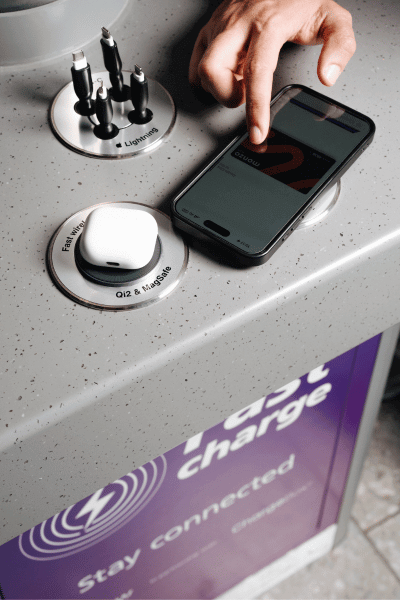
Qi2 wireless pads

Elevating the passenger experience
Now deployed across all terminals, the 41 FASTPodiums are delivering over 7,000 charges daily — equivalent to more than 2.5 million annually. The highest-performing unit, located in Terminal 2 Departures, recorded 2,486 charges in a single week — averaging 355 per day. Passenger behaviour shows a clear preference for direct-to-device charging, with 9 in 10 passengers opting for ChargeBox’s specially reinforced cables or Qi2 wireless pads. Of those, over 70% choose the high-performance USB-C and Lightning cables, delivering nearly three-quarters of all charging minutes to date — a clear sign that users prefer cables, and that they deliver the fastest, most intuitive and hassle-free experience for passengers on the move.
ChargeBox’s innovative Charging as a Service (CaaS) model delivers scalable, smart solutions that provide real-time insights into passenger charging habits, enabling Heathrow to optimise infrastructure and elevate the passenger experience. Automated fault detection eliminates time-consuming inspection processes, enhancing passenger experience while reducing service demands.
Addressing Digital Friction and Boosting Passenger Satisfaction
The deployment aligns with findings from the ACI Europe Survey on the Impact of Digitalisation and Automation on the Passenger Experience, which revealed that while 73% of passengers rely on digital services, confidence drops to just 48% among those aged 55 and older, often due to low battery anxiety. Dependable phone charging was highlighted as a key concern affecting the overall travel experience. ChargeBox’s high-availability, fast charging stations directly tackle this challenge, reducing stress, boosting digital confidence, and supporting a more seamless, passenger journey.
ChargeBox forecasts over 2.5 million charges annually at Heathrow, helping the airport meet the needs of today’s digitally reliant travellers. Its smart charging stations feature real-time monitoring and predictive maintenance capabilities, ensuring maximum reliability and operational resilience. This consistently high performance is designed to contribute positively to Customer Experience (CX) scores for Heathrow.
Heathrow’s Chief Solutions Officer, Helen Elsby, said: “With the rollout of ChargeBox stations across a further three Heathrow terminals, we are pleased to offer even more to passengers with reliable, simple and fast charging services. By working closely with SMEs like ChargeBox, Heathrow drives innovation across the airport to enhance passenger experience and help us meet our service goals.”
“I believe airports should be places where technology quietly supports every journey. Charging is a small detail, but without it, the digital travel experience can break down.” said Ian Hobson, CEO and Founder of ChargeBox. “Our work with Heathrow shows that when you make something as simple as powering your phone effortless, you can remove a layer of stress for passengers. We’re building charging networks that airports can rely on for decades, and we’re excited to bring the same approach to new partners like Dublin and Frankfurt.”
Driving Innovation and Global Interest
ChargeBox’s smart charging stations, remotely managed with real-time fault detection, provide useful insights into passenger behaviour, informing future infrastructure strategies. The success at Heathrow has sparked interest from airports worldwide, positioning ChargeBox as a pioneer in passenger charging solutions.
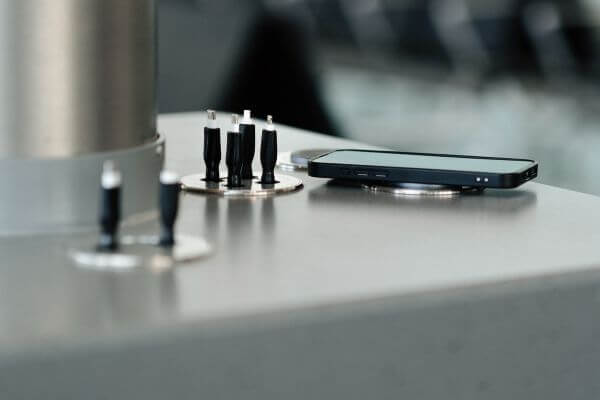
Qi2 wireless charging at Heathrow Airport

ChargeBox FastPodium at Heathrow Airport
About ChargeBox
ChargeBox is the global leader in self-service mobile device charging for public spaces, offering a unique Charging as a Service (CaaS) model with a digital-first approach. We design, build, and install high-availability, direct-to-device charging systems that keep people connected, satisfied, and digitally empowered.
With over 20 years of experience and more than 80 million charges delivered worldwide, ChargeBox provides the simplest, fastest, and most reliable charging experience — trusted by airports, hospitals, retailers, universities, and event operators around the globe.
Our connected solutions feature real-time monitoring and remote management, ensuring unmatched service availability while helping clients boost customer satisfaction, reduce operational burden and accelerate their digital strategies.
Learn more at www.chargebox.com
About Heathrow
Heathrow is the UK’s international gateway and the largest airport in Europe – connecting to 230 destinations across 85 countries. The airport welcomes over 200,000 passengers on roughly 1,300 flights each day, and serves as Britain’s hub for trade, tourism and investment. Over 80,000 colleagues work at Heathrow – the airport directly employs about 10% of them, with the rest working for Team Heathrow partners, including airlines, ground handlers and retailers.