ChargeBox and Frankfurt Airport Unveil Next Generation Charging Solution
Press Release
Passenger feedback is driving investment in reliable, future-proof device charging solutions, as ACI EUROPE findings reveal surging demand.
Frankfurt, Germany – November 18, 2025 – ChargeBox is thrilled to announce the launch of a six-month Discovery Project at Frankfurt Airport’s Terminal 1, introducing cutting-edge, fast-charging technology designed to power a wide range of modern devices, including smartphones, laptops, and tablets, ensuring travellers stay connected with unparalleled convenience.
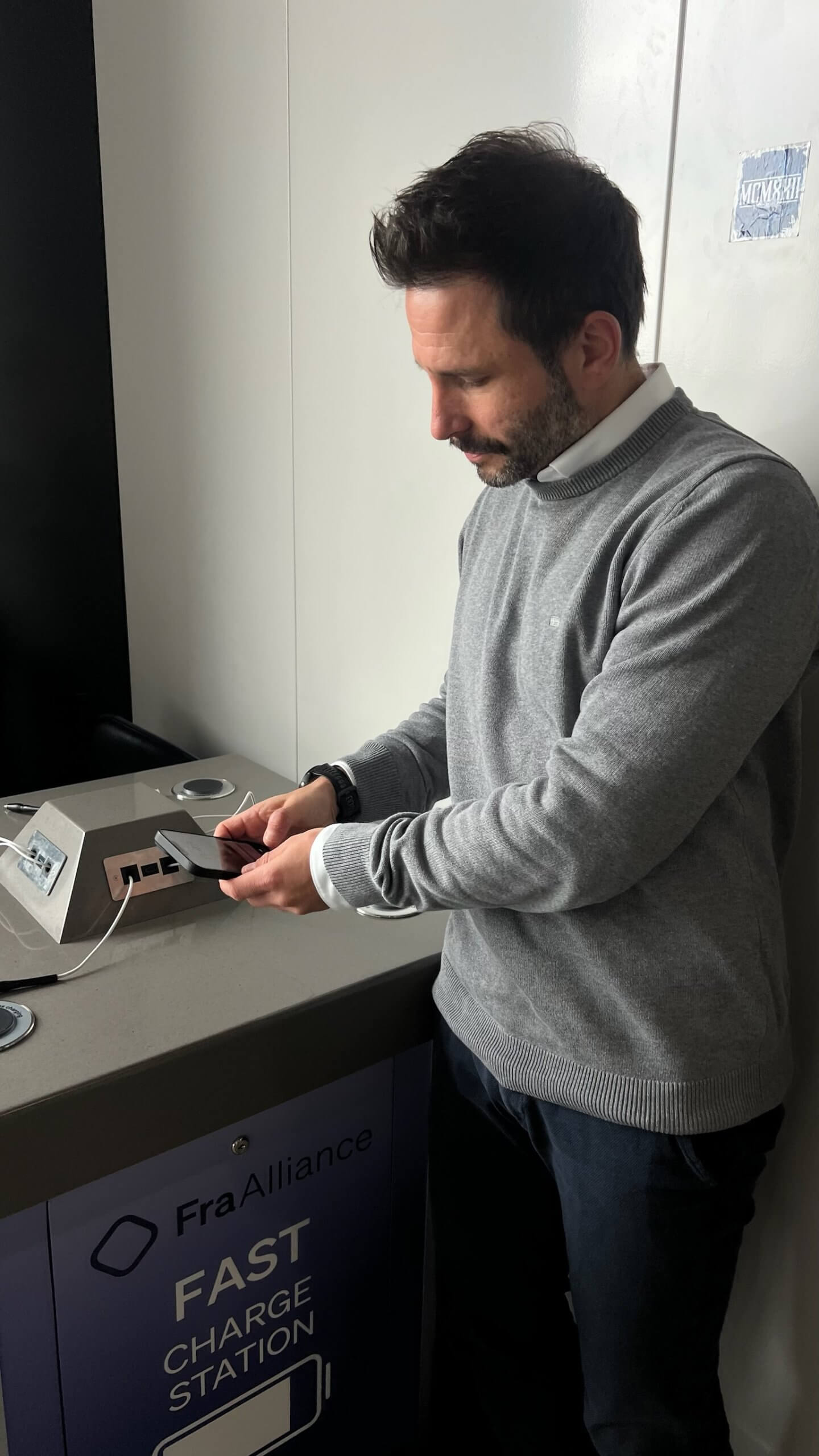
The project introduces ChargeBox’s FastHub technology, a connected, data-led charging platform designed for airports. Each FastHub provides direct-to-device USB Fast Charging via reinforced USB-C and Apple Lightning cables, USB sockets, and Qi2 fast wireless pads, delivering up to 25% battery life in just ten minutes with the latest phone models.

Fast charging podium at Frankfurt Airport
Charge Faster. Score Higher.

Improving the passenger experience
Frankfurt's new initiative directly addresses passengers' calls for even more reliable and user-friendly charging solutions, even though the airport already offers a wide variety of options that have been significantly expanded in recent years. This aligns with ACI EUROPE’s 2024 passenger digitalisation survey, which identified charging as a top infrastructure passenger need. In general, passengers don’t just want more power points, they want charging that’s fast, dependable and always available.
“Our passengers rely on their devices throughout the journey,” said Manuel Wiesner, Leader Consulting & Strategy at Frankfurt Airport.
“FastHub’s real-time fault detection allows us to see and resolve issues promptly, improving availability and saving operational time.”
Each FastHub seamlessly connects to ChargeBox’s cloud-based monitoring platform, delivering real-time insights into usage and performance. While usage data enables strategic long-term capacity planning, the true innovation lies in real-time fault detection and remote diagnostics, enabling proactive maintenance and ensuring consistently high service availability.
“The ACI EUROPE report echoes what Frankfurt’s own feedback revealed, passengers expect reliable charging that actually works,” said Ian Hobson, CEO of ChargeBox. “Our advanced systems deliver fast, direct-to-device charging for all devices, with real-time fault detection ensuring the highest service availability levels can be maintained efficiently. That’s how airports can raise satisfaction, improve Skytrax and ASQ scores, while cutting operational costs. At Heathrow and Dublin, we’ve seen just how much passengers appreciate great charging with hundreds of positive comments received through QR feedback.”
By focusing on availability, reliability and intelligent management, the Discovery Project showcases how smart, connected Charging-as-a-Service (CaaS) infrastructure can enhance the passenger experience and streamline airport operations.
This six-month pilot, running through early 2026, will deliver results that shape Frankfurt Airport’s long-term digital infrastructure and customer-experience strategy.
For more information on our scalable charging solutions for airports go to: www.chargebox.com
The Case for Sustainable, Fast Charging Lockers in Universities and Higher Education Colleges
In today’s digital age, mobile devices are indispensable tools for students in higher education. From accessing online resources and participating in virtual classes to staying connected with peers and faculty, the reliance on smartphones, tablets, and laptops has never been greater. However, with this increased dependence comes the ever-present challenge of maintaining battery life throughout a busy academic day. This is where sustainable, fast charging lockers come into play as an essential amenity for universities and higher education colleges.
Benefits of Fast Charging Lockers
Sustainability and Environmental Responsibility
Fast charging lockers designed with sustainability in mind can significantly reduce the environmental impact of electronic device usage. These lockers often use energy-efficient technologies and components, ensuring minimal power wastage. By integrating such systems, institutions can demonstrate their commitment to environmental stewardship and inspire students to adopt greener habits.
Enhanced Convenience and Accessibility
Unlike traditional charging stations or wall outlets, fast charging lockers provide a secure and convenient solution for students to charge their devices. Students can safely lock their devices in a designated locker, ensuring they are protected from theft or damage while charging. This added security gives students peace of mind and allows them to focus on their studies without worrying about their valuable gadgets.
Speed and Efficiency
The primary advantage of fast charging lockers is their ability to charge devices at an accelerated rate. With the capability to charge a device from 0% to 50% in a fraction of the time it would take with a standard charger, these lockers ensure that students can quickly top up their batteries between classes, during lunch breaks, or even in between lectures. This rapid charging capability helps maintain productivity and keeps students connected throughout the day.
Space Optimization
Fast charging lockers are designed to accommodate multiple devices simultaneously, making efficient use of space within the campus. This is particularly beneficial in high-traffic areas such as libraries, student unions, and common rooms, where the demand for charging facilities is high. By centralizing charging infrastructure, universities can avoid clutter and ensure an organized, aesthetically pleasing environment.
Support for Diverse Devices
Modern fast charging lockers are versatile, supporting a range of devices including smartphones, tablets, and laptops. This adaptability is crucial in a higher education setting where students use a variety of devices for different academic purposes. By providing a one-stop charging solution, universities can cater to the diverse needs of their student population.
Encouraging Responsible Device Usage
Providing accessible charging solutions encourages responsible device usage among students. With the assurance that they can charge their devices whenever necessary, students are less likely to resort to unsafe charging practices, such as using low-quality chargers or leaving devices unattended in public spaces.
The Future of Mobile Technology in Education
As we look towards the future, it’s clear that mobile technology is here to stay. The integration of mobile devices into educational frameworks has revolutionised the way students learn and interact. From interactive apps and e-books to virtual classrooms and online collaboration tools, the possibilities are endless. Mobile devices offer unparalleled flexibility and accessibility, enabling students to learn at their own pace and on their own terms.
In conclusion, the implementation of sustainable, fast charging lockers in universities and higher education colleges is a forward-thinking move that addresses the practical needs of students while promoting environmental responsibility. These lockers offer a superior alternative to traditional charging solutions, providing security, efficiency, and convenience. As mobile technology continues to evolve, ensuring that students have the necessary infrastructure to support their academic pursuits is not just beneficial—it’s essential. Mobile is indeed here to stay, and by embracing innovative charging solutions, educational institutions can better prepare for a connected and sustainable future.
The Future of Device and Smartphone Charging: Understanding USB-C Power Delivery
In recent years, USB Type-C has become the standard connection for charging a multitude of devices, from smartphones and tablets to laptops and beyond. This evolution in charging technology has revolutionised how we power our gadgets, offering numerous advantages that enhance convenience, efficiency and speed. In this blog, we’ll delve into the benefits of USB-C power delivery, explore how this charging technology works, and provide tips on selecting the right adapters and cables.
USB Type-C: The Standard Connection?
USB Type-C, commonly referred to as USB-C, is a versatile and reversible connector that has swiftly become the go-to standard for modern devices. Unlike its predecessors, USB-C is designed to handle not just data transfer but also power delivery, allowing it to charge devices quickly and efficiently. Its symmetrical design means it can be plugged in either way, eliminating the frustration of trying to insert the connector incorrectly.
Advantages of Power Delivery via USB-C
One of the standout features of USB-C is its support for USB Power Delivery (PD). This technology offers several key advantages:
1. Faster Charging: USB PD allows for higher power levels, meaning devices can charge much faster compared to older USB standards. This is particularly beneficial for high-capacity devices like laptops and tablets.
2. Universal Compatibility: USB-C PD can charge a wide range of devices, from smartphones to laptops, using the same cable and power adapter. This reduces the need for multiple chargers, simplifying your tech life.
3. Enhanced Safety: USB PD includes features that protect devices from overcharging, overheating, and other potential hazards, ensuring a safer charging experience.
4. Flexibility: With variable power delivery, USB PD can adjust the power output according to the device’s requirements, making it highly versatile.
USB-C Power Delivery. How it works.
How the Charging Technology Works: USB Power Delivery is an advanced specification that significantly improves the standard USB charging protocols. Here’s how it works:
Negotiation Process: When a USB-C cable is connected to a device, the charger and device communicate to determine the optimal power level. This negotiation ensures the device receives the correct amount of power without exceeding its capacity.
Variable Power Levels: USB PD can deliver power at varying levels, typically ranging from 5V (volts) to 20V, and up to 100W (watts). This flexibility allows it to charge everything from small smartphones to large laptops.
Bidirectional Charging: USB PD supports bidirectional power delivery, meaning a device can either receive power or provide power to another device. This is particularly useful for scenarios where one device, like a laptop, can charge another, such as a smartphone.
Which Power Adapter is best for you?
Choosing the right power adapter is crucial for efficient and safe charging. Here’s how to ensure compatibility:
1. Check the Device’s Specifications: Look at your device’s user manual or manufacturer’s website to find the recommended power requirements.
2. Examine the Adapter’s Output: Ensure the adapter’s voltage and wattage match or are within the acceptable range for your device.
3. Verify USB PD Support: If your device supports USB PD, make sure the adapter does as well. Many modern adapters explicitly state their compatibility with USB PD.
4. Connector Type: Confirm that the adapter has a USB-C output, as using the correct connector type is essential for compatibility.
The Best Cable for Charging via USB-C
Not all USB-C cables are created equal. Here’s what to consider when choosing a cable:
Power Rating: Ensure the cable supports the power levels required by your device. High-quality cables often list their power ratings on the packaging or cable itself.
Data Transfer Speeds: While primarily used for charging, USB-C cables can also transfer data. If this is important, look for cables that support higher data transfer rates.
Build Quality: Opt for cables with robust construction to avoid wear and tear. Features like reinforced connectors and braided exteriors can enhance durability.
Certification: Cables that are USB-IF (USB Implementers Forum) certified have been tested for compliance and safety, ensuring reliable performance.
ChargeBox: UK-designed and manufactured.
We only use real Apple Type C USB cables for all our latest charging solutions. We also strengthen them to give them a x 10 lifespan. That’s the difference between a cable that would last 400 charges and one that lasts 4,000!
Conclusion:
USB-C and USB Power Delivery are transforming the way we charge our devices, offering faster, safer, and more versatile options. USB-C has undeniably set a new standard in the realm of charging technology. Its versatility, speed, and efficiency make it an essential component in our increasingly connected lives.
Understanding how this technology works and knowing how to choose the right adapters and cables can significantly enhance the charging experience and let’s face it no one likes waiting more time than they need to, for their phone battery to charge! 🔋
A Blaggers guide to Fast Charge

Your questions answered.
All iPhones, since iPhone 8, and most Samsung or Google phones, have the latest USB PD Fast Charge standard in their hardware. But what is Fast Charging, and why should you care?
What is Fast Charging?
The technical name is USB 3.1 Power Delivery. The people-friendly term is “Fast Charge”, meaning you can charge your device at speeds up to 100W. In short, you can receive up to 50% phone charge in just 30 minutes!
So, if you’re stuck at an airport and thinking, “Yikes! I’m going to run out of battery before retrieving my electronic boarding pass!” – you’d be in luck if you had Fast Charging nearby, as you could get a 10% battery charge in about 5 minutes!
BUT unfortunately, public spaces are still behind the times in providing Fast Charging and most are yet to offer a reliable charging solution at all.
Do I need any specific equipment for Fast Charge?
Fast charge requires three components – a compatible phone/tablet/laptop or other devices, a charger that supports USB Fast Charge, and a compatible cable. The cable will need to have USB-C at least on the charger end and USB-C or Apple Lightning at the device end. Your device will need a Fast Charge system or a USB-C socket branded as Fast Charge for you to use your own cable at public charging solutions.
Can devices with Micro-USB use Fast Charge?
No, only devices with USB-C or Apple devices since 2017 with Lightning can use Fast Charge.
Isn’t wireless charging quick and better?
Wireless requires you to place your phone precisely on a wireless charging pad to get the best performance unless you use something like Apple’s MagSafe wireless charger. Fast Charge cabled charging is still 2-4 times faster and is more reliable. Wireless is better than nothing and fine for overnight charging, but not ideal for public charging when you want maximum charge in a short timeframe.
Is Fast Charge safe?
All modern devices control the power input to suit the devices’ battery characteristics. Manufacturer testing ensures the device takes the right amount of power at different battery charge levels to maximise the safe charge rate while maintaining long-term battery health. When phones go beyond 80-90% charge, they charge much more slowly, as this is when the phone will deliberately slow down the charge rate to protect battery longevity.
Can you only Fast Charge phones?
Many tablets (including all newer iPad models) support a higher level of fast charging. For example, iPads may use up to 30W, three times faster than the old base charger in the box or 1.5 times faster than the charger that ships with the iPad Pro. Of course, many laptops also support Fast Charging using USB-C cables.
I don’t have one of the big brand handsets, but I thought I already had Fast Charge.
You might do if it’s a less well-known Chinese brand, but it’s likely not using the international standard set by the USB Implementers Forum. Unfortunately, this means you will not benefit from public Fast Charging systems, and the technology’s proprietary nature might not hit all the safety standards.
So where could I charge my phone in a hurry when I’m out and about?
Look for USB-C plug points and charging stations with Fast Charge installed. Public spaces like shopping centres and airports have charging stations, but very few have adopted this technology. They will need to start investing in it soon because there will be demand from the public. If you find the charging facilities don’t cater for it, then ask for it. In the meantime, all new ChargeBox public charging solutions provide USB PD Fast Charge charging at up to 60W per cable, hugely outperforming any other public charging solutions we’ve encountered globally.
For more information on any of the Fast charge solutions we can offer your business, event or location – simply get in touch. We’d love to hear from you!
The ChargeBox Team
Introduction to nomophobia in retail
ChargeBox releases it's white paper on the impact of nomophobia
ChargeBox, the UK leading provider of secure device charging solutions, has undertaken customer research to establish the impact of a flat battery on the experience and spending of shoppers in retail.
Through the years in the charging industry, ChargeBox noted a clear correlation between a charged battery and shoppers’ extended dwell time in retail destinations.
Indeed, as mobile sessions on shopping Apps are growing at a rate of 174% per year, smartphones are more and more integrated into the customers’ shopping journey, from store location to price comparison and actual purchase. A flat battery, by preventing this, is seen by customers as a reason to cut short their shopping trip.
But more than only impacting dwell time, a flat battery, by creating a strong feeling of anxiety, turned out to have a tangible impact on shoppers’ enjoyment of they in-store shopping experience. A term first coined by the UK Post Office in 2008 refers to this anxiety as nomophobia, the fear of being without a mobile phone.
Chargebox decided to carry out extensive customer surveys in two popular shopping centres hosting its service, and reported that nomophobia affected 76% of its interviewed users. Offering a free charging solution relieved the interviewed shoppers from their stress of a dead battery, and enabled them to stay longer on site, triggering further unplanned spending.
Indeed, amongst the interviewed ChargeBox users, 56% spent money whilst their phones was on charge: 39% bought products, 17% were planning on spending money on food and beverages, and 32% were enabled to carry on window shopping, which they would not have been doing with the stress of a dead battery. The white paper, which gathers these statistics and expands further on the impact of nomophobia on retail, is available for download here.