Innovation in Regional Airports: How ChargeBox Supports Europe’s Digital Airport Strategy
In aviation, innovation isn’t just about aircraft or automation; it’s about improving the passenger journey, the experience.
The ACI EUROPE Regional Airports and Innovation 2025 report highlights how smaller, often regional airports are becoming vital testbeds for innovation. With their agility, shorter decision cycles and close-knit teams, these airports are ideally placed to trial new technologies that enhance efficiency, sustainability and passenger experience.
At ChargeBox, we believe regional airports have a unique opportunity to turn passenger amenities into powerful innovation platforms. Our work with Heathrow Airport, the world’s most connected aviation hub, shows what’s possible when airports adopt a structured, data-driven approach to digital experience and the same model can be applied at a regional scale.
Regional Airports: Europe’s Innovation Incubators
ACI EUROPE describes regional airports as “innovation centres”, agile environments where new technologies can be tested, validated and scaled.
The report outlines an eight-step innovation framework that encourages airports to:
- Define clear passenger challenges
- Run short, structured trials (typically six months)
- Measure results and adapt quickly
- Scale proven solutions
This mirrors the ChargeBox Discovery Project, a structured, low-risk model for testing and validating new passenger-experience initiatives. Each project begins with a measurable objective, gathers real-world data and produces a concise report to guide wider rollout. For regional airports, this offers a practical path to deliver visible innovation quickly and affordably.
Heathrow: A Blueprint for Measurable Digital Innovation
This year, ChargeBox partnered with Heathrow Airport and their innovation team to replace legacy charging poles with 41 new FASTPodiums, powered by the FASTHub intelligent engine.
“With the rollout of ChargeBox stations across a further three Heathrow terminals, we are pleased to offer even more to passengers with reliable, simple and fast charging services.” — Helen Elsby, Chief Solutions Officer, Heathrow Airport
The results were striking:
- Over 2.5 million annual passenger charges
- Near 100% uptime, up from 67% on legacy systems
- 300% more charging capacity
- Zero Heathrow support calls during the trial
While Heathrow is a major international hub, the innovation process behind this success, short pilot, clear KPIs, rapid rollout, is exactly what ACI EUROPE recommends for regional airports seeking to demonstrate impact through agile digital projects.
Learning from Bologna: Data-Driven Passenger Care
ACI’s Regional Airports and Innovation 2025 report highlights Bologna Airport as an example of how even mid-sized airports can lead in digital transformation. Bologna’s “I-CARE” programme reimagined passenger service through integrated communication platforms, data analytics and process optimisation.
The goal: faster, more personalised responses to passenger needs.
This mirrors ChargeBox’s own approach, using connected infrastructure and data insights to improve everyday passenger experiences. Both show how digital systems that enhance satisfaction can be developed, tested and scaled without large-scale infrastructure projects.
Charging as a Service: A Smart, Scalable Model
ChargeBox’s Charging-as-a-Service (CaaS) model aligns directly with ACI EUROPE’s call for airports to “foster partnerships with technology providers and startups.”
Through modular, cloud-connected infrastructure, airports gain:
- Real-time performance data for ASQ and Skytrax benchmarking
- Predictive maintenance with minimal engineering intervention
- Passenger insights to inform retail and digital-service strategies
- Sustainable design built for longevity and energy efficiency
For regional airports, this model provides a low-risk route to innovation: Fast to deploy, measurable in impact and easily scalable across other terminals or sister airports.
Why Regional Airports Should Act Now
ACI EUROPE’s report concludes with a clear message:
“Regional airports are innovation powerhouses. By embracing sustainability, digital transformation and multimodal integration, they will remain at the forefront of aviation’s future.”
Reliable device charging directly supports this vision. It improves passenger satisfaction, reduces operational friction and demonstrates a visible commitment to digital progress.
Today, providing charging for passengers' devices is no longer just a courtesy; it has become a key indicator of a modern, data-driven airport experience.
Final Thought
From Heathrow’s digital charging rollout to Bologna’s customer-care transformation, airports of all sizes are showing how small, focused innovations can deliver major passenger benefits.
ChargeBox is proud to support that direction, helping airports deliver smarter, more connected experiences across the world.
Smart Lock vs PIN
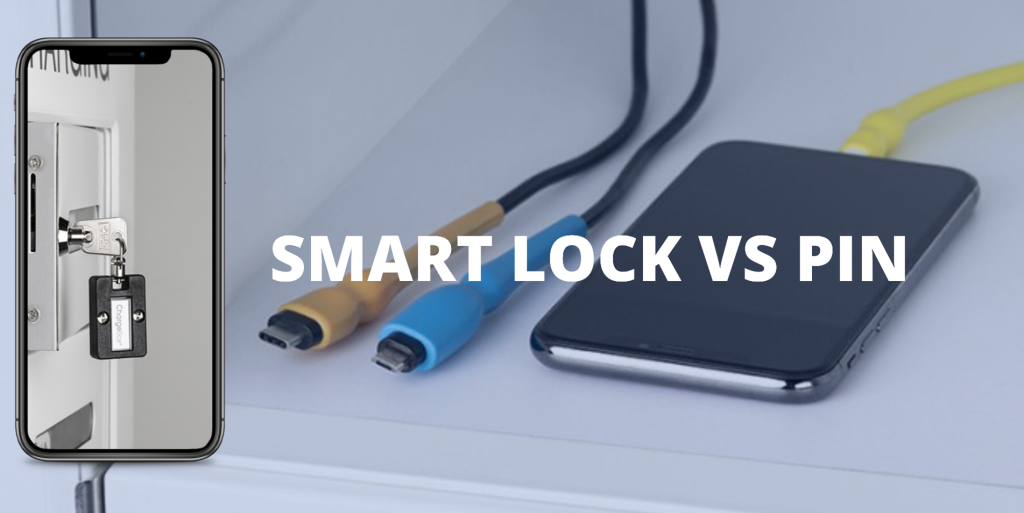
In this digital age, is it surprising to learn that key security still firmly trumps a PIN or a futuristic biometric system?
We patented our smart lock for charging lockers back in 2013, and it is still as relevant and market-leading today.
We thoroughly explored the alternatives in our quest for the ultimate locker security. But even now, in 2022, we still get asked about PIN lockers and how they compare.
To understand the limitations and benefits of a PIN-based system, we built one as a prototype and put it to the test. We trialled it in a Central London location and then sat back to observe usage on the CCTV.
On one occasion, we watched someone using the locker correctly, followed by someone else getting up from a nearby sofa, going to the same locker, typing in the PIN and stealing the device. The phone owner had done nothing wrong but found their device gone through no fault of their own.
This is just one example I hear you say. However, that alone doesn’t make key security better than a PIN. Surely there are ways PIN systems could be as good or better than a key?
We think not. Here are seven rock-solid reasons why key trumps PIN every time.
Security:
- It is pretty easy to see peoples’ keystrokes, especially when they’re unfamiliar with the system and do it slowly. Typically a user-selected PIN must be confirmed, which gives a thief a second opportunity to spot the PIN.
- Even with a six-digit PIN, anyone can remember a sequence of 6 digits. And it’s super-easy for someone standing behind to video a user entering a complex PIN.
- Preventing users from choosing common PINs (e.g. 123456) will reduce successful guesswork. Still, it’s not enough unless you also reduce how many attempts are allowed. This can create another problem, though – locking the genuine user from retrieving their device!
Ease of use:
- It is significantly more time-consuming and tricky for users to create a PIN (that passes the uniqueness test). You can easily spend a few minutes setting up a PIN system – while it’s just a few seconds to use a key. That gives more charging time and means the machine is quickly available for following users.
- What happens if a user forgets their PIN or gets locked out? Staff interventions to release the device and put the locker back in service. Even if this happens with 1 user in 100, it means staff interventions at busy locations every day.
Practicality:
- Without clever design, a PIN system makes it easy for a user to lock an empty locker and leave it that way, reducing service availability. Of course, this won’t happen everywhere, but anti-social behaviour is a risk in specific locations.
- What happens if a PIN security machine loses power (the site loses power, or the machine fails)? If this happens, there are two choices – open all the doors or keep them all locked. Neither answer is satisfactory, though the former is, of course, the worst. Would this also happen with a ChargeBox? Fortunately, the answer is “No”. If the power source goes down, all you need is the key to retrieve your device, as it’s only a mechanical process to unlock it.
But come on, there must be some bad things about a key?
Well, you have to carry it around with you, and it’s possible to lose one. However, in our experience of charging over 50 million phones, this happens to less than 1 in 50,000 charges. The host site can open the locker with an emergency key and retrieve the device subject to certain security checks if it does. All the while, our systems record every event down to the second and transmit this to our servers – e.g. door locked, charging started, cable disconnected, etc. So we can back up any truthful story with our audit trail, and if someone is not telling the truth, we can see that too.
So OK, a PIN is maybe not such a great idea, but biometric security is undoubtedly the future. After all, that’s what I use on my phone these days, and they can’t steal that, and I can’t lose it.
We’d welcome reliable biometric systems, but it’s far from reliable. Fingerprint-based and face profiles are two common biometric systems. You know it takes time to set up if you’ve used these before. And these are state-of-the-art systems by some of the world’s best technology manufacturers. Using biometrics, a phone charging locker is slow to use, insecure, or both.
Even worse is the assumption that a biometric reader will remain clean and fully functional. Used many times a day with many different fingerprints – dirty, wet etc., will affect performance. In addition, users will not be able to use the locker or retrieve their device resulting in more poor service and high staff interventions.
And of course, just as for PIN, if power is lost, so are your chances of retrieving your device.So, that is why we use keys – and we suspect why you use keys to secure your property too.