Heathrow Highlights ChargeBox as Partner in Expansion Plans
Heathrow has unveiled a bold £49 billion expansion masterplan — including a new third runway (£21 bn), the new T5X terminal (£12 bn) and modernising existing infrastructure (£15 bn). The project will nearly double passenger capacity to 150 million per year, accommodate up to 756,000 flights, deliver a 50% increase in cargo capacity and contribute 0.43% to UK GDP.
A Proud Moment for ChargeBox
We’re honoured to be mentioned directly in this strategic roadmap:
“Local SME ChargeBox Ltd is a pioneer in passenger charging, based in Chiswick. A charging-first, data-led SME, ChargeBox designs and manufactures its smart mobile device charging solutions in the UK. After a successful trial in Terminal 2, Heathrow expanded the rollout across all terminals within four months. The solution has since attracted interest from airports across Europe and North America, having seen it in action at Heathrow.” Read the official report here. Heathrow Airport Expansion Plan.
This official recognition cements ChargeBox’s place among the 1,100+ SMEs assisting Heathrow in delivering sustainable, smart, passenger-first infrastructure.
How ChargeBox Supports Heathrow’s Ambitious Goals
As Heathrow gears up for unprecedented growth, passenger infrastructure must be scalable, resilient and experience-driven.
ChargeBox supports this vision with:
- Fast-charge units currently live in three terminals, set for full airport deployment by the end of August 2025
- Operational intelligence, including real-time diagnostics, usage analytics and predictive maintenance
- Passenger-first, future-ready solutions that reduce stress, enhance satisfaction and support improved ASQ/Skytrax scores
Heathrow’s proposal is much more than expansion — it’s an opportunity to redefine passenger experience and operational excellence. To be named among the pioneering SMEs partnering on that journey is a profound milestone for ChargeBox.
Want to learn more about how we’re laying the foundation for future-ready airport infrastructure?
Get in touch and speak with one of our friendly team at ChargeBox 🙂
ChargeBox joins Heathrow’s ‘Made in the UK’ campaign
Smart, British-built charging infrastructure that’s designed for passengers – and built for airports.
We’re pleased to share that ChargeBox has been selected as one of just 12 suppliers featured in Heathrow’s new ‘Made in the UK’ campaign – a joint initiative with Make UK that celebrates British innovation, manufacturing, and SME excellence.
Out of more than 1,100 supply chain partners, 60% of whom are small or medium-sized businesses, this campaign shines a light on those quietly delivering real value behind the scenes. We’re proud to represent the SME community and grateful to Heathrow and Make UK for recognising the contribution of companies like ours.
Solving a Real Problem, the Right Way
Charging is often treated as a secondary feature in public spaces. But at airports, where passengers are more dependent than ever on connected devices, it’s a necessity. When charging doesn’t work or can’t keep up with demand, it impacts both the customer experience and operational performance.
At ChargeBox, we’ve spent over 20 years addressing this challenge head-on. Our focus is simple: to make public charging smarter, more reliable and easier to manage. We don’t bolt charging onto furniture; we build it as intelligent, airport-grade infrastructure, supported by real-time data, remote diagnostics and minimal maintenance.
Made and Managed in the UK
From design and coding to final assembly, our systems are built in the UK. It’s part of what makes us different, and it means we can move fast, stay flexible, and maintain full control over quality. Our charging units can be found in every terminal at Heathrow.
A Shared Commitment to Smarter Infrastructure
This campaign isn’t just about celebrating British business, it’s about recognising the people and companies working quietly to improve the systems we all rely on. Airports like Heathrow are under pressure to deliver better passenger experiences with smarter, safer, and more sustainable infrastructure. We’re proud to be part of that mission.
To hear more about our work at Heathrow, link the image below to watch ‘Made in the UK’, a short film featuring our CEO, Ian Hobson.
If you’d like to learn more about how we help airports deliver exceptional charging experiences with minimal operational overhead, get in touch or explore our airport solutions at www.chargebox.com.
The Airport Passenger Charging Puzzle?
Nowadays, your smartphone is your boarding pass, wallet, entertainment, flight tracker—even your taxi at the other end. Which is why, for the modern traveller, low battery anxiety is real.
So it’s no surprise that passengers expect charging to be fast, seamless, and dependable. Just like Wi-Fi.
And yet… in most airports, it’s not.
Despite the best intentions, charging remains one of the most fragmented and frustrating parts of the airport experience. And that’s because a truly great charging service isn’t built by just sticking a few AC and USB sockets on some furniture.
It’s a puzzle. A surprisingly intricate one. And most airports are missing critical pieces.
At ChargeBox, we’ve spent over 15 years figuring out how to solve it—working with partners like Heathrow, Groupe ADP, and lux-Airport to build charging solutions that don’t just work, but transform the passenger experience.
🧩 The Puzzle Pieces
Let’s break it down. Here are the six key elements that define whether your airport’s charging actually delivers:
1. Capacity
How many passengers can actually charge at once?
You might see lots of ports—but if half are broken, slow, or hidden away, the real capacity is far lower. When we reviewed legacy charging zones at a major airport, we found that just 30% of the advertised capacity was truly usable.
2. Availability
Are those chargers working when passengers need them?
Airports are great at tracking availability for things like toilets and lifts. But charging? They often rely on costly manual inspections that are redundant as soon as they’re completed. We’ve seen whole rows of sockets offline for days with no one noticing—until the complaints start rolling in.
3. User Experience
Is it quick, obvious, and easy to use?
Travellers don’t have time to hunt for a socket, decode vague signage, or fumble with their own cables. They just want to plug in and charge. Our data shows passengers overwhelmingly prefer reinforced built-in cables—USB-C and Apple Lightning—ready to go, no apps, no fuss.
4. Infrastructure & Safety
Is your system compliant and built for the future?
Too many setups still rely on AC sockets or outdated USB-A ports—the latter are prone to easily breaking and are near obsolete, while the former can be unsafe. We design around low-voltage DC and USB Power Delivery (PD), offering fast, safe charging for today’s and tomorrow’s devices.
5. Operational Support
Who’s checking, maintaining, and fixing faults?
Without monitoring, it’s guesswork. Our remote SLA model uses real-time fault alerts and telemetry facilitated by our digitally connected solutions to guide airport teams (or their contractors) with pinpoint accuracy to deliver near-perfect uptime.
6. Data & Insight
Are you learning from how passengers charge?
With smart analytics, you can see usage patterns by time, specific location, and charging experience (cable, USB port, wireless). That insight helps shape smarter layouts, better maintenance planning, and more effective commercialisation.
🛠️ What Happens When the Puzzle Is Solved?
Let’s take Heathrow as an example.
We rolled out a managed charging solution in Terminal 2—and the results were immediate:
- – 300% more real-world charging capacity vs. the legacy setup
- – 100% uptime over the first 5 months, thanks to proactive digitally connected fault detection
- – Built-in specially reinforced USB-C and Lightning cables, Qi2 wireless pads, and USB sockets—16 simultaneous charge points per charging station
- – A safer, future-proof system built on low-voltage DC infrastructure (no need for problematic and dangerous AC sockets and no more tripped fuses due to dodgy chargers!)
- – A fully managed SLA, led by ChargeBox
- – Monthly usage insights that help Heathrow continuously improve
Passengers didn’t just notice — they used it. A lot! And the operations team gained a reliable, data-backed model now being extended across other terminals.
🧳 Where Lockers Fit In
We provide open and locker solutions, as not everyone wants to stand beside their phone while it charges.
That’s where Lock & Leave solutions come in. In retail zones, lounges, or anywhere passengers are likely to dwell, browse or eat, lockers give them the freedom to walk away knowing their device is secure and charging fast.
At ChargeBox, our lockers aren’t the old-school PIN-and-hope versions. They’re fully connected, remotely monitored and packed with reinforced fast-charge cables, delivering the same standards as our open-access podiums.
Blended deployments — Stay & Charge + Lock & Leave — are often the sweet spot. More capacity, more flexibility and better alignment with passenger behaviours.
📉 Why Most Solutions Only Solve Part of the Puzzle
There’s no shortage of well-meaning attempts to improve airport charging. But many fall short because they tackle just one or two of the six puzzle pieces.
- – A USB socket on a seat might technically work, but without signage, support, or monitoring, usage is low, and complaints are high
- – A cheap kiosk might look flashy—but is usually poorly equipped with cheap tech and breaks within weeks or months, with no way to efficiently know or fix it
- – An unmonitored wireless charging pad might offer convenience—but if it’s broken or slow, passengers won’t return
And that’s the problem: charging that fails quietly does more damage than charging that never existed.
📈 The Commercial Opportunity
Charging doesn’t have to be a cost centre.
When done well, it drives:
- – Longer dwell times in key zones
- – Sponsorship opportunities with banks, telcos, and lifestyle brands
- – Digital media space for advertising or airport communications
In Lux-Airport, our sponsored ChargeBox units have supported hundreds of thousands of charges since 2022. Those are thousands of small but powerful moments when passengers engage with a brand and remember it.
🧭 A Smarter Path Forward
Here’s how we recommend airports approach the charging puzzle:
- Audit what’s really there
- Pilot a managed solution through a Low Risk Discovery Project
- Future-proof your infrastructure
- Embrace digitally connected remote SLAs
- Link it to CX/ASQ/Skytrax scores and commercial goals
✉️ Final Thought
Airports pour resources into wayfinding, lounges, biometrics, and F&B—but if your phone’s dead, none of that matters.
Great charging is invisible when it works, and unforgivable when it doesn’t.
It’s time to stop treating charging like an afterthought—and start solving the puzzle.
📩 Want to explore how we’re helping Heathrow, Dublin, and others reimagine the passenger charging experience?
Visit www.chargebox.com/charging-solutions-for-airports or drop us a message at ChargeBox.
Justin Stark
Sales and Marketing Director, ChargeBox Ltd
Why Power Alone Isn’t Enough Anymore
A couple of weeks ago, I shared why phone charging deserves a spot on every airport exec’s radar. The response was… unexpectedly enthusiastic.
Clearly, it struck a chord. Or perhaps several—most of them frayed, proprietary, and last seen at the bottom of a drawer with a label that says “Do not throw away—might fit something.”
Either way, it became clear that this topic isn’t just about power—it’s about everything power enables.
So here’s the follow-up:
Passenger charging isn’t just an amenity anymore. It’s digital infrastructure. And it’s time we started treating it that way.
The Old World: Install, Forget, Repeat
We’ve all seen it…
That sad little charging station in the corner.
A few fraying cables.
Half the power sockets and USB ports dead.
A cluster of passengers performing yoga poses to stay plugged in while scrolling.
This is the “install and forget” model which is still surprisingly common, and while it might technically provide power (albeit inconsistently), it’s definitely not delivering experience, confidence, or anything remotely modern.
It’s the equivalent of putting a sign above it that says, “Good luck!”
Power + Intelligence = Better Airports
At Heathrow, we recently started rolling out a smarter charging solution —one that doesn’t just provide power, but reports back on how it’s being used, how well it’s performing and where it needs attention.
A few things changed immediately:
- Our ops teams started seeing issues before passengers did.
- Trends emerged—like when usage peaked and where more capacity was needed.
- We learned that some charging experience types are now vastly more popular than others (USB-C is quietly staging a coup).
In short we stopped guessing.
This wasn’t just an upgrade in hardware — it was a shift in thinking.
Charging can act as a Window Into Passenger Behaviour!
What surprised me most? Charging data has a personality.
It tells you when people are stressed (spikes during delays).
It tells you when they’re relaxed (slow, steady usage on Saturday mornings).
Even when they’re trying to regain control (Sunday afternoons, phones at 4%, boarding in 10 minutes…).
Seeing how your passengers charge can reveal much about them, especially when you have the right tools.
So What Does This All Mean?
It means we need to stop treating charging like a box-ticking exercise and start seeing it as a way to:
✔ Ensure availability without sending someone to check a charging station manually.
✔ Make investment decisions based on actual usage (not guesses).
✔ Improve CX by knowing you’re keeping passengers connected—and maybe a bit less stressed.
✔ Unlock commercial opportunities that don’t feel like advertising wallpaper.
The Bottom Line
Legacy charging gave (some) passengers power.
But smart charging gives airports power + insight + control.
And in an environment where every decision has to work harder, power alone just isn’t enough anymore.
We’d love to hear from others on this.
Are you seeing this shift in thinking in your airport?
Is charging on your radar — or still on your to-do list?
Let’s keep the conversation going.
Justin Stark
Sales and Marketing Director, ChargeBox Ltd
The Future of Device and Smartphone Charging: Understanding USB-C Power Delivery
In recent years, USB Type-C has become the standard connection for charging a multitude of devices, from smartphones and tablets to laptops and beyond. This evolution in charging technology has revolutionised how we power our gadgets, offering numerous advantages that enhance convenience, efficiency and speed. In this blog, we’ll delve into the benefits of USB-C power delivery, explore how this charging technology works, and provide tips on selecting the right adapters and cables.
USB Type-C: The Standard Connection?
USB Type-C, commonly referred to as USB-C, is a versatile and reversible connector that has swiftly become the go-to standard for modern devices. Unlike its predecessors, USB-C is designed to handle not just data transfer but also power delivery, allowing it to charge devices quickly and efficiently. Its symmetrical design means it can be plugged in either way, eliminating the frustration of trying to insert the connector incorrectly.
Advantages of Power Delivery via USB-C
One of the standout features of USB-C is its support for USB Power Delivery (PD). This technology offers several key advantages:
1. Faster Charging: USB PD allows for higher power levels, meaning devices can charge much faster compared to older USB standards. This is particularly beneficial for high-capacity devices like laptops and tablets.
2. Universal Compatibility: USB-C PD can charge a wide range of devices, from smartphones to laptops, using the same cable and power adapter. This reduces the need for multiple chargers, simplifying your tech life.
3. Enhanced Safety: USB PD includes features that protect devices from overcharging, overheating, and other potential hazards, ensuring a safer charging experience.
4. Flexibility: With variable power delivery, USB PD can adjust the power output according to the device’s requirements, making it highly versatile.
USB-C Power Delivery. How it works.
How the Charging Technology Works: USB Power Delivery is an advanced specification that significantly improves the standard USB charging protocols. Here’s how it works:
Negotiation Process: When a USB-C cable is connected to a device, the charger and device communicate to determine the optimal power level. This negotiation ensures the device receives the correct amount of power without exceeding its capacity.
Variable Power Levels: USB PD can deliver power at varying levels, typically ranging from 5V (volts) to 20V, and up to 100W (watts). This flexibility allows it to charge everything from small smartphones to large laptops.
Bidirectional Charging: USB PD supports bidirectional power delivery, meaning a device can either receive power or provide power to another device. This is particularly useful for scenarios where one device, like a laptop, can charge another, such as a smartphone.
Which Power Adapter is best for you?
Choosing the right power adapter is crucial for efficient and safe charging. Here’s how to ensure compatibility:
1. Check the Device’s Specifications: Look at your device’s user manual or manufacturer’s website to find the recommended power requirements.
2. Examine the Adapter’s Output: Ensure the adapter’s voltage and wattage match or are within the acceptable range for your device.
3. Verify USB PD Support: If your device supports USB PD, make sure the adapter does as well. Many modern adapters explicitly state their compatibility with USB PD.
4. Connector Type: Confirm that the adapter has a USB-C output, as using the correct connector type is essential for compatibility.
The Best Cable for Charging via USB-C
Not all USB-C cables are created equal. Here’s what to consider when choosing a cable:
Power Rating: Ensure the cable supports the power levels required by your device. High-quality cables often list their power ratings on the packaging or cable itself.
Data Transfer Speeds: While primarily used for charging, USB-C cables can also transfer data. If this is important, look for cables that support higher data transfer rates.
Build Quality: Opt for cables with robust construction to avoid wear and tear. Features like reinforced connectors and braided exteriors can enhance durability.
Certification: Cables that are USB-IF (USB Implementers Forum) certified have been tested for compliance and safety, ensuring reliable performance.
ChargeBox: UK-designed and manufactured.
We only use real Apple Type C USB cables for all our latest charging solutions. We also strengthen them to give them a x 10 lifespan. That’s the difference between a cable that would last 400 charges and one that lasts 4,000!
Conclusion:
USB-C and USB Power Delivery are transforming the way we charge our devices, offering faster, safer, and more versatile options. USB-C has undeniably set a new standard in the realm of charging technology. Its versatility, speed, and efficiency make it an essential component in our increasingly connected lives.
Understanding how this technology works and knowing how to choose the right adapters and cables can significantly enhance the charging experience and let’s face it no one likes waiting more time than they need to, for their phone battery to charge! 🔋
Unlocking Personalities: Decoding Your Mobile Phone Charging Habits
Welcome readers! As you know, here at Chargebox we love spending our lives obsessing about the best phone charging experiences so that you don’t have to. Normally we’re buried deep stats about user experience, charging speeds, secure lockers, cable specs, location specifics, hospital, airport, retail, events… Well you get the idea!
We recently came across the article “New study reveals the ten types of mobile phone users”, (by behavioural analyst, Emma Kenny) and liked it so much, it got us thinking.
Are there any obvious traits or quirks that people display in their phone charging behaviour and what these habits might say about them?
So we locked our best and brightest minds in a room with all our phone charging data and insight, collected over many years, and this is what they came up with – five distinct types of mobile phone charging behaviours and personality types.
The Night Charger :
Ah, the night charger – the steadfast souls who plug in their phones before hitting the hay and let them juice up all night long. These individuals believe in starting each day with a fully charged device, even if it means their poor phone spends more time plugged in than they do! To them, a charged phone equals peace of mind, even if it means sacrificing a bit of battery longevity in the process.
The Prepared Packrat (Power Hoarder) :
Meet the prepared packrat, armed to the teeth with battery packs, charging cables, and plugs galore. You’ll never catch these folks with a low battery warning – they’re like modern-day Boy Scouts, always ready for a charging emergency. Whether it’s a trip to the local shop or a trek through the wilderness, they’ve got enough charging firepower to keep their devices going for days on end.
The Rule Follower :
For the rule follower, every percentage point of battery life is precious, and they’re not about to jeopardize it by overcharging. These cautious chargers strictly adhere to the manufacturer’s recommendations, never leaving their phones plugged in for a moment longer than necessary. They’re the ones you’ll catch unplugging their phones at precisely 80% battery, following the advice to maximize battery health – even if it means a few extra trips to a charging point throughout the day.
The Forgetful Wanderer :
Ah, the forgetful wanderer – forever chasing elusive power outlets and muttering curses under their breath as their battery dwindles to single digits. These free spirits have a knack for leaving home without a charged phone and are no strangers to the dreaded dead battery scenario. But fear not, for they’ve mastered the art of creative charging solutions, from begging bartenders for access to outlets to scavenging for USB ports in coffee shops.
The Eternal Optimist :
Last but not least, we have the eternal optimist – the dreamers who believe that battery life is but a mere suggestion and that their phones will somehow defy the odds and stay powered indefinitely. You’ll find them gleefully ignoring low battery warnings and living life on the edge, convinced that their device will miraculously hold out until they reach their next charging destination. Ignoring the subtle warnings of impending power depletion, they gallivant through life with boundless optimism, convinced that their device will miraculously power through any charging emergency, somehow! And hey, sometimes they’re right – but when they’re wrong, they’re spectacularly wrong.
Just like fingerprints, each person’s charging style is unique and tells us something about their personality.
So, which charging persona resonates with you? There’s no right or wrong way. Or is there?
Thanks for reading!
#Charging #Phone #Chronicles #Mobile #Psychology
How Sustainable Are Public Phone Charging Solutions?
In pursuit of sustainability, we’ve embarked on a profound journey to determine the environmental footprint of our business operations and the life cycle of our charging solutions. Collaborating with expert third parties, we’ve analysed and dissected the carbon emissions of our entire operation. The result? We have already taken significant strides toward achieving our goal of NetZero emissions by 2030. Contact us for our latest report which shows over a 30% reduction compared with 2019 on a constant revenue basis.
For a long time, we’ve championed the belief that alternative solutions simply can’t match the sustainability performance of ChargeBox. It’s this unwavering conviction that propelled us to dig deeper into the sustainability (or otherwise) of rented power banks.
While the term “sustainability” is scattered across the websites of providers offering such solutions, you’ll also notice a distinct lack of details with more in-depth reading. The mere presence of a “sustainability officer” doesn’t inherently drive meaningful change. So, we’ve decided to pull back the curtain and reveal our research and findings for a comprehensive understanding.
Remember first of all, that power banks have a limited lifecycle. Given the amount of valuable materials in them together with the effort to mine, refine and produce battery packs, we wanted to see what the lifecycle emissions of a power bank solution would be.
We have included references to scientific literature and other sources of data for our calculations and to show full transparency but are happy to share our calculations or even amend them, if better data can be provided.
What we found truly shocked us! Our data and calculations are shown below but first, let’s summarise what we have used as relative comparisons before looking at the results.
Comparing ChargeBox Charging Stations With Power Bank Charging Stations
Our own charging stations with 6 lockers can charge well in excess of 100 devices a day – and frequently do. So, we have compared a large 40-power bank charging solution with our ChargeBox FAST6. Here’s what we included for this analysis as well as what we didn’t include:
- We have included the embedded carbon in the respective machines – a recent model ChargeBox FAST6 6-locker USB Fast charge station and a 40 power bank charging machine (which we have estimated). We have assumed a 5 year operating life for both solutions (most ChargeBox stations go on considerably longer).1
- We have included the emissions from expected electricity consumption during that 5 year lifetime if operated in the UK using our typical emissions per unit of electricity. Here we have assumed similar electricity usage, though power banks introduce an extra level of loss that we have assumed conservatively at 10%.2
- We have not included emissions involved in installation and service activities for both solutions, though these are expected to be similar.
- For the power bank solution, we added in the embedded carbon to produce each Lithium-Ion battery based on a scientific paper with such metrics. We did not include embedded carbon in casing and cables, or for transportation from Asia.3
- We estimated the number of power banks that would be required over the 5 year lifecycle based on expected failure rates as well as losses due to other factors such as customers keeping the devices.4
- We did NOT factor in end-of-life recycling and re-use.5
- We ran our numbers both with an equivalent number of charges provided over 5 years, as well as using a much lower number for the power bank rental solutions which is our expectation of real usage.6
Power Banks Produce 26 Times More Carbon Emissions Than ChargeBox
If a power bank rental solution provides the same number of charges as a ChargeBox over a 5 year cycle, then we calculated the emissions of that solution to be over 33 tonnes of CO2 compared with just 1.2 tonnes for ChargeBox. This is both in total and per charge (since the charges given are equal).
In the case that the power bank solution provides just 1/5 the number of charges of a ChargeBox (which of course means just 1/5 the number of satisfied users), then the power bank CO2 emissions drops to around 8 tonnes – still 6 times more than ChargeBox with just 20% of the service given.
| Usage Scenario | Same Usage | Power Bank 1/5 of ChargeBox Usage |
| ChargeBox emissions (tonnes of CO2) | 1.2 | 1.2 |
| Power Bank rental emissions (tonnes of CO2) | 33 | 8 |
| Comparison | ChargeBox emits 26 times less carbon | ChargeBox emits 6 times less carbon but charges 5 times more devices |
| Carbon per charge | Power Banks 26 times more | Power Banks 31 times more |
We also varied our assumptions to see if battery loss/failure rates were much lower than what we believe to be the case. Even here, power banks solutions emit 12 times the emissions per charge given in the scenario of a 1/5th usage (over 3 tonnes total) ; and 7 times for equivalent usage (over 9 tonnes).
We will happily re-work our model if credible alternatives are presented to us for any of our assumptions. Climate calculations are very difficult to do accurately and we would always caution about differences of as much as 50%. But when the differences represent at least an order of magnitude, there is little doubt that such solutions are not comparable on a sustainability basis.
Is 33 tonnes of CO2 emissions a lot?
It’s equivalent to:
- 39 seats on a flight from London to New York
- 6 years of a single person’s carbon emissions across all their activities (average UK person)
Remember also (if you read the footnotes) we have not factored in extra embedded carbon from machine manufacture in China, and freight emissions for both machines and batteries. Both of these would result in additional emissions for power bank solutions but do not apply to UK-manufactured ChargeBox.
Of course, you might argue that both solutions are worse than charging at home. In the case of the power banks, it almost certainly is, but with ChargeBox it would be similar to charging at home. While we are at the mercy of our hosts in terms of how they procure their energy, we encourage all to use 100% renewable – as we do in our own operations.
If you’d like to know more about a sustainable way to keep your visitors, guests, students and patients’ devices charged, drop us a line – we’d love to hear from you.
Thanks for reading!
1 We have used our own embedded carbon as a reasonable estimate of embedded carbon in the power bank charging machine. The reasoning is that it is a similar size metal box, with similar types of electronics, screens and other components. We have NOT allowed for the fact this is produced – most likely – in China which has carbon emissions relating to electricity in production at more than 2x the UK where ChargeBox is manufactured (and even here, our metal fabricator uses extensive solar energy installed on its buildings which was not factored into our calculations). We have also NOT allowed for emissions due to shipment of the units from China to the UK.
2 We have calculated both the base level electricity to keep each machine functioning and the electricity used to charge either the power banks (power bank solution) or devices directly (ChargeBox) during a 5 year lifetime in the UK and then used the UK’s electricity emissions number (which was 181g.CO2/KWh in 2020 and is probably a bit lower now). The electricity for both will be similar per use, though the power banks introduce an additional efficiency loss and we included a figure of 10% in our calculations. The amount of electricity consumed by either solution was not hugely material or different. With the scenario for 20% usage of power banks compared with ChargeBox that would translate into lower electricity emissions – but obviously producing less charged devices.
3 We added in the embedded carbon we calculated is in every power bank based on a scientific paper outlining such a figure for any type of Li-ion battery. This did not include extras such as cases or cables. The paper estimated the embedded energy required to make a battery, and we then used the figure for China’s electricity emissions per kWh as stated here
4 We varied our assumptions on these figures to see the impact, but in every scenario, there was still a significant impact. Our base level estimates were taken from the experience of one of our international partners who also operates a power bank rental solution
5 With ChargeBox we responsibly recycle all metalwork and after re-test, we will re-use some electronic components and wiring. Power bank rental companies may or may not recycle their failed batteries, but for those that are lost or kept by customers, there is likely a significant carbon cost. It is our expectation many of these end up in drawers and eventually landfill.
6 Most ChargeBox usage is free so is at very high levels; most power bank usage is charged for, so usage is lower. We ran numbers for both equal levels of high use, and 20% use for power bank solutions – so just 1/5th the number of devices charged. We used 50 uses/day for ChargeBox – a typical value. We then compared 50 uses/day for the power bank rental as well as the scenario of just 10 uses/day. We have used values from both scenarios and also shown an equivalent number of emissions per charge.
The Apple Lightning cable is Dead, Long Live the Apple Lightning cable!

When Phil Schiller, then SVP at Apple, introduced the Lightning cable in 2012 with the launch of the iPhone 5, he said it was “the cable for the next decade”. Sure enough – and having exceeded that with 11 years under its belt – it has been a reliable cable and we can’t imagine using a non-reversible cable any more (even though the EU wanted to standardise around that stupid micro-USB plug). @ChargeBox we have found it to be the best cable (though not without our modification to the junction of cable and head which extended life from 300+ charges to 4,000+; more on that in a future post).
The actual ending is very reliable – far more so than USB-C which has a tendency to break off. You can occasionally get dirt or corrosion on the pins, but this can usually be cleaned off quickly.
With the introduction of USB-C to all iPhone 15 models, it was portrayed as the death knell for Lightning. Of course, in many ways it is – and over future years, will undoubtedly be. But in one clever move, Apple actually made the Lightning cables you already have MORE useful, not less ($29 purchase required!).
Indeed stay with me here while I explain, slightly tongue in cheek, that the Lightning cable has now become the only true Universal cable! There’s even something for Android users too.
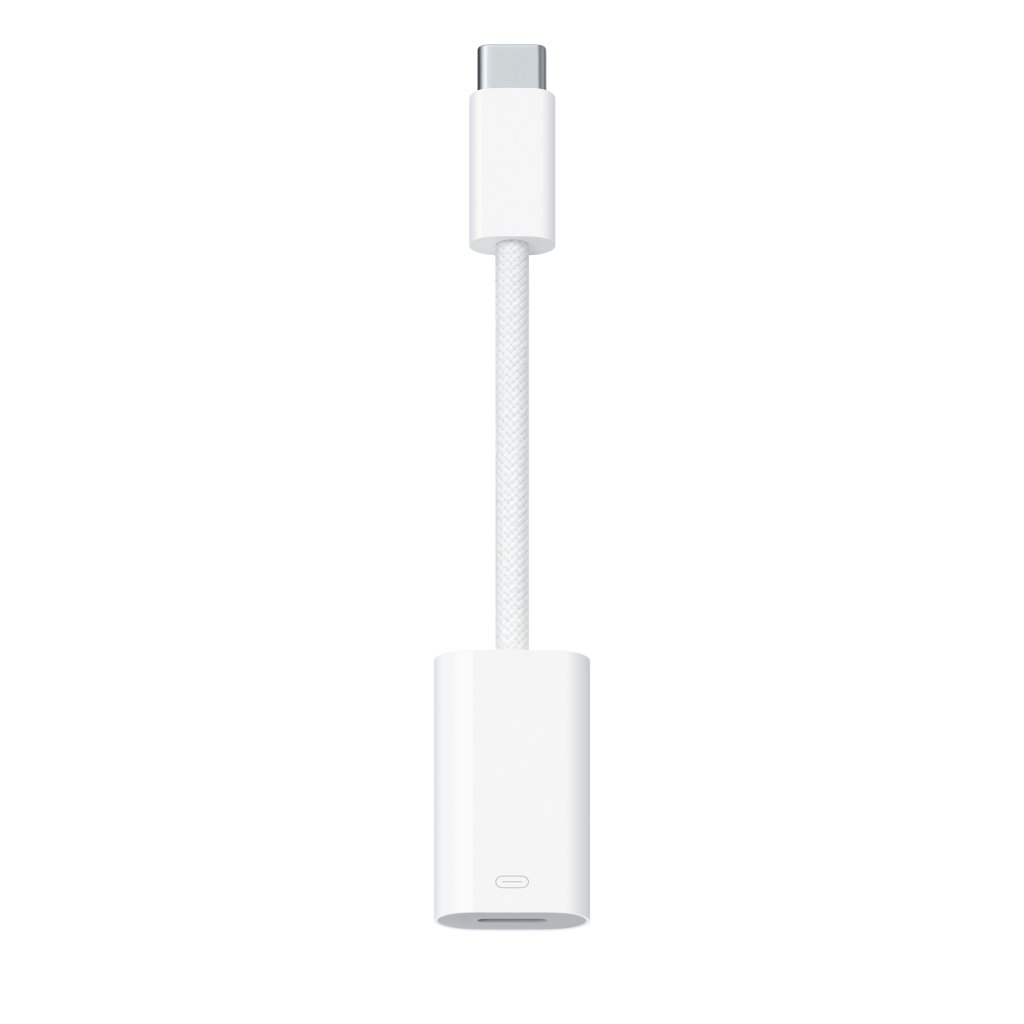
If you’re like me, you’ll have quite a few Lightning cables around the house and office – for charging phones, AirPods, older iPads, and even pencils and keyboards. I’ve got quite a few USB-C to Lightning as well as some older USB-A to Lightning.
With the release this week of the simple USB-C to Lightning dongle adapter you can now plug in a Lightning cable into a USB-C device. Ostensibly to protect investment in things such as music systems, car adapters etc, this little gem also has the added advantage of allowing you to use Lightning cables to charge not just iPhone 15 models, but also iPad Pros, and, wait for it, ANY recent MacBooks – Air and Pro varieties! (Hang on non-Apple users!)
I picked up my adapter at the local Apple Store yesterday – the person I spoke to didn’t know it existed but they found the stock. It has some useful benefits for our business in field testing which first brought it to my attention. I wondered if it would work with my iPad Pro? And of course, why wouldn’t it work? Indeed using it with my 11.9” M1 iPad Pro I was able to see around 26W charging at 9V with my 96W MacBook Pro charger and USB-C to Lightning cable. I have seen 15V charging when the iPad Pro starts at very low battery with up to 35W, so a limitation here is that I think 27W (9V/3A) is as far as this goes. But that’s almost full speed charging of a modern iPad (note it’s also higher than the 20W charger Apple have typically included if you have access to a higher power USB PD charger such as those with MacBooks).
So, then I thought if it can do this, it might also allow charging my new 15” MacBook Air. And, lo and behold, this also worked. Yes, charging a modern laptop with a Lightning cable! I was able to confirm these details through the “About this Mac” —> System Report —> Power.
It advertised to the MacBook Air as a 28W charger – specifically identifying as the Apple USB-C to Lightning Adapter. (I’m guessing it has a chip in it which probably contributes to the price and which converts the power signalling from Lightning protocol to USB-C). Obviously, it’s not as good as the 70W charger which is optional for this MacBookAir, but a good match for the 35W dual charger in a pinch and not far off the 30W charger included with the base MacBook Air. But, wait. There’s MORE!
Then I started wondering about all the old USB-A adapters out there. Amazingly these work too with 11W recorded into the MacBook Air using a 12W old iPad charger.
So, not only does this adapter allow you to continue using your Lightning cables with new phones, it also allows you to charge ANY other Apple USB-C devices with almost any USB based charger and any Lightning cable.
Ironically, Apple’s done more for sustainability with this one action than the EU’s “rule” about USB-C – which by itself is a big initial negative rendering lots of chargers and cables useless without such solutions.
If you had to take just one cable with you for all your Apple gear, the answer may turn out to be Lightning!
If you’re not one of the 1 billion+ Apple users, how does this help YOU?
Well, for Android users – though I haven’t tested this – it should also allow you to use Lightning cables to charge Android phones – including providing pretty good USB PowerDelivery charge to 27W. So, a cable for every situation! Right now, the only true Universal cable. How ironic, EU? But very much in-tune with Apple’s sustainability push at the announcement event.
Here’s a handy summary of what you can do:
- You’ll need the Apple USB-C to Lightning adapter for this £29/$29 at the Apple Store. You plug a Lightning cable INTO the adapter and then plug the adapter INTO a USB-C device.
- The faster the charger you use, the faster the charging experience, but any charger above 30W is not going to help any further
- If you’ve forgotten the USB-C to USB-C cable that came with your new iPhone15, you can charge with this setup at similar speeds to iPhone 14 models.
- You can charge a USB-C iPad using this setup at a good speed (depending on charger).
- You can charge any USB-C based MacBook using this setup at a decent speed (MacBook Air models and using a 30W charger) or an acceptable speed (MacBook Pro models). In a pinch even a USB-A charger and USB-A Lightning cable will charge these devices up but over a much longer period (USB-A limits of 12W are an absolute maximum). But this would be ok in an overnight situation.
- You should be able to charge almost any Android phone that has a USB-C input using this setup and with approximately 0-50% charge in 30 minutes using a 20W (or ideally 30W) charger.
- You should also be able to charge larger USB-C based tablets and laptops using this setup, with power dependent upon the charger available (again up to around 27W).
- Of course, this same setup (without the adapter) can continue to charge all of your Apple devices and peripherals.
- Taking the adapter with you (Android or Apple users) allows you to “hijack” any friends Apple Lightning configuration to charge your USB-C based device.
So, this little gem of a dongle is a real get-out-of-jail device for all sorts of situations, and useful for many road warriors to carry around. If you have any other situations you’ve found it useful or think it might be useful, let us know and we can update this post.
Thanks for reading!
A Blaggers guide to Fast Charge

Your questions answered.
All iPhones, since iPhone 8, and most Samsung or Google phones, have the latest USB PD Fast Charge standard in their hardware. But what is Fast Charging, and why should you care?
What is Fast Charging?
The technical name is USB 3.1 Power Delivery. The people-friendly term is “Fast Charge”, meaning you can charge your device at speeds up to 100W. In short, you can receive up to 50% phone charge in just 30 minutes!
So, if you’re stuck at an airport and thinking, “Yikes! I’m going to run out of battery before retrieving my electronic boarding pass!” – you’d be in luck if you had Fast Charging nearby, as you could get a 10% battery charge in about 5 minutes!
BUT unfortunately, public spaces are still behind the times in providing Fast Charging and most are yet to offer a reliable charging solution at all.
Do I need any specific equipment for Fast Charge?
Fast charge requires three components – a compatible phone/tablet/laptop or other devices, a charger that supports USB Fast Charge, and a compatible cable. The cable will need to have USB-C at least on the charger end and USB-C or Apple Lightning at the device end. Your device will need a Fast Charge system or a USB-C socket branded as Fast Charge for you to use your own cable at public charging solutions.
Can devices with Micro-USB use Fast Charge?
No, only devices with USB-C or Apple devices since 2017 with Lightning can use Fast Charge.
Isn’t wireless charging quick and better?
Wireless requires you to place your phone precisely on a wireless charging pad to get the best performance unless you use something like Apple’s MagSafe wireless charger. Fast Charge cabled charging is still 2-4 times faster and is more reliable. Wireless is better than nothing and fine for overnight charging, but not ideal for public charging when you want maximum charge in a short timeframe.
Is Fast Charge safe?
All modern devices control the power input to suit the devices’ battery characteristics. Manufacturer testing ensures the device takes the right amount of power at different battery charge levels to maximise the safe charge rate while maintaining long-term battery health. When phones go beyond 80-90% charge, they charge much more slowly, as this is when the phone will deliberately slow down the charge rate to protect battery longevity.
Can you only Fast Charge phones?
Many tablets (including all newer iPad models) support a higher level of fast charging. For example, iPads may use up to 30W, three times faster than the old base charger in the box or 1.5 times faster than the charger that ships with the iPad Pro. Of course, many laptops also support Fast Charging using USB-C cables.
I don’t have one of the big brand handsets, but I thought I already had Fast Charge.
You might do if it’s a less well-known Chinese brand, but it’s likely not using the international standard set by the USB Implementers Forum. Unfortunately, this means you will not benefit from public Fast Charging systems, and the technology’s proprietary nature might not hit all the safety standards.
So where could I charge my phone in a hurry when I’m out and about?
Look for USB-C plug points and charging stations with Fast Charge installed. Public spaces like shopping centres and airports have charging stations, but very few have adopted this technology. They will need to start investing in it soon because there will be demand from the public. If you find the charging facilities don’t cater for it, then ask for it. In the meantime, all new ChargeBox public charging solutions provide USB PD Fast Charge charging at up to 60W per cable, hugely outperforming any other public charging solutions we’ve encountered globally.
For more information on any of the Fast charge solutions we can offer your business, event or location – simply get in touch. We’d love to hear from you!
The ChargeBox Team