How Mobile Phones Are Transforming the Airport Experience for Passengers
In the modern travel landscape, mobile phones have become indispensable companions, revolutionising the way we navigate airports. From booking flights to boarding planes, these devices are central to almost every aspect of the passenger journey.
As airports continue to embrace digital transformation, emerging technologies are reshaping how travellers use their mobile phones, enhancing convenience, efficiency, and overall experience.
1. Mobile Check-In and Digital Boarding Passes
Gone are the days of printed boarding passes and long queues at check-in counters. Mobile check-in and digital boarding passes have streamlined the airport experience, allowing passengers to check in, select seats, and download their boarding passes directly to their phones. This not only saves time but also reduces the need for paper, aligning with sustainability efforts.
Biometric technology on mobile phones, such as facial recognition and fingerprint scanning, allows passengers to streamline their airport experience. By securely storing their identity data on their phone, travellers can use biometrics to verify their identity whenever needed. This eliminates the need for physical documents, reduces wait times, and makes the entire travel experience faster and more convenient.
2. Real-Time Flight Updates and Navigation
One of the most stressful aspects of air travel is uncertainty — whether it’s delays, gate changes, or tight connections. Mobile apps now offer real-time flight updates, ensuring passengers are always informed about their journey. These apps provide notifications about boarding times, gate assignments, and even baggage claim details, all in real time.
In addition, indoor navigation apps are transforming the way travellers move through airports. Using augmented reality (AR) and GPS technology, these apps guide passengers to their gates, lounges, shops, and even charging stations. With just a few taps, travellers can easily navigate complex airport layouts, minimising the risk of missing flights.
3. Mobile Payments and Contactless Transactions
Mobile payment solutions, such as Apple Pay and Google Wallet, are increasingly being adopted across airport retail, dining, and duty-free stores. This shift towards contactless transactions not only speeds up the purchasing process but also enhances hygiene—a significant consideration in the post-pandemic world.
Moreover, mobile wallets allow passengers to store multiple currencies, making it easier to manage expenses during international travel. Combined with loyalty apps that store frequent flyer miles and reward points, mobile payments are becoming the go-to method for savvy travellers.
4. Entertainment and Connectivity
For many passengers, mobile phones are a primary source of entertainment during long waits and flights. Airports are responding by offering improved Wi-Fi connectivity, allowing travellers to stream movies, catch up on work, or connect with loved ones without interruption. Additionally, charging solutions, such as those provided by ChargeBox, ensure that devices remain powered up throughout the journey.
Emerging technologies like 5G are set to further enhance the in-airport experience. With faster download speeds and reduced latency, 5G will enable seamless streaming, video calls, and even augmented reality experiences, transforming idle time at the airport into productive or enjoyable moments.
5. Personalised Travel Assistance
Artificial intelligence (AI) is playing a growing role in personalising the airport experience. Chatbots and virtual assistants, integrated into airline apps, provide travellers with real-time answers to their queries, from baggage allowances to lounge access. Some apps even offer personalised recommendations for dining, shopping, and activities based on the passenger’s preferences and flight schedule.
AI-driven apps also help passengers manage their travel plans, offering suggestions on the best time to leave for the airport, traffic updates, and weather forecasts. VR, on the other hand, offers immersive experiences, such as virtual tours of the airport or even pre-flight relaxation sessions. These technologies not only enhance the passenger experience but also offer new opportunities for retail and entertainment, creating a more engaging and enjoyable environment.
6. Sustainability and Environmental Considerations
As environmental concerns take centre stage, airports and airlines are increasingly focusing on sustainability. Mobile phones play a key role in these efforts by reducing the need for paper tickets, boarding passes, and brochures. Digital receipts, mobile passports, and electronic visas further minimise paper waste substantially.
Conclusion
Mobile phones have undeniably transformed the airport experience, making travel more efficient, convenient, and personalised. As emerging technologies like biometric security, 5G, and AI continue to evolve, the role of mobile devices in air travel will only expand.
The availability of airport charging services is no longer just a convenience — it’s a necessity. Offering reliable and fast charging ensures that passengers can stay connected, access real-time updates, and utilise essential apps for navigation, payments, and entertainment throughout their journey.
Airports and airlines that embrace these essential innovations to boost the passenger experience will be better positioned to meet the needs of today’s tech-savvy travellers, directly contributing to a smoother, less stressful and more informed, travel experience for all.
The Case for Sustainable, Fast Charging Lockers in Universities and Higher Education Colleges
In today’s digital age, mobile devices are indispensable tools for students in higher education. From accessing online resources and participating in virtual classes to staying connected with peers and faculty, the reliance on smartphones, tablets, and laptops has never been greater. However, with this increased dependence comes the ever-present challenge of maintaining battery life throughout a busy academic day. This is where sustainable, fast charging lockers come into play as an essential amenity for universities and higher education colleges.
Benefits of Fast Charging Lockers
Sustainability and Environmental Responsibility
Fast charging lockers designed with sustainability in mind can significantly reduce the environmental impact of electronic device usage. These lockers often use energy-efficient technologies and components, ensuring minimal power wastage. By integrating such systems, institutions can demonstrate their commitment to environmental stewardship and inspire students to adopt greener habits.
Enhanced Convenience and Accessibility
Unlike traditional charging stations or wall outlets, fast charging lockers provide a secure and convenient solution for students to charge their devices. Students can safely lock their devices in a designated locker, ensuring they are protected from theft or damage while charging. This added security gives students peace of mind and allows them to focus on their studies without worrying about their valuable gadgets.
Speed and Efficiency
The primary advantage of fast charging lockers is their ability to charge devices at an accelerated rate. With the capability to charge a device from 0% to 50% in a fraction of the time it would take with a standard charger, these lockers ensure that students can quickly top up their batteries between classes, during lunch breaks, or even in between lectures. This rapid charging capability helps maintain productivity and keeps students connected throughout the day.
Space Optimization
Fast charging lockers are designed to accommodate multiple devices simultaneously, making efficient use of space within the campus. This is particularly beneficial in high-traffic areas such as libraries, student unions, and common rooms, where the demand for charging facilities is high. By centralizing charging infrastructure, universities can avoid clutter and ensure an organized, aesthetically pleasing environment.
Support for Diverse Devices
Modern fast charging lockers are versatile, supporting a range of devices including smartphones, tablets, and laptops. This adaptability is crucial in a higher education setting where students use a variety of devices for different academic purposes. By providing a one-stop charging solution, universities can cater to the diverse needs of their student population.
Encouraging Responsible Device Usage
Providing accessible charging solutions encourages responsible device usage among students. With the assurance that they can charge their devices whenever necessary, students are less likely to resort to unsafe charging practices, such as using low-quality chargers or leaving devices unattended in public spaces.
The Future of Mobile Technology in Education
As we look towards the future, it’s clear that mobile technology is here to stay. The integration of mobile devices into educational frameworks has revolutionised the way students learn and interact. From interactive apps and e-books to virtual classrooms and online collaboration tools, the possibilities are endless. Mobile devices offer unparalleled flexibility and accessibility, enabling students to learn at their own pace and on their own terms.
In conclusion, the implementation of sustainable, fast charging lockers in universities and higher education colleges is a forward-thinking move that addresses the practical needs of students while promoting environmental responsibility. These lockers offer a superior alternative to traditional charging solutions, providing security, efficiency, and convenience. As mobile technology continues to evolve, ensuring that students have the necessary infrastructure to support their academic pursuits is not just beneficial—it’s essential. Mobile is indeed here to stay, and by embracing innovative charging solutions, educational institutions can better prepare for a connected and sustainable future.
The Future of Device and Smartphone Charging: Understanding USB-C Power Delivery
In recent years, USB Type-C has become the standard connection for charging a multitude of devices, from smartphones and tablets to laptops and beyond. This evolution in charging technology has revolutionised how we power our gadgets, offering numerous advantages that enhance convenience, efficiency and speed. In this blog, we’ll delve into the benefits of USB-C power delivery, explore how this charging technology works, and provide tips on selecting the right adapters and cables.
USB Type-C: The Standard Connection?
USB Type-C, commonly referred to as USB-C, is a versatile and reversible connector that has swiftly become the go-to standard for modern devices. Unlike its predecessors, USB-C is designed to handle not just data transfer but also power delivery, allowing it to charge devices quickly and efficiently. Its symmetrical design means it can be plugged in either way, eliminating the frustration of trying to insert the connector incorrectly.
Advantages of Power Delivery via USB-C
One of the standout features of USB-C is its support for USB Power Delivery (PD). This technology offers several key advantages:
1. Faster Charging: USB PD allows for higher power levels, meaning devices can charge much faster compared to older USB standards. This is particularly beneficial for high-capacity devices like laptops and tablets.
2. Universal Compatibility: USB-C PD can charge a wide range of devices, from smartphones to laptops, using the same cable and power adapter. This reduces the need for multiple chargers, simplifying your tech life.
3. Enhanced Safety: USB PD includes features that protect devices from overcharging, overheating, and other potential hazards, ensuring a safer charging experience.
4. Flexibility: With variable power delivery, USB PD can adjust the power output according to the device’s requirements, making it highly versatile.
USB-C Power Delivery. How it works.
How the Charging Technology Works: USB Power Delivery is an advanced specification that significantly improves the standard USB charging protocols. Here’s how it works:
Negotiation Process: When a USB-C cable is connected to a device, the charger and device communicate to determine the optimal power level. This negotiation ensures the device receives the correct amount of power without exceeding its capacity.
Variable Power Levels: USB PD can deliver power at varying levels, typically ranging from 5V (volts) to 20V, and up to 100W (watts). This flexibility allows it to charge everything from small smartphones to large laptops.
Bidirectional Charging: USB PD supports bidirectional power delivery, meaning a device can either receive power or provide power to another device. This is particularly useful for scenarios where one device, like a laptop, can charge another, such as a smartphone.
Which Power Adapter is best for you?
Choosing the right power adapter is crucial for efficient and safe charging. Here’s how to ensure compatibility:
1. Check the Device’s Specifications: Look at your device’s user manual or manufacturer’s website to find the recommended power requirements.
2. Examine the Adapter’s Output: Ensure the adapter’s voltage and wattage match or are within the acceptable range for your device.
3. Verify USB PD Support: If your device supports USB PD, make sure the adapter does as well. Many modern adapters explicitly state their compatibility with USB PD.
4. Connector Type: Confirm that the adapter has a USB-C output, as using the correct connector type is essential for compatibility.
The Best Cable for Charging via USB-C
Not all USB-C cables are created equal. Here’s what to consider when choosing a cable:
Power Rating: Ensure the cable supports the power levels required by your device. High-quality cables often list their power ratings on the packaging or cable itself.
Data Transfer Speeds: While primarily used for charging, USB-C cables can also transfer data. If this is important, look for cables that support higher data transfer rates.
Build Quality: Opt for cables with robust construction to avoid wear and tear. Features like reinforced connectors and braided exteriors can enhance durability.
Certification: Cables that are USB-IF (USB Implementers Forum) certified have been tested for compliance and safety, ensuring reliable performance.
ChargeBox: UK-designed and manufactured.
We only use real Apple Type C USB cables for all our latest charging solutions. We also strengthen them to give them a x 10 lifespan. That’s the difference between a cable that would last 400 charges and one that lasts 4,000!
Conclusion:
USB-C and USB Power Delivery are transforming the way we charge our devices, offering faster, safer, and more versatile options. USB-C has undeniably set a new standard in the realm of charging technology. Its versatility, speed, and efficiency make it an essential component in our increasingly connected lives.
Understanding how this technology works and knowing how to choose the right adapters and cables can significantly enhance the charging experience and let’s face it no one likes waiting more time than they need to, for their phone battery to charge! 🔋
Mobile Phone Addiction and Nomophobia: Understanding the Digital Epidemic
Understanding Mobile Phone Addiction and Nomophobia: A Digital Epidemic
In today’s hyper-connected world, mobile phones are indispensable, offering unparalleled convenience by keeping us connected, informed, and entertained. However, this convenience has a downside: mobile phone addiction, a growing global concern, especially in the UK. One specific manifestation of this addiction is known as Nomophobia.
What is Nomophobia?
Nomophobia is the fear or anxiety associated with being without a mobile phone or beyond mobile phone contact. This term emerged from a study commissioned by the UK Post Office in 2008, highlighting the extent of mobile phone dependency among the public. Symptoms of nomophobia include:
- Panic or anxiety when the phone battery is low or there is no network coverage.
- Constantly carrying a charger or backup battery.
- Using the phone in inappropriate settings, such as during meals or social gatherings.
What is Mobile Phone Addiction?
Mobile phone addiction is characterized by an over-reliance on mobile devices, significantly interfering with daily activities, personal relationships, and productivity. Key signs of this addiction include:
- Excessive checking of the phone, even without notifications.
- Anxiety when the phone is not accessible.
- Spending more time on the phone than intended.
- Neglecting face-to-face interactions in favor of mobile device use.
Factors Contributing to Mobile Phone Addiction
Several factors contribute to the high levels of mobile phone addiction in the UK:
- Social Media: Platforms like Instagram, Facebook, and TikTok are designed to be addictive, encouraging continuous engagement.
- Work Demands: The rise of remote work and the expectation of constant availability compel many to check their phones regularly.
- Fear of Missing Out (FOMO): This psychological phenomenon drives individuals to stay connected to avoid missing out on important events, news, or social interactions.
Who Are the Most Addicted?
Certain demographics in the UK show higher levels of mobile phone addiction:
- Young Adults: Those aged 18-24 are particularly prone to mobile phone addiction. A University of Derby study found that 13% of young adults could be classified as “addicted” to their smartphones.
- Teenagers: The NHS has expressed concerns about the impact of excessive phone use on teenagers’ mental health, citing increased levels of anxiety, depression, and sleep deprivation.
- Professionals: Many working professionals also exhibit signs of mobile phone addiction due to the constant need to stay connected for work, coupled with social media use.
The Extent of Mobile Phone Addiction in the UK
Recent statistics paint a concerning picture of mobile phone usage in the UK:
- High Usage Rates: According to a 2023 Ofcom report, the average UK adult spends over 3 hours and 23 minutes per day on their mobile phone, highlighting our growing reliance on these devices.
- Frequent Checks: Research indicates that the average UK user checks their phone approximately 58 times a day, with younger adults (aged 18-24) checking around 79 times a day.
- Bedtime Usage: A Deloitte survey found that 41% of UK adults check their phones within five minutes of waking up, and 37% check their phones just before going to bed, leading to disrupted sleep patterns and other health issues.
Consequences of Mobile Phone Addiction
Mobile phone addiction and Nomophobia can lead to several adverse effects:
- Mental Health Issues: Continuous mobile phone use is linked to increased anxiety, stress, and depression. The constant bombardment of notifications and the pressure to stay connected can be overwhelming.
- Sleep Disruption: Exposure to blue light from screens before bedtime can interfere with sleep patterns, leading to insomnia and poor-quality sleep.
- Decreased Productivity: Frequent phone use can distract individuals from their tasks, leading to decreased productivity at work or school.
- Social Impact: While mobile phones are designed to keep us connected, excessive use can lead to social isolation, with people spending more time on their devices than interacting face-to-face with family and friends.
Combating Mobile Phone Addiction
Combating mobile phone addiction requires a multi-faceted approach:
- Digital Detox: Encourage periodic breaks from mobile phone use to reduce dependency.
- Setting Boundaries: Establish phone-free zones and times, such as during meals or an hour before bedtime.
- Mindfulness Practices: Techniques like meditation can help reduce anxiety associated with nomophobia.
- Professional Help: For severe cases, cognitive-behavioral therapy (CBT) has proven effective in managing addiction.
Conclusion
Mobile phone addiction and Nomophobia are growing concerns, particularly in technologically advanced societies like the UK. By understanding the signs of addiction and taking proactive steps to manage mobile phone use, individuals can regain control over their lives and reduce the negative impacts on their mental and physical well-being. With awareness and appropriate interventions, it is possible to foster a healthier relationship with our digital devices.
Sources:
- Ofcom Report 2023
- Deloitte Survey
- University of Derby Study
- NHS Mental Health Concerns on Teenagers and Mobile Phone Use
Mobile Phone Batteries: Their Evolution and Limitations.
In an era where technological innovations seem to know no bounds, one persistent challenge continues to vex smartphone users worldwide: the limitations of mobile phone batteries. Despite the leaps and bounds made in smartphone capabilities, the evolution of battery technology has been, and continues to be, a slower, more incremental journey. In this blog, we’ll explore the advancements and limitations of mobile phone batteries, their technology, and give you some tips on how to prolong battery life that help to liberate us from the tyranny of carrying chargers and charging cables.
The Evolution of Mobile Phone Batteries:
Mobile phone batteries have come a long way since the early days of bulky devices with limited endurance. The introduction of Lithium-ion batteries in the 1990s revolutionised the industry, offering higher energy density and longer-lasting power. However, while smartphones have evolved into sleek, multifunctional devices, battery technology still needs to catch up!
Advancements and Limitations:
While some smartphones boast impressive battery life, such as the Apple iPhone 15 Pro Max, Samsung Galaxy S24 Ultra, and Google Pixel 8 Pro, the reality is that most devices still require daily charging. Despite incremental improvements in battery longevity and efficiency, the fundamental limitations of Lithium-ion technology persist.
Why Batteries Lag Behind:
The disparity between smartphone advancements and battery capabilities can be attributed to several factors. Firstly, the demand for slimmer, lighter devices conflicts with the need for larger, more powerful batteries. Consumers prioritise sleek designs over extended battery life, leading manufacturers to prioritise form factor over function.
Additionally, the pace of battery technology development is inherently slower than that of other smartphone components. While processors, cameras, and displays undergo rapid advancements, battery technology faces inherent challenges such as energy density, safety concerns, and cost-effectiveness.
Mobile phone batteries rely on chemical reactions to store and release energy, making their advancements inherently more challenging compared to the physics-driven developments of other device components. While electronics progress swiftly due to advancements in physics, battery technology faces huge complexities in optimising chemical compositions and reactions, leading to slower progress and incremental improvements over time.
Future Developments:
Technology companies are actively exploring new avenues for battery innovation despite these challenges. Solid-state batteries, which utilise solid electrolytes instead of liquid ones, hold promise for higher energy density, faster charging, and enhanced safety. Companies like Tesla, Samsung, and Toyota are investing heavily in solid-state battery research, aiming to revolutionise energy storage across various industries.
Furthermore, advancements in materials science, such as the integration of lithium metal into battery designs, offer potential breakthroughs in energy density and longevity. Companies like Quantumscape are at the forefront of developing next-generation batteries based on lithium metal technology, paving the way for significant advancements in mobile phone batteries.
Tips for Prolonging Battery Life:
While we await the arrival of next-generation battery technologies, there are steps we can take to maximise the performance and longevity of our current mobile phone batteries:
- Optimise Settings: Adjust the display brightness, and enable power-saving modes to reduce battery consumption. Don’t wait for 20% level before low power mode is offered to go into it if you’re on a long day. There is some loss of features/notifications of course, but usually not much. See here https://support.apple.com/en-gb/HT205234
- Manage Charging Habits: Avoid frequent deep discharges and opt for partial charging whenever possible to minimise stress on the battery. The sweet spot is between about 20-80% charge. Newer iPhones for example let you set 80% as the maximum battery charge level which is good – unless you’re on a long day in which case turn it off for that day.
- Avoid Extreme Temperatures: Extreme heat or cold exposure can degrade battery health, so keep your phone in moderate environments. When in the car, don’t have it in full sun, or next to vents putting out hot air.
- Use Original Chargers: Stick to genuine certified chargers and cables provided by the manufacturer to ensure compatibility and safe charging.
- Consider Battery Replacements: If your smartphone’s battery performance significantly deteriorates over time, consider replacing the battery to restore optimal performance. Your device should tell you about the battery condition and its capacity. You can expect some deterioration after between 500-1000 charge cycles, with more after that level. 3+ year-old devices may well benefit, though if carefully managed, can give much longer life.
- Fast-charging technologies often incorporate features such as temperature management and voltage regulation to minimise stress on the battery, helping to prolong its lifespan.
Conclusion:
While mobile phone batteries may lag behind the rapid pace of smartphone advancements, ongoing research and development efforts offer hope for a future where battery life ceases to be a daily concern. By embracing emerging technologies and adopting prudent battery management practices, we can free ourselves from the shackles of charging cables and enjoy uninterrupted connectivity on our smartphones. And when you consider that the average person checks their phone 150 times a day (that’s once every 6 minutes!), our hunger for battery juice than never depletes, is only going to increase.
It might not be long before we can see the prototypes for a more powerful, kinetic charging system that harnesses motion or mechanical energy to generate the electricity needed to power a smartphone. Exercising to charge up all round?
Chargebox packs in a summer of sizzling events.
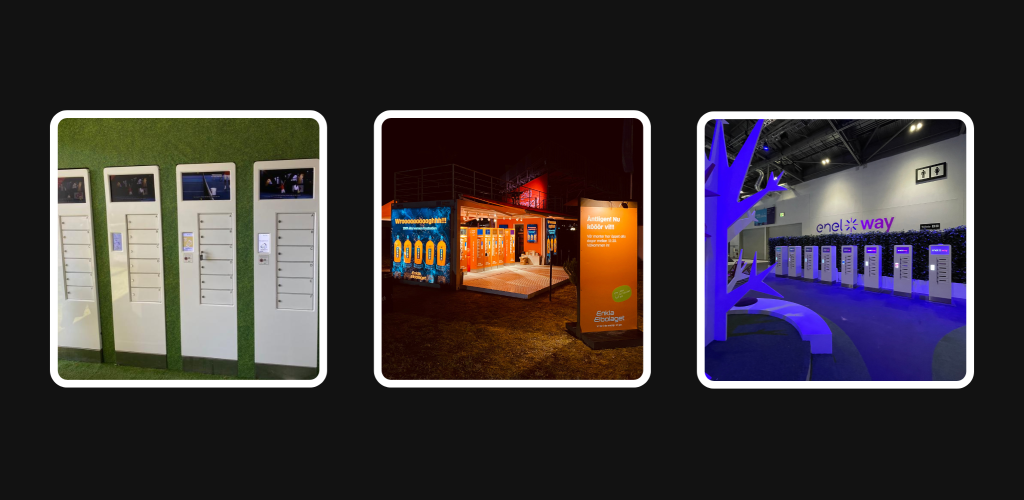
It’s been a hot busy Summer so far and we wouldn’t have it any other way.
We’re pleased to have been picked to provide charging services at many significant events this summer and it’s not over yet.
The season kicked off in the traditional style with our annual pilgrimage to SW19. We’re now in our 9th year of working with the tournament and it’s one of our favourite events to attend. HSBC created customer booths with free device charging to entice spectators. Usage of the service was up an incredible 33% this year from last year demonstrating that, like Emma Radacanu, our service proves to be a firm fan favourite.

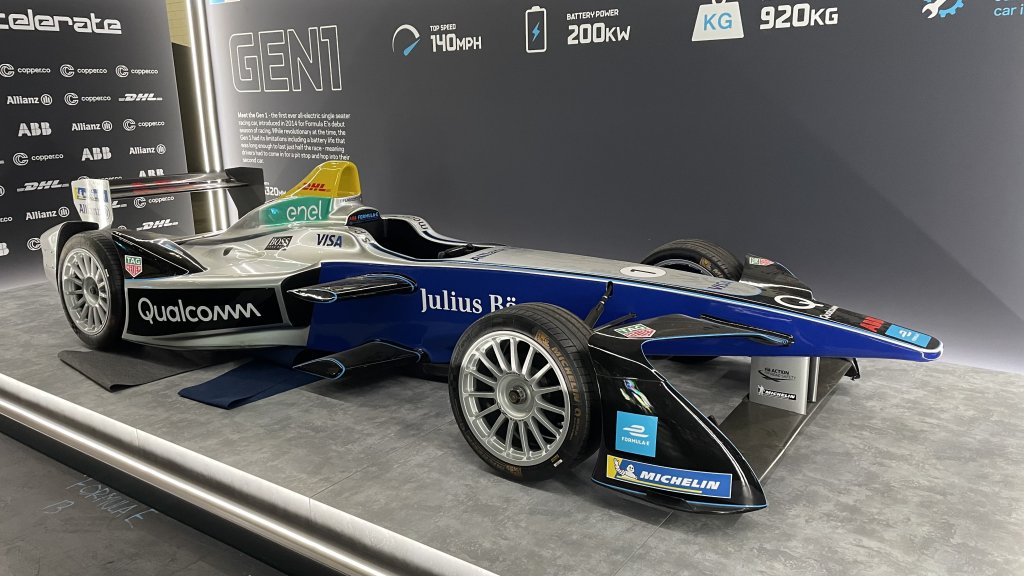
From a much-loved old client to a much-loved new one. A new major sporting event we are delighted to welcome to the fold is Formula E. According to the top driver, Antonio Felix da Costa, the event at Excel London this year was the best yet! Perhaps it was due in part to the fabulous Recharge zone in the Allianz E-Village 😂. Sponsors, enel x way created a perfect area to relax in, with plenty of comfortable seating, low lighting and eight ChargeBox Fast units. With the World’s fastest electric cars on show, this event absolutely had to have the world’s fastest phone charging too!
Over in Sweden, our partners at Paraply Production converted a shipping container into a charging zone, in order to provide an essential service at some of Sweden’s biggest music festivals. As part of an activation for utility company Enkla Elbolaget, they upgraded their charging service for 2022. Previously they operated a phone check-in, where staff would take customer phones and plug them in on shelves. This, however, was labour intensive and an organisational headache. ChargeBox’s simple, secure and intuitive lockers are completely self-service so festival goers can independently charge their phones up quickly and easily. Boom!
We’ve also been flying high this summer with some prestigious aviation events, attending both the Air Tattoo and the Farnborough Airshow. Like Wimbledon, the Farnborough Airshow is an event we’ve worked with for many years but post-Covid, we are enormously pleased to be back on the live events scene! Both shows had sponsors supporting their services, these being Raytheon Technologies and Lockheed Martin respectively. Sponsoring charging at events is great for awareness and brands also benefit from the halo effect of providing a useful free service. By securing sponsorship of the service, event partners provide an enhanced experience which negates costs and often makes providing charging, profitable.
Finally a mention of the British Summer Time Festival at Hyde Park. Our services were available to VIP guests of charity supporter Utopia. Just think of the pop royalty who could have used our service – Elton John, Adele, Mick Jagger? Alas, we didn’t get to see any of the gigs ourselves this year but hopefully, we’ll be back again next year to see some of the action!
We’ve had so many great events partners already this summer with more yet to come! Sorry if we didn’t mention your event with us this time.
Get in touch if you’d like us to mention you!
ChargeBox positively impacts the event experience for hundreds of thousands of fans, delegates and attendees. From business conferences to major sporting occasions, we’ll keep your attendees charged and connected.
ChargeBox at the NHS – Small Improvements That Make A Big Impact
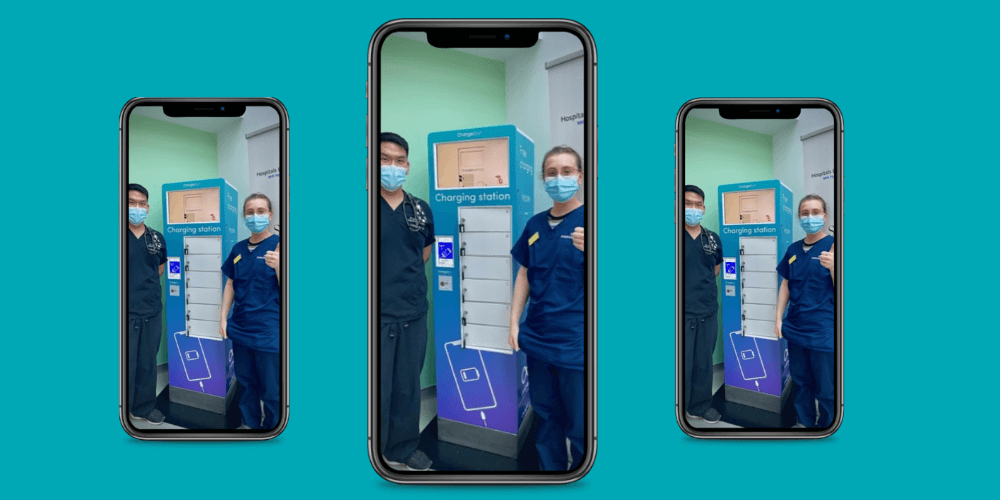
The hospital charity that funded the service tweeted about its arrival. 143 Retweets, 85 Quote Tweets and 1,369 Likes later, here are some of the highlights of those responses:
‘Great idea for the new ED build’. ‘Love this! We’ll definitely look at it’. ‘Great idea, something we can think about for @EDQEH1?’ ‘Look at this fab idea! 😍@StarsAppeal’. ‘Great idea for patients’. ‘Can we do this???’. ‘What an amazing idea! Well done.👍’ ‘What a brilliant idea – do we have one of these in our ED?’ NorthMidNHS. ‘Excellent idea!’ “Love this!’
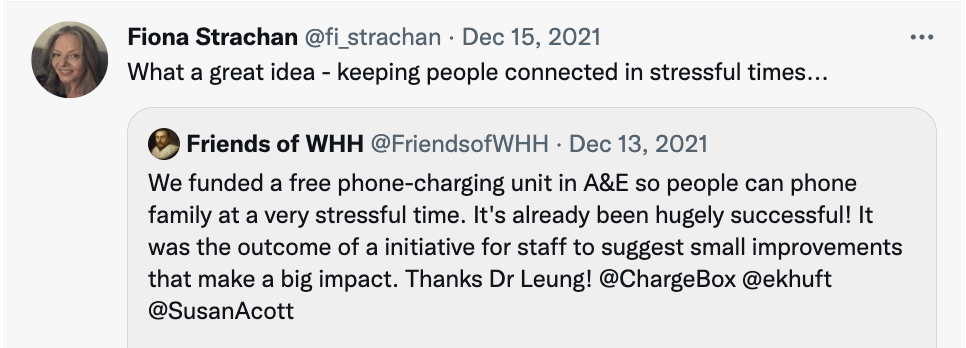

Positive validations from NHS staff continued to flow…
Chief Nursing Officer, Evonne Hunt at Medway NHS Trust said ‘What a brilliant idea!’.
Joel Bonner, Patient Experience Lead at Gloucestershire Hospitals NHS Foundation Trust commented: ‘the sort of thing I had in mind!’ to which Sally Hayes, Deputy Divisional Director Quality & Nursing Medicine said ‘Yep! Saw that last night! Go for it!’

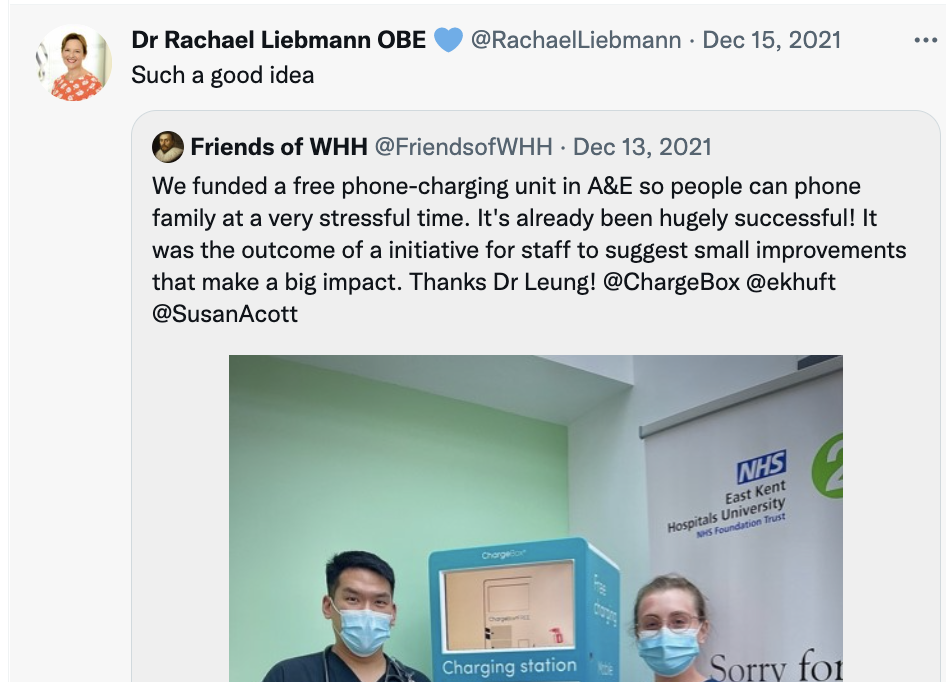
Other comments even made us chuckle as curiosity about the new Chargebox grew. ‘Where do we buy one of these beauties???’ Really, Clare? But thank you 🙏 And Sarah 😂 ’Please can we have one for Christmas?’ ‘How groovy is this!? Yeah, baby!
&tbnid=OQq4MQpfNnO8FM&vet=12ahUKEwjR68OSqIz5AhVSiRoKHaoGA-gQMygAegUIARDiAQ..i&docid=57W0r4TBuHtuoM&w=339&h=293&q=austin%20powers&ved=2ahUKEwjR68OSqIz5AhVSiRoKHaoGA-gQMygAegUIARDiAQ)
But Clare Campion, Interim Director of Nursing & Quality at The Children’s Trust and Registered Nurse Brian Webster summed up best why having charged up, connected devices at hospitals are essential.
‘Fantastic initiative, well done! That will make such a difference to people who are there for far longer than they’d like to be, and left home in a hurry without a charged phone, or spare battery. Will take a lot of anxiety away. 👏’
‘Person centredness. I helped someone today in ICU get their phone and tablet charged and WiFi connected then facilitated a video call with family. They didn’t care (verbally) about all the clinical skills I did all day but for this, they couldn’t thank me enough!’
And patient Douglas Bilton also gave us a valuable review of the service. ‘This is such a great idea. I’ve had to go to A&E 3 times this year and on each, phone charging has been a concern.’
So as you can see, keeping patients’ devices charged is essential. We hear this all the time in our conversations with NHS partners so it’s rewarding to see it stated openly and genuinely for all to see.
About ChargeBox:
ChargeBox is the trusted, safe and secure charging provider at over twenty NHS Trusts because our service will:
Alleviate stress as patients and visitors can stay connected with loved ones, access critical information and stay entertained.
Increase staff productivity as they no longer have to deal with charging requests.
Support the increased volume of mobile devices within the NHS as pagers are phased out.
Reduce the uncontrolled use of sockets which can result in health and safety risks – Estate and Facilities Alert Dec 2018
Tell us about your local hospital – is device charging a service you think is essential these days?.
Why it’s essential to keep passenger smart phones charged and connected at the airport.

We all know how stressful travel can be, and airports come with their own added baggage! And having a flat or low phone battery is only going to make matters worse.
Before a passenger journey begins, the smartphone has already been integral to organising the travel. Who checks in at the airport anymore? Most passengers save valuable time and don’t risk a queue by checking in before arrival. When they arrive at the airport, they’ve likely booked their parking through a mobile app or confirmed a meeting location with a concierge service.
It’s at the airport where the smart phone becomes indispensable. Of course, free wifi is available at most airports, but with the improvement of mobile telecoms and 5G, most people can happily manage without wifi.
But can they manage with a low or flat smart phone battery? Absolutely not.
Here are FIVE reasons why keeping passengers’ phones charged and connected is essential:
Do you want passengers to use your airport app?
As Gatwick say in their marketing, “Get Gatwick in the palm of your hand and turn your smart phone into a trusty companion to get you to and through the airport hassle-free”. Airports want the opportunity to start a direct dialogue with their customers and make money from the journey through the added value the apps offer. In exchange, they provide live updates about your flight, security information and times, discounted offers and even collecting pre-ordered food.
Using electronic tickets/boarding passes
A fast, convenient and hygienic way to show documents. But more importantly, an environmentally friendly way to reduce paper waste that avoids unnecessary printouts. For example, when flying EasyJet and using their app you can save up to eight boarding passes per flight and you don’t need to be online to access them. One-third of boarding passes were digital in 2019 so that percentage will have grown exponentially post-pandemic.
To pay for things
The adoption of mobile payments like Apple and Google Pay has exploded. People no longer carry a wallet or purse as often as they used to. Not constrained by the £100 contactless limit and more secure than a card, mobile payments are the future. The global market penetration of Apple Pay is significant and the UK leads the way with over 60% of Apple users who use it. So keep passenger spending easy and simple.
Stay connected
Make calls, email, message work, family and friends. And of course, stay connected on social media. It’s what our devices were designed to do. Video calls are the new normal, 1 in 3 people have made one in the last month and 7 in 10 UK adults are making them weekly. But they drain your phone battery. A regular call uses approximately 0.33% of battery a minute whereas a video call uses somewhere between 1-2%, up to six times more drain! Using social media combines the battery drain double whammy of video sharing and location-based services. Do you want influencers to share how much they love the airport experience on TikTok? You better make sure they can keep their phone charged.
Entertainment
It’s inevitable that flights might be delayed, need rescheduling or even be subject to cancellation – but what do passengers want to do when there’s a hiccup to travel plans? Most likely, watch their favourite TV shows or games for kids. Keeping devices charged not only removes low battery anxiety but also helps keep passengers entertained and distracted from the worry caused by disruption.
So if you want happy passengers, you know what to do!
Fast charging and protecting your smart phone’s battery life.
Do you want to charge your smart phone safely and keep the battery life good for as long as possible?
Are you surprised at how slowly your smart phone appears to charge sometimes?
Are you confused by the different cables and chargers around?
If you answered yes to just one of these, you’ve come to the right place…
Your smart phone’s Lithium-Ion battery is an incredibly sophisticated component that has evolved to supply reliable power for much of the day, safely, and for an extended lifetime of 1,000 charges.
Over those 1,000 charges, your battery will start to deteriorate and not yield the life it had when it was new.
A key way to reduce that degradation is NOT to charge it past 80-90% if you don’t have to and ideally keep it above 10-20%. This may mean charging it twice daily to keep it in that range and skipping overnight charging to 100%.
Like most people, you’ve probably got several chargers you’ve received with smart phone purchases over the years.
If you’re still using the charger that came with a smartphone just a few years ago, you need to change it!
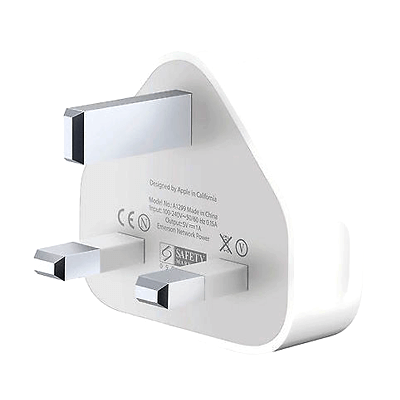
👈 If you are using one of these to charge your iPhone 8 onwards, it’s only providing between 18-30% of the power your smart phone needs.
In other words, your smart phone could be charging up to five times slower than it’s capable of. 😳
Why Battery Size Matters
Smart phones now have 3-4X more battery capacity than just a decade ago. You may not have noticed the change as it has been a gradual change in line with smart phones getting thinner. While some of that capacity provides better battery life, more is used because smartphones now have giant screens and are more power-hungry. What could charge a smart phone a decade ago will only give you a fraction of the power needed now.
To understand if your smartphone is getting a meaningful charge, you should measure it in terms of the % battery boost in a particular timeframe, e.g. 0-50% battery in 30 minutes.
Using an old charger with your new smartphone may take over 2 hours to get a meaningful charge. Of course, that’s not a lot of use when you’ve only got 10 minutes to get out of the house.
So what’s the answer?
Faster charging. The first iteration was QuickCharge from Qualcomm. This allowed slightly quicker charging using the micro-USB cable. However, it was proprietary and generally limited to specific Android devices that used Qualcomm components (by no means all). Plus, it was limited to the inferior micro-USB cable, which breaks easily.
Now USB is leading the way in providing fast charging standards developed and agreed upon by a cross-industry group, including leading vendors such as Apple, Samsung, and Google, as well as chip companies such as Intel and Texas Instruments.
They developed a better cable ending – USB-C – and the next-generation USB charging technology known rather boringly as USB Power Delivery (PD). It’s now considered the only true Fast Charge technology for smart phones, which is also compatible with laptops and tablets.
How does USB PD work in the simplest terms?
Well, it’s actually quite straightforward. Power, measured in Watts, is simply Volts multiplied by Amps. So, with old USB charging, you might have between 5W and 12W of power (at best). But with USB PD, chargers can go all the way to 100W – over 8 times more power or 20x more power than the typical 5W chargers many people still use! (Remember that Apple charger above?)
Most smart phones today charge in the 20W-45W bracket, so a PD charger offering anywhere from 20W to 45W is good enough. But if you use a higher power charger made for a larger laptop or tablet, that’s even better. Of course, you don’t need a 100W USB PD charger, but neither will it do any harm.
USB PD continues to develop and is being stretched to 240W of power in the next generation. This could permit e-bike/e-scooter or power tool batteries to be charged while also permitting charging some of the largest laptops or powering small desktops.
Qualcomm has adopted USB PD in its QuickCharge4 standard, meaning devices supporting QC4 will also support USB PD chargers. In addition, Apple’s Lightning cable (with a USB-C adapter on the charger end) also supports USB PD chargers.
Am I using USB PD Fast Charge today?
If your charger has a USB-C port, it may be USB PD, but not definitively. If you can find the specs, look for USB PD to be mentioned and voltage levels other than 5V (e.g. 9V) and/or power of 18W or more.
If your charger has a USB-A socket, it is definitely NOT a USB PD fast charge charger. And just because your smart phone has a USB-C socket does NOT mean it’s a smart phone capable of USB PD Fast charging.
And finally.
We’ve not discussed loads of geeky terms here, such as Wh, or mAh but it is REALLY useful to understand a very simple relationship. Watts = power. A Wh or Watthour is simply the amount of power that can be sustained for one hour – so you can be a powerful runner with a quick sprint, but a one-hour run is the power you can maintain for one hour – “energy”.
In electrical terms, there are two key components that make up power; Volts and Current (amps). Multiply the two, and you get the Watts. Maintain that for one hour and you get Watthours. So, 5V * 1A = 5 Watts. Maintain that for 1 hour and you get 5Wh of energy – a smartphone that runs at 1Wh will get you 5 hours of usage.
So there it is. Fast charging in a nutshell.