ChargeBox and Frankfurt Airport Unveil Next Generation Charging Solution
Press Release
Passenger feedback is driving investment in reliable, future-proof device charging solutions, as ACI EUROPE findings reveal surging demand.
Frankfurt, Germany – November 18, 2025 – ChargeBox is thrilled to announce the launch of a six-month Discovery Project at Frankfurt Airport’s Terminal 1, introducing cutting-edge, fast-charging technology designed to power a wide range of modern devices, including smartphones, laptops, and tablets, ensuring travellers stay connected with unparalleled convenience.
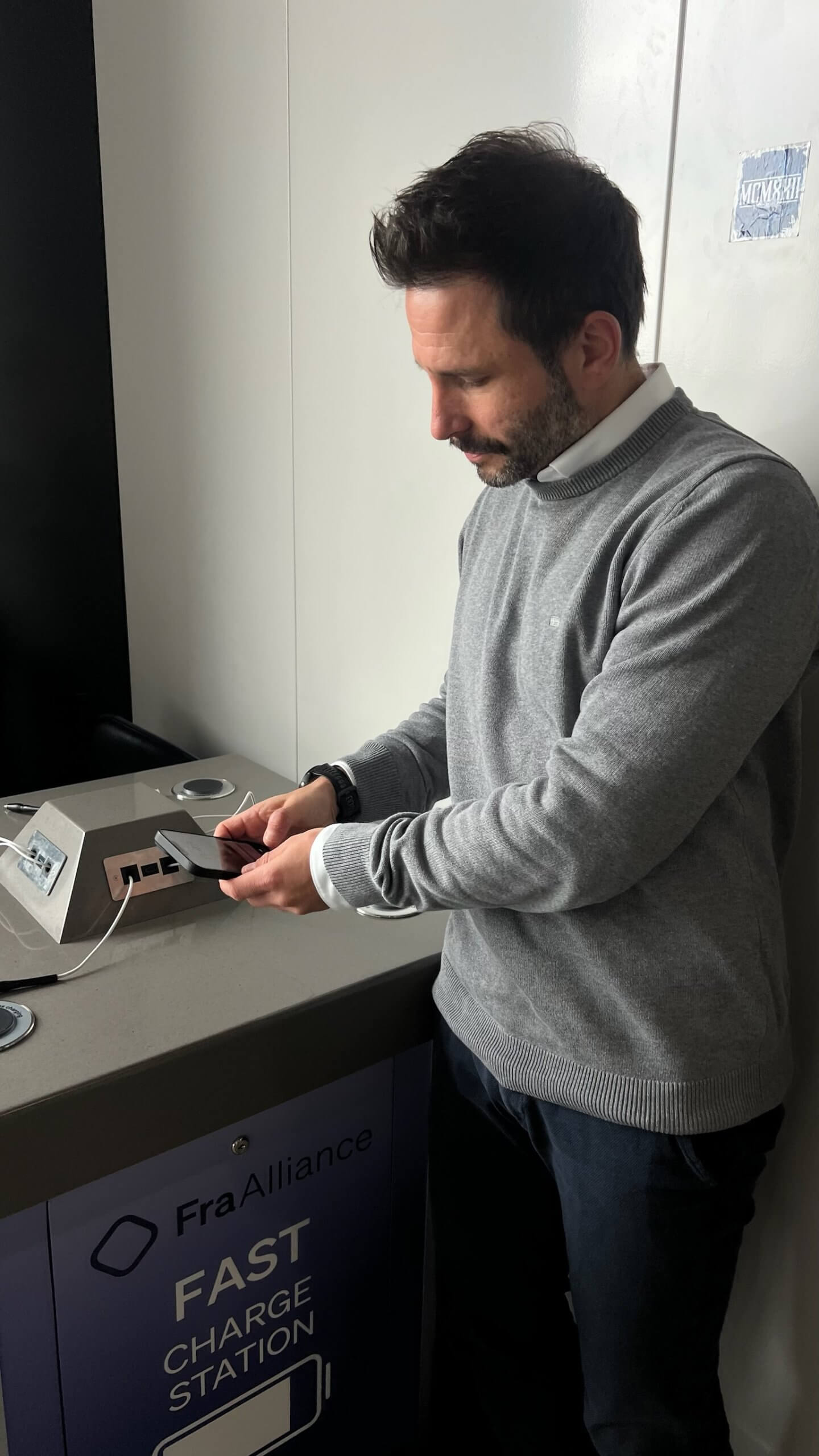
The project introduces ChargeBox’s FastHub technology, a connected, data-led charging platform designed for airports. Each FastHub provides direct-to-device USB Fast Charging via reinforced USB-C and Apple Lightning cables, USB sockets, and Qi2 fast wireless pads, delivering up to 25% battery life in just ten minutes with the latest phone models.

Fast charging podium at Frankfurt Airport
Charge Faster. Score Higher.

Improving the passenger experience
Frankfurt's new initiative directly addresses passengers' calls for even more reliable and user-friendly charging solutions, even though the airport already offers a wide variety of options that have been significantly expanded in recent years. This aligns with ACI EUROPE’s 2024 passenger digitalisation survey, which identified charging as a top infrastructure passenger need. In general, passengers don’t just want more power points, they want charging that’s fast, dependable and always available.
“Our passengers rely on their devices throughout the journey,” said Manuel Wiesner, Leader Consulting & Strategy at Frankfurt Airport.
“FastHub’s real-time fault detection allows us to see and resolve issues promptly, improving availability and saving operational time.”
Each FastHub seamlessly connects to ChargeBox’s cloud-based monitoring platform, delivering real-time insights into usage and performance. While usage data enables strategic long-term capacity planning, the true innovation lies in real-time fault detection and remote diagnostics, enabling proactive maintenance and ensuring consistently high service availability.
“The ACI EUROPE report echoes what Frankfurt’s own feedback revealed, passengers expect reliable charging that actually works,” said Ian Hobson, CEO of ChargeBox. “Our advanced systems deliver fast, direct-to-device charging for all devices, with real-time fault detection ensuring the highest service availability levels can be maintained efficiently. That’s how airports can raise satisfaction, improve Skytrax and ASQ scores, while cutting operational costs. At Heathrow and Dublin, we’ve seen just how much passengers appreciate great charging with hundreds of positive comments received through QR feedback.”
By focusing on availability, reliability and intelligent management, the Discovery Project showcases how smart, connected Charging-as-a-Service (CaaS) infrastructure can enhance the passenger experience and streamline airport operations.
This six-month pilot, running through early 2026, will deliver results that shape Frankfurt Airport’s long-term digital infrastructure and customer-experience strategy.
For more information on our scalable charging solutions for airports go to: www.chargebox.com
Heathrow Fast-Tracks ChargeBox Rollout to Power Stress-Free Passenger Experiences
News Release
London, September 18, 2025 – Heathrow Airport, the world’s most connected aviation hub, has announced the rollout of ChargeBox fast charging stations across Terminals 3, 4, and 5, following a highly successful trial in Terminal 2, which has converted the trial to a permanent deployment. 41 charging stations, each equipped with 16 fast-charging endpoints, give a 300% increase in mobile charging capacity compared with legacy facilities, with 75% of charging sessions achieving fast charge speeds (20%+ battery in 10 minutes). This technology is designed to support nearly 84 million annual passenger journeys through Heathrow.
The decision to accelerate the rollout after just four months of a six-month trial in Terminal 2, where ChargeBox upgraded six existing charging poles, achieved near-100% uptime with zero Heathrow support interventions and minimal hardware replacements, was driven by compelling data and overwhelmingly positive passenger feedback.

Chargebox powers passenger experience at Heathrow
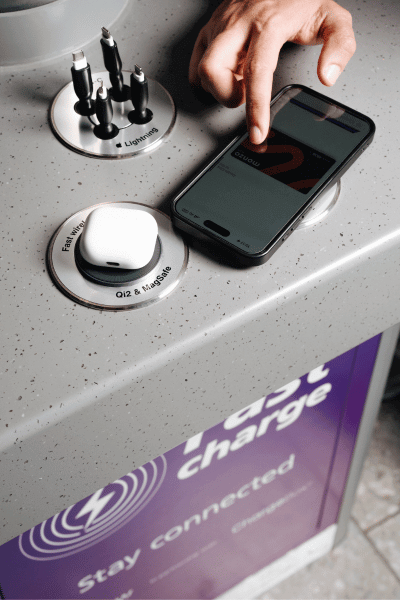
Qi2 wireless pads

Elevating the passenger experience
Now deployed across all terminals, the 41 FASTPodiums are delivering over 7,000 charges daily — equivalent to more than 2.5 million annually. The highest-performing unit, located in Terminal 2 Departures, recorded 2,486 charges in a single week — averaging 355 per day. Passenger behaviour shows a clear preference for direct-to-device charging, with 9 in 10 passengers opting for ChargeBox’s specially reinforced cables or Qi2 wireless pads. Of those, over 70% choose the high-performance USB-C and Lightning cables, delivering nearly three-quarters of all charging minutes to date — a clear sign that users prefer cables, and that they deliver the fastest, most intuitive and hassle-free experience for passengers on the move.
ChargeBox’s innovative Charging as a Service (CaaS) model delivers scalable, smart solutions that provide real-time insights into passenger charging habits, enabling Heathrow to optimise infrastructure and elevate the passenger experience. Automated fault detection eliminates time-consuming inspection processes, enhancing passenger experience while reducing service demands.
Addressing Digital Friction and Boosting Passenger Satisfaction
The deployment aligns with findings from the ACI Europe Survey on the Impact of Digitalisation and Automation on the Passenger Experience, which revealed that while 73% of passengers rely on digital services, confidence drops to just 48% among those aged 55 and older, often due to low battery anxiety. Dependable phone charging was highlighted as a key concern affecting the overall travel experience. ChargeBox’s high-availability, fast charging stations directly tackle this challenge, reducing stress, boosting digital confidence, and supporting a more seamless, passenger journey.
ChargeBox forecasts over 2.5 million charges annually at Heathrow, helping the airport meet the needs of today’s digitally reliant travellers. Its smart charging stations feature real-time monitoring and predictive maintenance capabilities, ensuring maximum reliability and operational resilience. This consistently high performance is designed to contribute positively to Customer Experience (CX) scores for Heathrow.
Heathrow’s Chief Solutions Officer, Helen Elsby, said: “With the rollout of ChargeBox stations across a further three Heathrow terminals, we are pleased to offer even more to passengers with reliable, simple and fast charging services. By working closely with SMEs like ChargeBox, Heathrow drives innovation across the airport to enhance passenger experience and help us meet our service goals.”
“I believe airports should be places where technology quietly supports every journey. Charging is a small detail, but without it, the digital travel experience can break down.” said Ian Hobson, CEO and Founder of ChargeBox. “Our work with Heathrow shows that when you make something as simple as powering your phone effortless, you can remove a layer of stress for passengers. We’re building charging networks that airports can rely on for decades, and we’re excited to bring the same approach to new partners like Dublin and Frankfurt.”
Driving Innovation and Global Interest
ChargeBox’s smart charging stations, remotely managed with real-time fault detection, provide useful insights into passenger behaviour, informing future infrastructure strategies. The success at Heathrow has sparked interest from airports worldwide, positioning ChargeBox as a pioneer in passenger charging solutions.
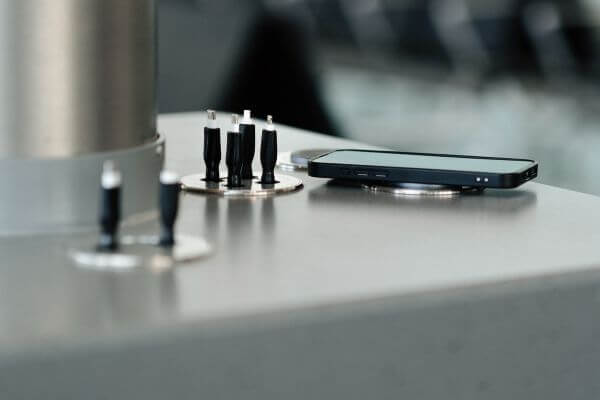
Qi2 wireless charging at Heathrow Airport

ChargeBox FastPodium at Heathrow Airport
About ChargeBox
ChargeBox is the global leader in self-service mobile device charging for public spaces, offering a unique Charging as a Service (CaaS) model with a digital-first approach. We design, build, and install high-availability, direct-to-device charging systems that keep people connected, satisfied, and digitally empowered.
With over 20 years of experience and more than 80 million charges delivered worldwide, ChargeBox provides the simplest, fastest, and most reliable charging experience — trusted by airports, hospitals, retailers, universities, and event operators around the globe.
Our connected solutions feature real-time monitoring and remote management, ensuring unmatched service availability while helping clients boost customer satisfaction, reduce operational burden and accelerate their digital strategies.
Learn more at www.chargebox.com
About Heathrow
Heathrow is the UK’s international gateway and the largest airport in Europe – connecting to 230 destinations across 85 countries. The airport welcomes over 200,000 passengers on roughly 1,300 flights each day, and serves as Britain’s hub for trade, tourism and investment. Over 80,000 colleagues work at Heathrow – the airport directly employs about 10% of them, with the rest working for Team Heathrow partners, including airlines, ground handlers and retailers.
How much energy does a Chargebox consume?

We get asked this question frequently because decision-makers are keen to understand the energy cost of operating a charging service and the sustainability of our products. With recent energy price hikes, it’s an important consideration when planning which type of charging service to install.
The good news is that even a heavily used ChargeBox isn’t going to make much of a difference to your energy bills. This is down to two key factors – first, we’ve chosen very low-power components to keep ChargeBox operational and managed, which means most of the energy used is actually to charge devices. The second factor is that charging a device – even a tablet or laptop – requires surprisingly little energy compared to activities such as boiling a kettle.
Remember also that providing a charging service isn’t necessarily increasing your electricity consumption. For example, if sockets are available to visitors, passengers, customers, staff, etc., they will charge their devices ad-hoc. So, ChargeBox is replacing this usage with a highly efficient and safely managed charging infrastructure. This can also lead to a reduced requirement to provide power sockets with reduced installation, repair, and management costs, resulting in reduced capital and operating expenditure.
Depending on the product, a single Chargebox uses just one 13A socket to power between 3 and 8 simultaneous charges. Multiple units can even use the same single socket if placed close together. So it’s an energy win-win!
Energy usage of ChargeBox Vs Other electrical items
Our largest ChargeBox model is our FAST6 (6-locker) charging station for fast-charging phones and devices. Based on 100 uses daily of 20 minutes average charge, with an average power of 20W – and allowing for the large advertising screen on the unit, here are the following comparisons:
- Boiling a kettle just 5 times in one day consumes more energy and creates more emissions than the FAST6 does in a complete day of operation.
- The electricity used to charge a typical large EV to 100% just ONCE consumes more electricity than 73 ChargeBox FAST6’s in high usage – equivalent to charging 7,300 devices!
- Having just 10 x 10W LED lights (the most efficient ones) on in your office consumes TWICE as much electricity daily as a ChargeBox FAST6 charging 100 devices.
- The average UK driver emits more CO2 in a day than 24 x ChargeBox FAST6 units charging 2,400 devices.
- A single high-power ElectricVehicle supercharger (e.g. at 150kW) uses more electricity in just 21 days than our 300-station UK fleet in a year, which can easily charge up to 5 million devices to 40% battery.
With customers increasingly dependent on their devices, and the reducing dependence on carbon-intensive activities this brings, it’s time for companies to unleash the power of offering a world-class charging service.
Device charging should be an essential part of the customer experience rather than encouraging ad-hoc plug socket hoarding!
Over and Out,
Upgrading Your Event Experience With A Phone Charging Station
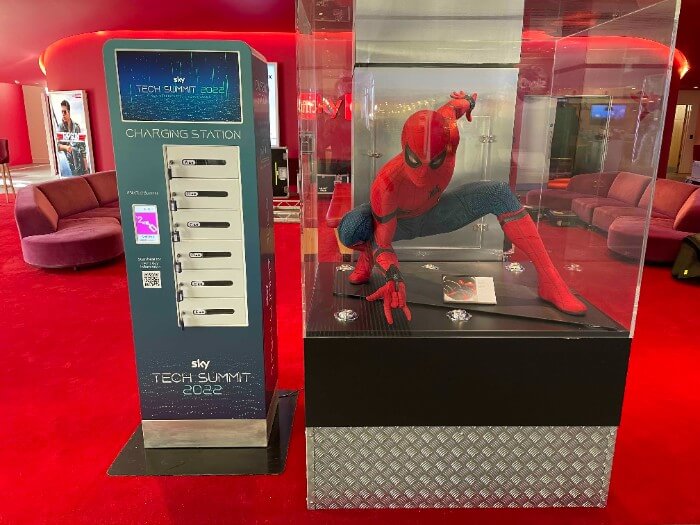
Free phone charging is an essential addition to any event, providing attendees with the opportunity to stay connected and make the most of their experience. Running out of power can cause major anxiety and frustration for guests. When device batteries are low, attendees may become disconnected from the event and ultimately leave before they’ve had a chance to enjoy it fully.
Providing easy access to free charging capabilities creates a feeling of convenience for your guests and enhances their overall experience by removing potential stress or worry about battery life.
Mobile devices have become indispensable tools
Mobile devices have become indispensable tools for staying connected, both in our private lives and in business. They allow attendees to navigate their way around the venue easily with app maps or GPS; they give quick access to tickets, loyalty cards, and other digital passes; they enable event goers to stay up-to-date with live event news, updates and offers; and of course, they let people engage in conversations with their peers by sharing photos, videos and thoughts on social media.
At events, mobile device batteries can run down quickly as attendees take advantage of all the features they offer. If battery levels become too low it can inhibit the full enjoyment of a particular event experience.
Fast Charge is essential for the event experience
Offering Fast Charge at events greatly enhances the experience for many attendees. By incorporating USB 3.1 Power Delivery technology, device batteries can charge up to 2-4 times faster than traditional methods, decreasing wait times and allowing users to spend more time enjoying the event instead of waiting for their phone to charge.
This revolutionary technology can also dramatically increase service availability. By decreasing the amount of time needed to use a charger, more attendees can access the phone charging station and have their phones charged in a shorter period of time. This can be a huge benefit for event organisers who want to maximise the event experience for all of their guests.
Fast Charge is the perfect way to provide a reliable phone charging service and make sure that everyone can power up their device in no time.
A charging station is a great way for sponsors to be involved
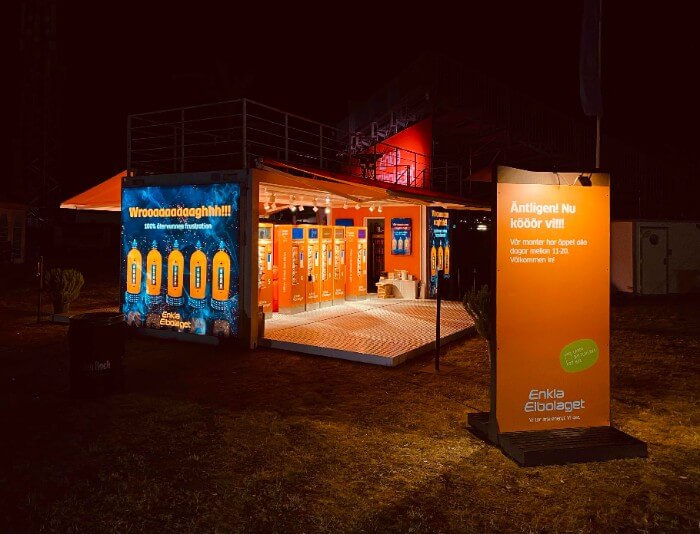
Phone charging stations offer a unique solution to both boost event engagement and provide convenience to guests. They can also be used as a platform to strengthen the brand presence of sponsors or partners. They effectively turn phone charging into an immersive experience with customised vinyl wraps and digital screens ensuring that companies remain visible throughout the event.
This can go a long way in creating an unforgettable experience for your guests while offering them an invaluable source of convenience. Allowing companies to take advantage of this valuable service helps to create a halo effect around their brand, further increasing loyalty and improving overall event success.
What’s the right charger for me?
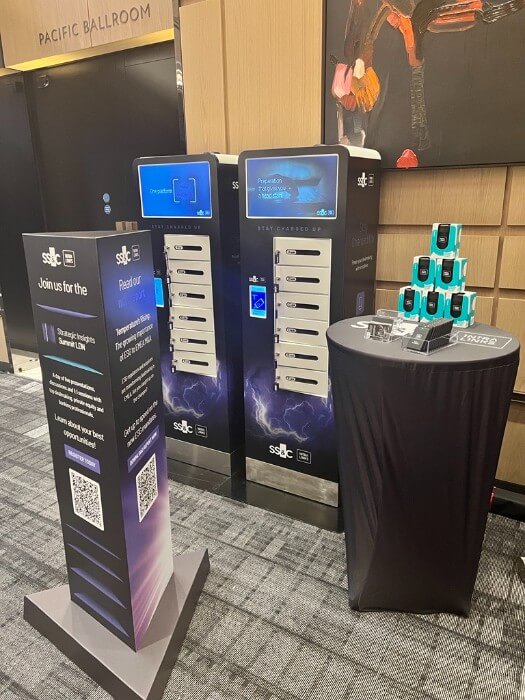
When selecting a solution, there are a number of options to consider. From ‘Lock and Leave’ solutions that allow users to safely leave their mobile phone to charge while they get on with their day, to ‘Stay and Charge’ solutions that enable people to charge their devices while still using them, you’ll have no trouble finding the perfect mobile phone charging for your needs.
What else is important when considering mobile phone charging stations?
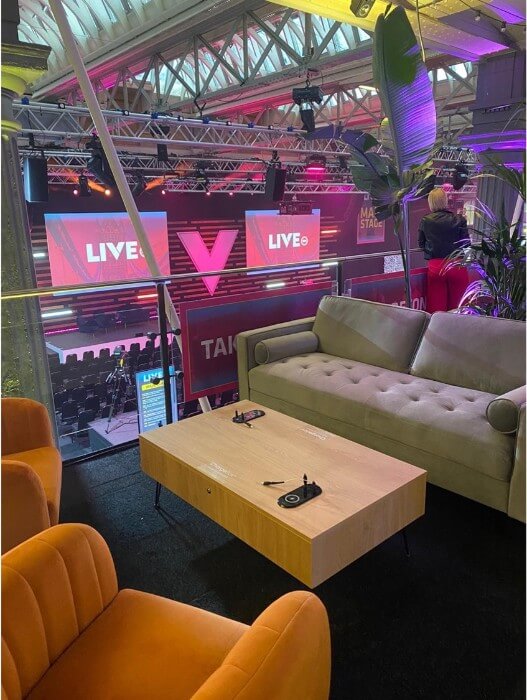
In addition to choosing the right phone charging station for your event, you should also factor in how many are needed and where they should be located. Make sure that charging services are placed near seating or areas of high traffic so attendees can easily access them throughout the event.
Moreover, ensure that these chargers boast reliable security features such as remote management capabilities and fault detection protocols to provide maximum protection for users. With this in mind, selecting the right phone charger will prove invaluable in ensuring a great event experience for your guests and peace of mind for yourself!
Other considerations when choosing charging stations
To ensure that devices are safe, it is important to use phone charging stations manufactured by a reputable company with stringent safety protocols in place. Additionally, phone charging stations should have real-time monitoring systems installed so that potential problems can be identified and dealt with immediately.
Furthermore, services should have multiple layers of encryption in order to safeguard user data from any malicious activity. Finally, having an onsite technician present who is skilled in resolving technical issues related to device charging will help maintain a smooth event experience for event-goers.
Phone charging solutions, an essential service
In conclusion, free phone charging solutions can be a great addition to any event as they provide convenience and peace of mind.
When selecting phone charging solutions for your event, make sure you factor in the type of phone charger needed, where it should be located and the security features that need to be implemented.
Fast-Charge phone chargers are perfect for events requiring shorter wait times and higher service availability. Something to watch out for! Choose reputable companies with stringent safety protocols in place when it comes to device charging where public liability is a consideration.
If you would like help finding the right phone charging solution for your next event, then drop us a message! We’d love to hear more about your vision and help make it a reality.
Fast charging and protecting your smart phone’s battery life.
Do you want to charge your smart phone safely and keep the battery life good for as long as possible?
Are you surprised at how slowly your smart phone appears to charge sometimes?
Are you confused by the different cables and chargers around?
If you answered yes to just one of these, you’ve come to the right place…
Your smart phone’s Lithium-Ion battery is an incredibly sophisticated component that has evolved to supply reliable power for much of the day, safely, and for an extended lifetime of 1,000 charges.
Over those 1,000 charges, your battery will start to deteriorate and not yield the life it had when it was new.
A key way to reduce that degradation is NOT to charge it past 80-90% if you don’t have to and ideally keep it above 10-20%. This may mean charging it twice daily to keep it in that range and skipping overnight charging to 100%.
Like most people, you’ve probably got several chargers you’ve received with smart phone purchases over the years.
If you’re still using the charger that came with a smartphone just a few years ago, you need to change it!
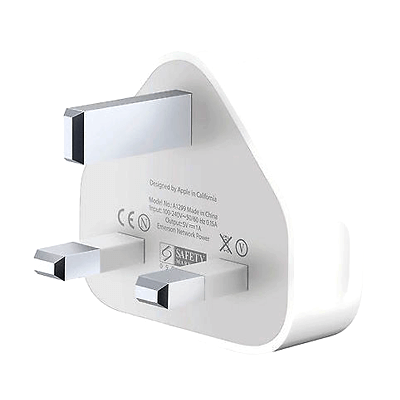
👈 If you are using one of these to charge your iPhone 8 onwards, it’s only providing between 18-30% of the power your smart phone needs.
In other words, your smart phone could be charging up to five times slower than it’s capable of. 😳
Why Battery Size Matters
Smart phones now have 3-4X more battery capacity than just a decade ago. You may not have noticed the change as it has been a gradual change in line with smart phones getting thinner. While some of that capacity provides better battery life, more is used because smartphones now have giant screens and are more power-hungry. What could charge a smart phone a decade ago will only give you a fraction of the power needed now.
To understand if your smartphone is getting a meaningful charge, you should measure it in terms of the % battery boost in a particular timeframe, e.g. 0-50% battery in 30 minutes.
Using an old charger with your new smartphone may take over 2 hours to get a meaningful charge. Of course, that’s not a lot of use when you’ve only got 10 minutes to get out of the house.
So what’s the answer?
Faster charging. The first iteration was QuickCharge from Qualcomm. This allowed slightly quicker charging using the micro-USB cable. However, it was proprietary and generally limited to specific Android devices that used Qualcomm components (by no means all). Plus, it was limited to the inferior micro-USB cable, which breaks easily.
Now USB is leading the way in providing fast charging standards developed and agreed upon by a cross-industry group, including leading vendors such as Apple, Samsung, and Google, as well as chip companies such as Intel and Texas Instruments.
They developed a better cable ending – USB-C – and the next-generation USB charging technology known rather boringly as USB Power Delivery (PD). It’s now considered the only true Fast Charge technology for smart phones, which is also compatible with laptops and tablets.
How does USB PD work in the simplest terms?
Well, it’s actually quite straightforward. Power, measured in Watts, is simply Volts multiplied by Amps. So, with old USB charging, you might have between 5W and 12W of power (at best). But with USB PD, chargers can go all the way to 100W – over 8 times more power or 20x more power than the typical 5W chargers many people still use! (Remember that Apple charger above?)
Most smart phones today charge in the 20W-45W bracket, so a PD charger offering anywhere from 20W to 45W is good enough. But if you use a higher power charger made for a larger laptop or tablet, that’s even better. Of course, you don’t need a 100W USB PD charger, but neither will it do any harm.
USB PD continues to develop and is being stretched to 240W of power in the next generation. This could permit e-bike/e-scooter or power tool batteries to be charged while also permitting charging some of the largest laptops or powering small desktops.
Qualcomm has adopted USB PD in its QuickCharge4 standard, meaning devices supporting QC4 will also support USB PD chargers. In addition, Apple’s Lightning cable (with a USB-C adapter on the charger end) also supports USB PD chargers.
Am I using USB PD Fast Charge today?
If your charger has a USB-C port, it may be USB PD, but not definitively. If you can find the specs, look for USB PD to be mentioned and voltage levels other than 5V (e.g. 9V) and/or power of 18W or more.
If your charger has a USB-A socket, it is definitely NOT a USB PD fast charge charger. And just because your smart phone has a USB-C socket does NOT mean it’s a smart phone capable of USB PD Fast charging.
And finally.
We’ve not discussed loads of geeky terms here, such as Wh, or mAh but it is REALLY useful to understand a very simple relationship. Watts = power. A Wh or Watthour is simply the amount of power that can be sustained for one hour – so you can be a powerful runner with a quick sprint, but a one-hour run is the power you can maintain for one hour – “energy”.
In electrical terms, there are two key components that make up power; Volts and Current (amps). Multiply the two, and you get the Watts. Maintain that for one hour and you get Watthours. So, 5V * 1A = 5 Watts. Maintain that for 1 hour and you get 5Wh of energy – a smartphone that runs at 1Wh will get you 5 hours of usage.
So there it is. Fast charging in a nutshell.