What are the risks of public phone charging?
This month the FBI warned that using public charging may put your data at risk but what are the REAL risks of using public phone charging?
ChargeBox has provided secure charging solutions for public use since 2005. We are privileged to partner with many of the world’s best-known retail, education, public transport, healthcare and event organisations.
We have never experienced a breach of our users’ data in all that time with over 55 million charges provided!
So let’s look at what we know about public charging stations and the risks you need to be aware of when using one.
What is Juice-Jacking?
“Juice Jacking” is a cyber-attack where a hacker gains unauthorised access to a device such as a smartphone by compromising the USB port. Once malware is installed on a device, it can perform various malicious actions, such as stealing sensitive data, track user activity, or even give hackers remote access to the device.
OMG, that sounds scary. Does it happen a lot?
No, it doesn’t. It’s unclear how common these attacks are; any instances have not been widely publicised. The risk was first identified in 2011, so it’s not a new threat.
So, the risk of it happening is extremely low?
The risk of ‘Juice Jacking’ is infinitely small. However, your safety and access to essential phone capabilities are at risk if your battery is low or out of power. These risks are far higher than the danger of having your device hacked.
So are public charging solutions safe?
It’s not possible to say, with absolute 100% certainty, that ALL public charging solutions are safe but as with most things in life, it’s up to the individual to make informed decisions.
That makes sense. Can I limit the likelihood of this happening to me?
It’s important to practice good cybersecurity habits. Here’s what we recommend:
- Always keep your device up-to-date with software updates, especially security updates. This is your first level of protection against any form of attack on your device in any situation.
- Once software updates are no longer available due to the age of your device, you should consider getting a newer device.
- If you are using a public charging solution, where are you? If you’re in a location managed by a respectable company, you can expect that company to have procured a safe & secure solution that can’t be tampered with.
- If you’re unsure who is providing a solution, look for a name and a website. Check the origins of the equipment, the company, and its data and device security pledges.
What precautions does ChargeBox take to ensure the safest and most secure charging experience?
- Our charging solutions, including electronics and firmware, are designed and manufactured in the UK. We use our own software to control our solutions with the highest levels of security in mind.
- We are governed by national laws in the countries we operate, and our business depends on our end users having a great experience and our clients who host ChargeBox giving a great experience to their visitors.
- ChargeBox solutions are connected securely to our servers, giving us precise information about operational levels and recording the safety of the charge.
- The charging components and cable endings we use are all securely locked so they are not accessible to third-party agents without evidence of tampering.
Isn’t this all a storm in a teacup? Surely the FBI has got more significant cybersecurity concerns to deal with?
Yes! It distracts from device and data safety dangers for which the FBI has been notably absent – namely, the sophisticated malware attacks aided by systems such as Pegasus and others.
Finally, out of interest, what data does ChargeBox access?
Our users’ data privacy is a fundamental aspect of our business model and company ethics. For complete details of your data privacy with any interactions with our stations or our company please visit:
https://www.chargebox.com/your-data-privacy-with-chargebox/
Thanks for reading!
A Blaggers guide to Fast Charge

Your questions answered.
All iPhones, since iPhone 8, and most Samsung or Google phones, have the latest USB PD Fast Charge standard in their hardware. But what is Fast Charging, and why should you care?
What is Fast Charging?
The technical name is USB 3.1 Power Delivery. The people-friendly term is “Fast Charge”, meaning you can charge your device at speeds up to 100W. In short, you can receive up to 50% phone charge in just 30 minutes!
So, if you’re stuck at an airport and thinking, “Yikes! I’m going to run out of battery before retrieving my electronic boarding pass!” – you’d be in luck if you had Fast Charging nearby, as you could get a 10% battery charge in about 5 minutes!
BUT unfortunately, public spaces are still behind the times in providing Fast Charging and most are yet to offer a reliable charging solution at all.
Do I need any specific equipment for Fast Charge?
Fast charge requires three components – a compatible phone/tablet/laptop or other devices, a charger that supports USB Fast Charge, and a compatible cable. The cable will need to have USB-C at least on the charger end and USB-C or Apple Lightning at the device end. Your device will need a Fast Charge system or a USB-C socket branded as Fast Charge for you to use your own cable at public charging solutions.
Can devices with Micro-USB use Fast Charge?
No, only devices with USB-C or Apple devices since 2017 with Lightning can use Fast Charge.
Isn’t wireless charging quick and better?
Wireless requires you to place your phone precisely on a wireless charging pad to get the best performance unless you use something like Apple’s MagSafe wireless charger. Fast Charge cabled charging is still 2-4 times faster and is more reliable. Wireless is better than nothing and fine for overnight charging, but not ideal for public charging when you want maximum charge in a short timeframe.
Is Fast Charge safe?
All modern devices control the power input to suit the devices’ battery characteristics. Manufacturer testing ensures the device takes the right amount of power at different battery charge levels to maximise the safe charge rate while maintaining long-term battery health. When phones go beyond 80-90% charge, they charge much more slowly, as this is when the phone will deliberately slow down the charge rate to protect battery longevity.
Can you only Fast Charge phones?
Many tablets (including all newer iPad models) support a higher level of fast charging. For example, iPads may use up to 30W, three times faster than the old base charger in the box or 1.5 times faster than the charger that ships with the iPad Pro. Of course, many laptops also support Fast Charging using USB-C cables.
I don’t have one of the big brand handsets, but I thought I already had Fast Charge.
You might do if it’s a less well-known Chinese brand, but it’s likely not using the international standard set by the USB Implementers Forum. Unfortunately, this means you will not benefit from public Fast Charging systems, and the technology’s proprietary nature might not hit all the safety standards.
So where could I charge my phone in a hurry when I’m out and about?
Look for USB-C plug points and charging stations with Fast Charge installed. Public spaces like shopping centres and airports have charging stations, but very few have adopted this technology. They will need to start investing in it soon because there will be demand from the public. If you find the charging facilities don’t cater for it, then ask for it. In the meantime, all new ChargeBox public charging solutions provide USB PD Fast Charge charging at up to 60W per cable, hugely outperforming any other public charging solutions we’ve encountered globally.
For more information on any of the Fast charge solutions we can offer your business, event or location – simply get in touch. We’d love to hear from you!
The ChargeBox Team
How much energy does a Chargebox consume?

We get asked this question frequently because decision-makers are keen to understand the energy cost of operating a charging service and the sustainability of our products. With recent energy price hikes, it’s an important consideration when planning which type of charging service to install.
The good news is that even a heavily used ChargeBox isn’t going to make much of a difference to your energy bills. This is down to two key factors – first, we’ve chosen very low-power components to keep ChargeBox operational and managed, which means most of the energy used is actually to charge devices. The second factor is that charging a device – even a tablet or laptop – requires surprisingly little energy compared to activities such as boiling a kettle.
Remember also that providing a charging service isn’t necessarily increasing your electricity consumption. For example, if sockets are available to visitors, passengers, customers, staff, etc., they will charge their devices ad-hoc. So, ChargeBox is replacing this usage with a highly efficient and safely managed charging infrastructure. This can also lead to a reduced requirement to provide power sockets with reduced installation, repair, and management costs, resulting in reduced capital and operating expenditure.
Depending on the product, a single Chargebox uses just one 13A socket to power between 3 and 8 simultaneous charges. Multiple units can even use the same single socket if placed close together. So it’s an energy win-win!
Energy usage of ChargeBox Vs Other electrical items
Our largest ChargeBox model is our FAST6 (6-locker) charging station for fast-charging phones and devices. Based on 100 uses daily of 20 minutes average charge, with an average power of 20W – and allowing for the large advertising screen on the unit, here are the following comparisons:
- Boiling a kettle just 5 times in one day consumes more energy and creates more emissions than the FAST6 does in a complete day of operation.
- The electricity used to charge a typical large EV to 100% just ONCE consumes more electricity than 73 ChargeBox FAST6’s in high usage – equivalent to charging 7,300 devices!
- Having just 10 x 10W LED lights (the most efficient ones) on in your office consumes TWICE as much electricity daily as a ChargeBox FAST6 charging 100 devices.
- The average UK driver emits more CO2 in a day than 24 x ChargeBox FAST6 units charging 2,400 devices.
- A single high-power ElectricVehicle supercharger (e.g. at 150kW) uses more electricity in just 21 days than our 300-station UK fleet in a year, which can easily charge up to 5 million devices to 40% battery.
With customers increasingly dependent on their devices, and the reducing dependence on carbon-intensive activities this brings, it’s time for companies to unleash the power of offering a world-class charging service.
Device charging should be an essential part of the customer experience rather than encouraging ad-hoc plug socket hoarding!
Over and Out,
What is Qi2 Wireless Charging?
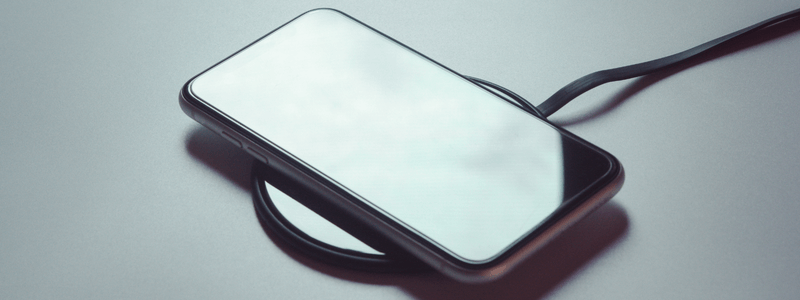
Did you know that wireless charging has been around for ten years already? Time races, and we all adapt to new technology, changing how we maintain our devices without even thinking about it.
But do you charge your phone wirelessly most of the time? Probably not.
That’s because wireless charging is not the best experience compared to a cable, but is that about to change?
The Wireless Power Consortium (WPC) has this month announced an update to Qi wireless charging, revealing that the new Qi2 (pronounced ‘chee two’) will launch later in 2023. Compatible devices will also become available before the year’s end.
Great news for consumers because it helps address the current issues with wireless charging and will ultimately open up the way for broader adoption of wireless charging.
So how long before we don’t need cables at all to charge our phones?
Qi2, based on Apple’s MagSafe technology, uses a series of magnets to create a magnetic connection. A phone perfectly aligned with the charging device will receive improved energy efficiency and faster charging. Result!
For this to make more sense, it helps to understand how wireless charging works.
Inside every wireless charger is a coil of copper wire. When an electric current passes through the coil, it generates a magnetic field. Phones that support wireless charging also include a coil inside their back casing. Placing your phone on a wireless charging pad induces an electric current to the phone’s coil, and then charging begins.
Problems occur as soon as you increase the distance between the two coils. Moving the coils vertically or horizontally away from each other results in a loss of energy and reduced charging speed.
Qi2’s magnets solve this problem by aligning the transmitter and receiver coils almost perfectly. This results in a more consistent charge (you won’t easily knock your phone off the charger) and is less destructive to your phone. This is because any lost energy during wireless charging converts to heat which can impact long-term battery health.
The WPC says that Qi2 will have “faster charging for some devices” and could enable “significant future increases in wireless charging speeds that are safe and energy efficient.” That means more than the current 15-watt maximum of Qi and MagSafe.
The million-dollar question is, how long will it be before we receive the same 25-watt plus charge that a cable can provide?
A dramatic improvement in wireless charging could present the opportunity to eliminate ports from phones completely. That would reduce production costs, free up a tiny bit of valuable space in our phones for something else and improve water resistance.
Exciting times are ahead for phone innovation but much depends on how Qi2 is implemented and the market reaction.
We always believed that Apple® MagSafe was a superior wireless charging technology and that’s why it’s already integrated into all our wireless solutions. Boom!
The ChargeBox Team
Upgrading Your Event Experience With A Phone Charging Station
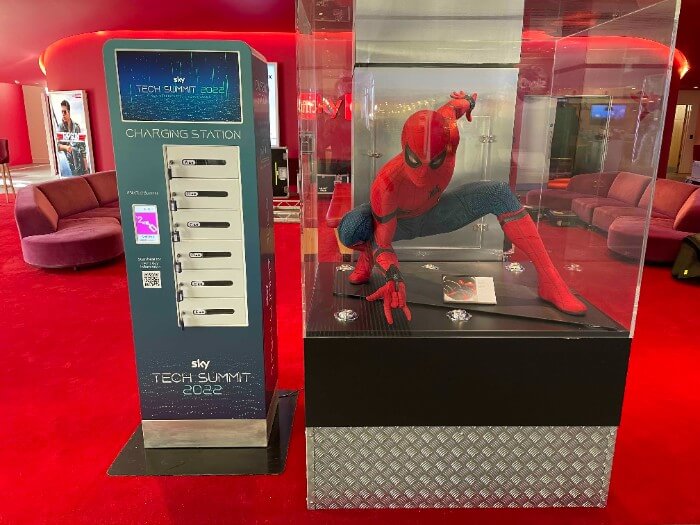
Free phone charging is an essential addition to any event, providing attendees with the opportunity to stay connected and make the most of their experience. Running out of power can cause major anxiety and frustration for guests. When device batteries are low, attendees may become disconnected from the event and ultimately leave before they’ve had a chance to enjoy it fully.
Providing easy access to free charging capabilities creates a feeling of convenience for your guests and enhances their overall experience by removing potential stress or worry about battery life.
Mobile devices have become indispensable tools
Mobile devices have become indispensable tools for staying connected, both in our private lives and in business. They allow attendees to navigate their way around the venue easily with app maps or GPS; they give quick access to tickets, loyalty cards, and other digital passes; they enable event goers to stay up-to-date with live event news, updates and offers; and of course, they let people engage in conversations with their peers by sharing photos, videos and thoughts on social media.
At events, mobile device batteries can run down quickly as attendees take advantage of all the features they offer. If battery levels become too low it can inhibit the full enjoyment of a particular event experience.
Fast Charge is essential for the event experience
Offering Fast Charge at events greatly enhances the experience for many attendees. By incorporating USB 3.1 Power Delivery technology, device batteries can charge up to 2-4 times faster than traditional methods, decreasing wait times and allowing users to spend more time enjoying the event instead of waiting for their phone to charge.
This revolutionary technology can also dramatically increase service availability. By decreasing the amount of time needed to use a charger, more attendees can access the phone charging station and have their phones charged in a shorter period of time. This can be a huge benefit for event organisers who want to maximise the event experience for all of their guests.
Fast Charge is the perfect way to provide a reliable phone charging service and make sure that everyone can power up their device in no time.
A charging station is a great way for sponsors to be involved
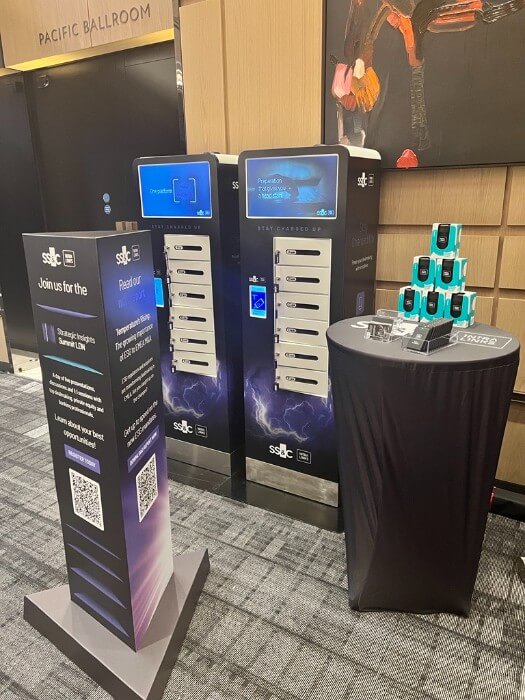
Phone charging stations offer a unique solution to both boost event engagement and provide convenience to guests. They can also be used as a platform to strengthen the brand presence of sponsors or partners. They effectively turn phone charging into an immersive experience with customised vinyl wraps and digital screens ensuring that companies remain visible throughout the event.
This can go a long way in creating an unforgettable experience for your guests while offering them an invaluable source of convenience. Allowing companies to take advantage of this valuable service helps to create a halo effect around their brand, further increasing loyalty and improving overall event success.
What’s the right charger for me?
When selecting a solution, there are a number of options to consider. From ‘Lock and Leave’ solutions that allow users to safely leave their mobile phone to charge while they get on with their day, to ‘Stay and Charge’ solutions that enable people to charge their devices while still using them, you’ll have no trouble finding the perfect mobile phone charging for your needs.
What else is important when considering mobile phone charging stations?
In addition to choosing the right phone charging station for your event, you should also factor in how many are needed and where they should be located. Make sure that charging services are placed near seating or areas of high traffic so attendees can easily access them throughout the event.
Moreover, ensure that these chargers boast reliable security features such as remote management capabilities and fault detection protocols to provide maximum protection for users. With this in mind, selecting the right phone charger will prove invaluable in ensuring a great event experience for your guests and peace of mind for yourself!
Other considerations when choosing charging stations
To ensure that devices are safe, it is important to use phone charging stations manufactured by a reputable company with stringent safety protocols in place. Additionally, phone charging stations should have real-time monitoring systems installed so that potential problems can be identified and dealt with immediately.
Furthermore, services should have multiple layers of encryption in order to safeguard user data from any malicious activity. Finally, having an onsite technician present who is skilled in resolving technical issues related to device charging will help maintain a smooth event experience for event-goers.
Phone charging solutions, an essential service
In conclusion, free phone charging solutions can be a great addition to any event as they provide convenience and peace of mind.
When selecting phone charging solutions for your event, make sure you factor in the type of phone charger needed, where it should be located and the security features that need to be implemented.
Fast-Charge phone chargers are perfect for events requiring shorter wait times and higher service availability. Something to watch out for! Choose reputable companies with stringent safety protocols in place when it comes to device charging where public liability is a consideration.
If you would like help finding the right phone charging solution for your next event, then drop us a message! We’d love to hear more about your vision and help make it a reality.
Should mobile phone charging be a free public service?

We all like something for free but what public services do we deserve to get for free and what should we pay for? If you are required to pay to use a toilet or to access WiFi in a public space, it can leave a bad feeling as the expectation is that these services should always be free. But what about public phone charging? Shouldn’t that be a free public service too?
When ChargeBox launched in 2005 the original idea was that people would happily pay less than the price of a cup of coffee to charge their phone. For the first few years, ChargeBox operated as a pay-to-use service. It wasn’t until a major mall operator approached us in 2011 asking for a free-to-use service for their shoppers, that everything changed.
When we launched our free-to-use service usage increased by over 2000% overnight. People love free phone charging!
Now over 95% of our charging locations are free to use.
But what’s right for your location?
Free to Use:
- Increases customer satisfaction and enhances the experience. Adds to your location’s positive brand identity.
- Facilitates charging at scale. More people using the service means that visitors dwell for longer and are likely to be happier and more satisfied by the ease of being able to stay connected.
- Greater ROI. 100 people using a free service will benefit you exponentially more (additional spending & goodwill) than the revenue 5 people will generate for you by paying for phone charging. (In our experience Pay to Use phone charge volume is ~ 5% of Free to Use phone charge volume.
- A service available to all without discrimination. Yes if people are really in need of a phone charge you could argue that they will pay for it. But what about the people who can’t afford it or have to prioritise what is most essential at that time?
- Less staff intervention is required. A paid service adds an additional layer of complexity to providing a service – more can go wrong.
Pay to Use:
- Limits anti-social behaviour. With payment required and an audit trail back to the user it discourages misuse e.g. kids congregating around a free service.
- Will generate a small direct revenue stream in certain locations, typically ones where people can’t or won’t leave easily e.g. hospitals, casinos and theme parks.
- When a location has zero budget it allows them to offer an essential service at little to no cost.
At ChargeBox we offer both Free to Use and Pay to Use services and ultimately the decision on what is best for your location is down to you. What links our free and pay-for services is that they are both the best charging experiences available.
- The fastest available phone charging. Three to four times faster charging than any alternative solutions.
- Simple and intuitive to use with minimal barriers to get charged up!
When you’re paying for a service these factors become even more critical.
Which service would you lean towards as a business owner? We’d love to hear your views.
Team Chargebox
Chargebox packs in a summer of sizzling events.
It’s been a hot busy Summer so far and we wouldn’t have it any other way.
We’re pleased to have been picked to provide charging services at many significant events this summer and it’s not over yet.
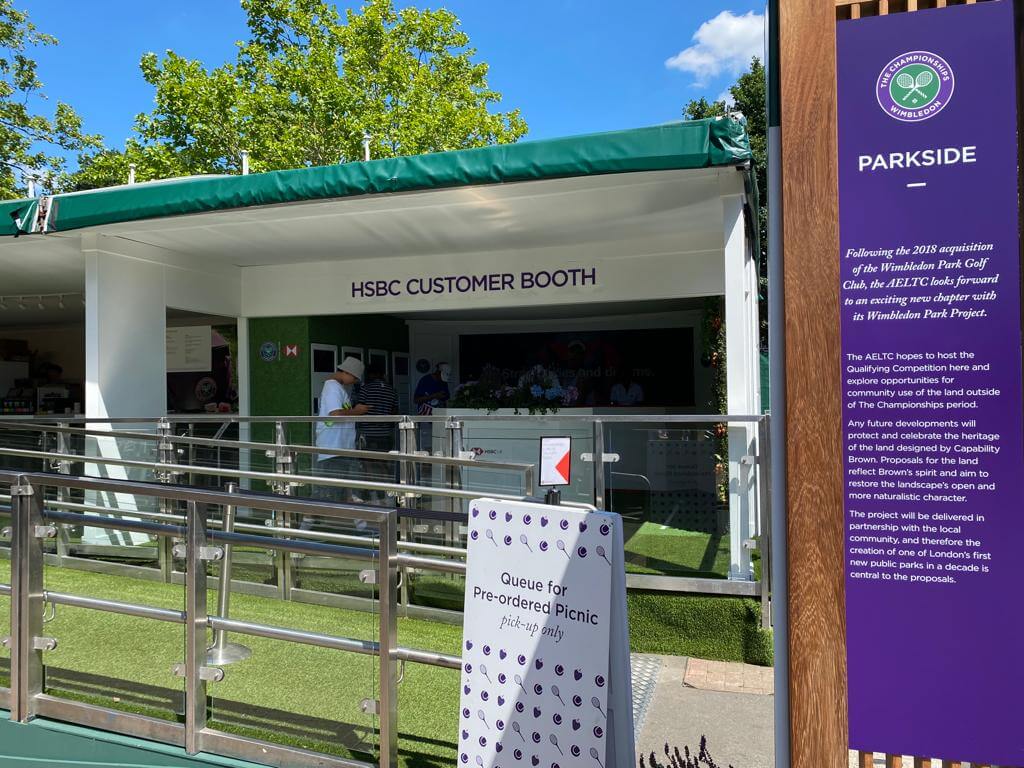
The season kicked off in the traditional style with our annual pilgrimage to SW19. We’re now in our 9th year of working with the tournament and it’s one of our favourite events to attend. HSBC created customer booths with free device charging to entice spectators. Usage of the service was up an incredible 33% this year from last year demonstrating that, like Emma Radacanu, our service proves to be a firm fan favourite.
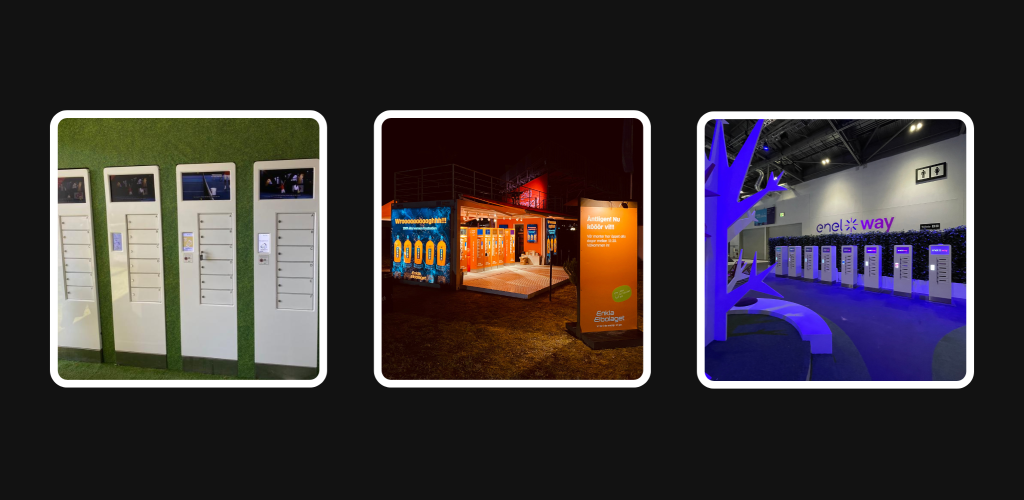
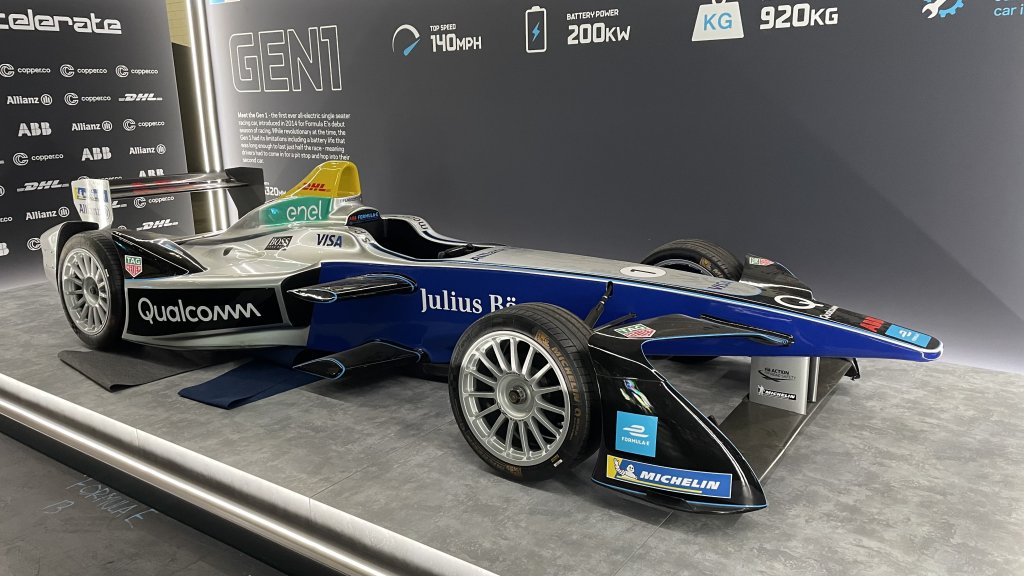
From a much-loved old client to a much-loved new one. A new major sporting event we are delighted to welcome to the fold is Formula E. According to the top driver, Antonio Felix da Costa, the event at Excel London this year was the best yet! Perhaps it was due in part to the fabulous Recharge zone in the Allianz E-Village 😂. Sponsors, enel x way created a perfect area to relax in, with plenty of comfortable seating, low lighting and eight ChargeBox Fast units. With the World’s fastest electric cars on show, this event absolutely had to have the world’s fastest phone charging too!
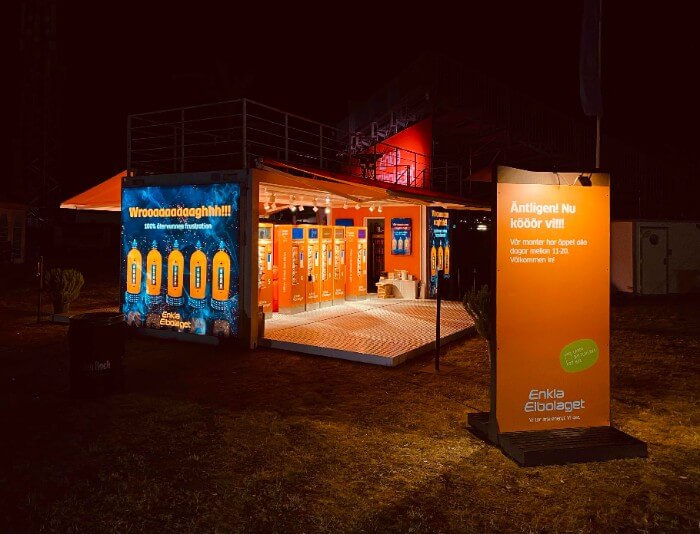
Over in Sweden, our partners at Paraply Production converted a shipping container into a charging zone, in order to provide an essential service at some of Sweden’s biggest music festivals. As part of an activation for utility company Enkla Elbolaget, they upgraded their charging service for 2022. Previously they operated a phone check-in, where staff would take customer phones and plug them in on shelves. This, however, was labour intensive and an organisational headache. ChargeBox’s simple, secure and intuitive lockers are completely self-service so festival goers can independently charge their phones up quickly and easily. Boom!
We’ve also been flying high this summer with some prestigious aviation events, attending both the Air Tattoo and the Farnborough Airshow. Like Wimbledon, the Farnborough Airshow is an event we’ve worked with for many years but post-Covid, we are enormously pleased to be back on the live events scene! Both shows had sponsors supporting their services, these being Raytheon Technologies and Lockheed Martin respectively. Sponsoring charging at events is great for awareness and brands also benefit from the halo effect of providing a useful free service. By securing sponsorship of the service, event partners provide an enhanced experience which negates costs and often makes providing charging, profitable.
Finally a mention of the British Summer Time Festival at Hyde Park. Our services were available to VIP guests of charity supporter Utopia. Just think of the pop royalty who could have used our service – Elton John, Adele, Mick Jagger? Alas, we didn’t get to see any of the gigs ourselves this year but hopefully, we’ll be back again next year to see some of the action!
We’ve had so many great events partners already this summer with more yet to come! Sorry if we didn’t mention your event with us this time.
Get in touch if you’d like us to mention you!
ChargeBox positively impacts the event experience for hundreds of thousands of fans, delegates and attendees. From business conferences to major sporting occasions, we’ll keep your attendees charged and connected.
ChargeBox at the NHS – Small Improvements That Make A Big Impact
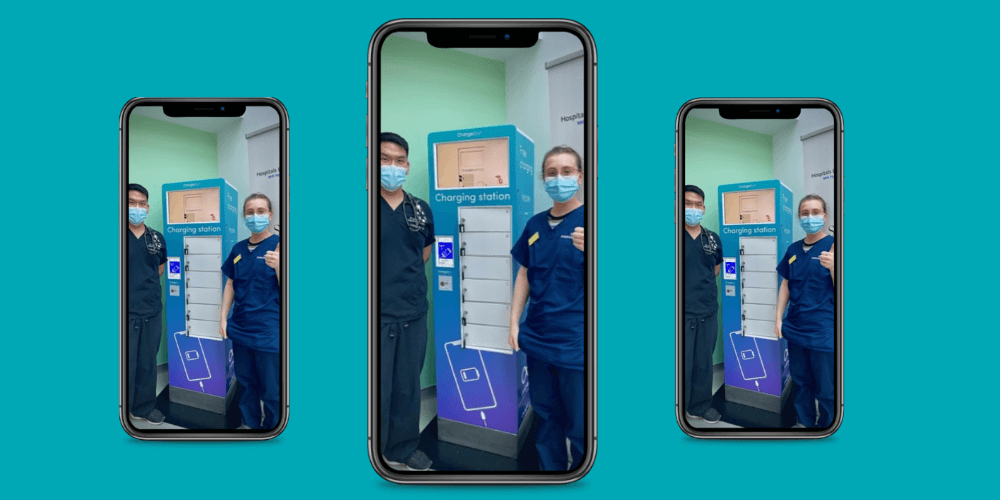
The hospital charity that funded the service tweeted about its arrival. 143 Retweets, 85 Quote Tweets and 1,369 Likes later, here are some of the highlights of those responses:
‘Great idea for the new ED build’. ‘Love this! We’ll definitely look at it’. ‘Great idea, something we can think about for @EDQEH1?’ ‘Look at this fab idea! 😍@StarsAppeal’. ‘Great idea for patients’. ‘Can we do this???’. ‘What an amazing idea! Well done.👍’ ‘What a brilliant idea – do we have one of these in our ED?’ NorthMidNHS. ‘Excellent idea!’ “Love this!’
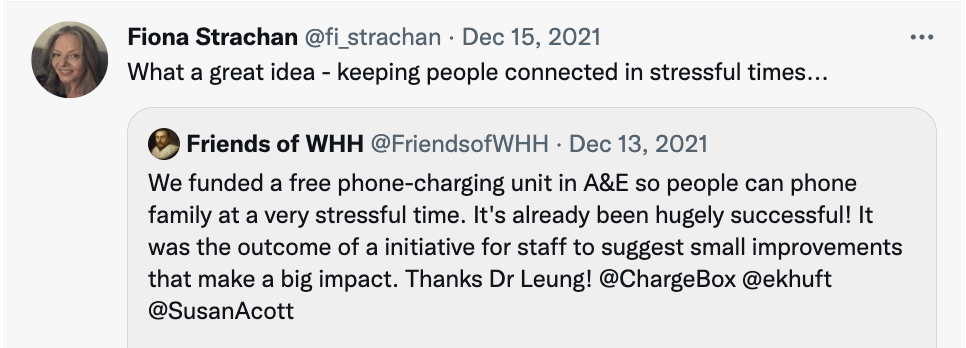

Positive validations from NHS staff continued to flow…
Chief Nursing Officer, Evonne Hunt at Medway NHS Trust said ‘What a brilliant idea!’.
Joel Bonner, Patient Experience Lead at Gloucestershire Hospitals NHS Foundation Trust commented: ‘the sort of thing I had in mind!’ to which Sally Hayes, Deputy Divisional Director Quality & Nursing Medicine said ‘Yep! Saw that last night! Go for it!’
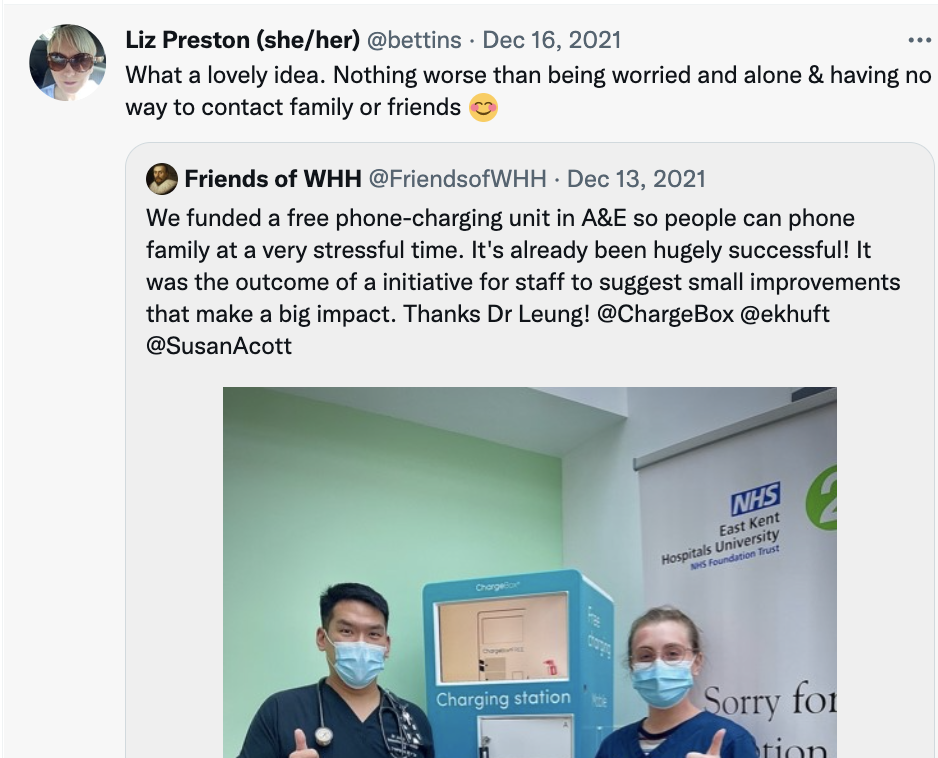
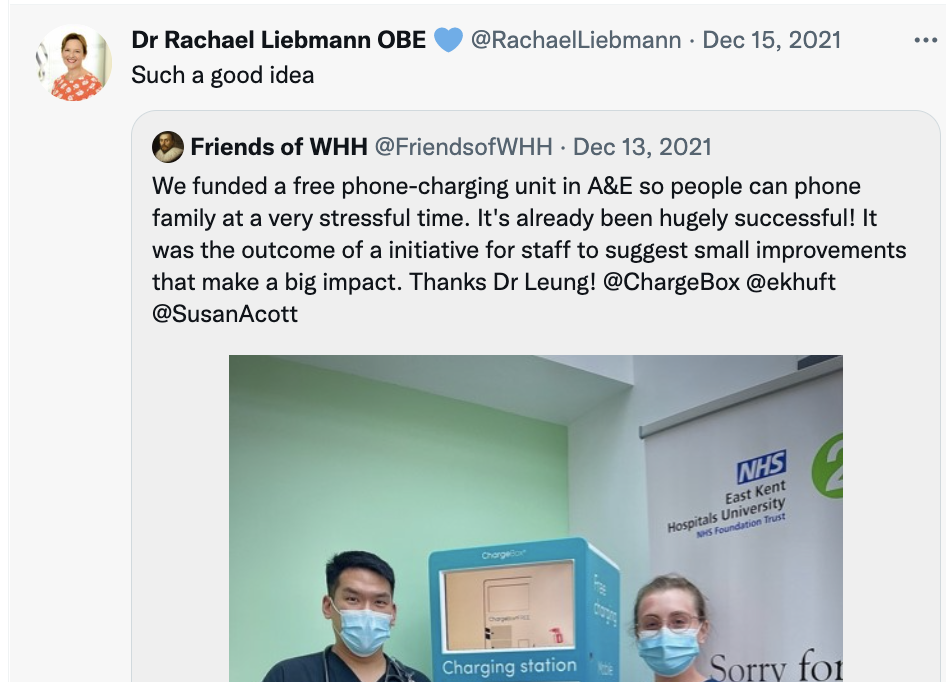
Other comments even made us chuckle as curiosity about the new Chargebox grew. ‘Where do we buy one of these beauties???’ Really, Clare? But thank you 🙏 And Sarah 😂 ’Please can we have one for Christmas?’ ‘How groovy is this!? Yeah, baby!
&tbnid=OQq4MQpfNnO8FM&vet=12ahUKEwjR68OSqIz5AhVSiRoKHaoGA-gQMygAegUIARDiAQ..i&docid=57W0r4TBuHtuoM&w=339&h=293&q=austin%20powers&ved=2ahUKEwjR68OSqIz5AhVSiRoKHaoGA-gQMygAegUIARDiAQ)
But Clare Campion, Interim Director of Nursing & Quality at The Children’s Trust and Registered Nurse Brian Webster summed up best why having charged up, connected devices at hospitals are essential.
‘Fantastic initiative, well done! That will make such a difference to people who are there for far longer than they’d like to be, and left home in a hurry without a charged phone, or spare battery. Will take a lot of anxiety away. 👏’
‘Person centredness. I helped someone today in ICU get their phone and tablet charged and WiFi connected then facilitated a video call with family. They didn’t care (verbally) about all the clinical skills I did all day but for this, they couldn’t thank me enough!’
And patient Douglas Bilton also gave us a valuable review of the service. ‘This is such a great idea. I’ve had to go to A&E 3 times this year and on each, phone charging has been a concern.’
So as you can see, keeping patients’ devices charged is essential. We hear this all the time in our conversations with NHS partners so it’s rewarding to see it stated openly and genuinely for all to see.
About ChargeBox:
ChargeBox is the trusted, safe and secure charging provider at over twenty NHS Trusts because our service will:
Alleviate stress as patients and visitors can stay connected with loved ones, access critical information and stay entertained.
Increase staff productivity as they no longer have to deal with charging requests.
Support the increased volume of mobile devices within the NHS as pagers are phased out.
Reduce the uncontrolled use of sockets which can result in health and safety risks – Estate and Facilities Alert Dec 2018
Tell us about your local hospital – is device charging a service you think is essential these days?.
Fast charging and protecting your smart phone’s battery life.
Do you want to charge your smart phone safely and keep the battery life good for as long as possible?
Are you surprised at how slowly your smart phone appears to charge sometimes?
Are you confused by the different cables and chargers around?
If you answered yes to just one of these, you’ve come to the right place…
Your smart phone’s Lithium-Ion battery is an incredibly sophisticated component that has evolved to supply reliable power for much of the day, safely, and for an extended lifetime of 1,000 charges.
Over those 1,000 charges, your battery will start to deteriorate and not yield the life it had when it was new.
A key way to reduce that degradation is NOT to charge it past 80-90% if you don’t have to and ideally keep it above 10-20%. This may mean charging it twice daily to keep it in that range and skipping overnight charging to 100%.
Like most people, you’ve probably got several chargers you’ve received with smart phone purchases over the years.
If you’re still using the charger that came with a smartphone just a few years ago, you need to change it!
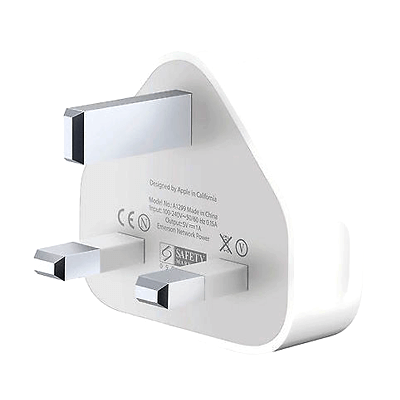
👈 If you are using one of these to charge your iPhone 8 onwards, it’s only providing between 18-30% of the power your smart phone needs.
In other words, your smart phone could be charging up to five times slower than it’s capable of. 😳
Why Battery Size Matters
Smart phones now have 3-4X more battery capacity than just a decade ago. You may not have noticed the change as it has been a gradual change in line with smart phones getting thinner. While some of that capacity provides better battery life, more is used because smartphones now have giant screens and are more power-hungry. What could charge a smart phone a decade ago will only give you a fraction of the power needed now.
To understand if your smartphone is getting a meaningful charge, you should measure it in terms of the % battery boost in a particular timeframe, e.g. 0-50% battery in 30 minutes.
Using an old charger with your new smartphone may take over 2 hours to get a meaningful charge. Of course, that’s not a lot of use when you’ve only got 10 minutes to get out of the house.
So what’s the answer?
Faster charging. The first iteration was QuickCharge from Qualcomm. This allowed slightly quicker charging using the micro-USB cable. However, it was proprietary and generally limited to specific Android devices that used Qualcomm components (by no means all). Plus, it was limited to the inferior micro-USB cable, which breaks easily.
Now USB is leading the way in providing fast charging standards developed and agreed upon by a cross-industry group, including leading vendors such as Apple, Samsung, and Google, as well as chip companies such as Intel and Texas Instruments.
They developed a better cable ending – USB-C – and the next-generation USB charging technology known rather boringly as USB Power Delivery (PD). It’s now considered the only true Fast Charge technology for smart phones, which is also compatible with laptops and tablets.
How does USB PD work in the simplest terms?
Well, it’s actually quite straightforward. Power, measured in Watts, is simply Volts multiplied by Amps. So, with old USB charging, you might have between 5W and 12W of power (at best). But with USB PD, chargers can go all the way to 100W – over 8 times more power or 20x more power than the typical 5W chargers many people still use! (Remember that Apple charger above?)
Most smart phones today charge in the 20W-45W bracket, so a PD charger offering anywhere from 20W to 45W is good enough. But if you use a higher power charger made for a larger laptop or tablet, that’s even better. Of course, you don’t need a 100W USB PD charger, but neither will it do any harm.
USB PD continues to develop and is being stretched to 240W of power in the next generation. This could permit e-bike/e-scooter or power tool batteries to be charged while also permitting charging some of the largest laptops or powering small desktops.
Qualcomm has adopted USB PD in its QuickCharge4 standard, meaning devices supporting QC4 will also support USB PD chargers. In addition, Apple’s Lightning cable (with a USB-C adapter on the charger end) also supports USB PD chargers.
Am I using USB PD Fast Charge today?
If your charger has a USB-C port, it may be USB PD, but not definitively. If you can find the specs, look for USB PD to be mentioned and voltage levels other than 5V (e.g. 9V) and/or power of 18W or more.
If your charger has a USB-A socket, it is definitely NOT a USB PD fast charge charger. And just because your smart phone has a USB-C socket does NOT mean it’s a smart phone capable of USB PD Fast charging.
And finally.
We’ve not discussed loads of geeky terms here, such as Wh, or mAh but it is REALLY useful to understand a very simple relationship. Watts = power. A Wh or Watthour is simply the amount of power that can be sustained for one hour – so you can be a powerful runner with a quick sprint, but a one-hour run is the power you can maintain for one hour – “energy”.
In electrical terms, there are two key components that make up power; Volts and Current (amps). Multiply the two, and you get the Watts. Maintain that for one hour and you get Watthours. So, 5V * 1A = 5 Watts. Maintain that for 1 hour and you get 5Wh of energy – a smartphone that runs at 1Wh will get you 5 hours of usage.
So there it is. Fast charging in a nutshell.
Smart Lock vs PIN
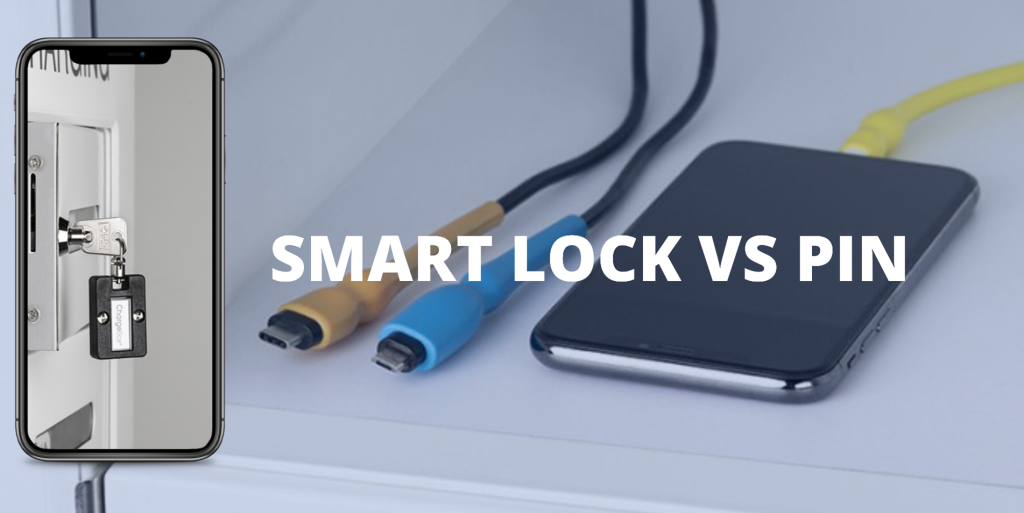
In this digital age, is it surprising to learn that key security still firmly trumps a PIN or a futuristic biometric system?
We patented our smart lock for charging lockers back in 2013, and it is still as relevant and market-leading today.
We thoroughly explored the alternatives in our quest for the ultimate locker security. But even now, in 2022, we still get asked about PIN lockers and how they compare.
To understand the limitations and benefits of a PIN-based system, we built one as a prototype and put it to the test. We trialled it in a Central London location and then sat back to observe usage on the CCTV.
On one occasion, we watched someone using the locker correctly, followed by someone else getting up from a nearby sofa, going to the same locker, typing in the PIN and stealing the device. The phone owner had done nothing wrong but found their device gone through no fault of their own.
This is just one example I hear you say. However, that alone doesn’t make key security better than a PIN. Surely there are ways PIN systems could be as good or better than a key?
We think not. Here are seven rock-solid reasons why key trumps PIN every time.
Security:
- It is pretty easy to see peoples’ keystrokes, especially when they’re unfamiliar with the system and do it slowly. Typically a user-selected PIN must be confirmed, which gives a thief a second opportunity to spot the PIN.
- Even with a six-digit PIN, anyone can remember a sequence of 6 digits. And it’s super-easy for someone standing behind to video a user entering a complex PIN.
- Preventing users from choosing common PINs (e.g. 123456) will reduce successful guesswork. Still, it’s not enough unless you also reduce how many attempts are allowed. This can create another problem, though – locking the genuine user from retrieving their device!
Ease of use:
- It is significantly more time-consuming and tricky for users to create a PIN (that passes the uniqueness test). You can easily spend a few minutes setting up a PIN system – while it’s just a few seconds to use a key. That gives more charging time and means the machine is quickly available for following users.
- What happens if a user forgets their PIN or gets locked out? Staff interventions to release the device and put the locker back in service. Even if this happens with 1 user in 100, it means staff interventions at busy locations every day.
Practicality:
- Without clever design, a PIN system makes it easy for a user to lock an empty locker and leave it that way, reducing service availability. Of course, this won’t happen everywhere, but anti-social behaviour is a risk in specific locations.
- What happens if a PIN security machine loses power (the site loses power, or the machine fails)? If this happens, there are two choices – open all the doors or keep them all locked. Neither answer is satisfactory, though the former is, of course, the worst. Would this also happen with a ChargeBox? Fortunately, the answer is “No”. If the power source goes down, all you need is the key to retrieve your device, as it’s only a mechanical process to unlock it.
But come on, there must be some bad things about a key?
Well, you have to carry it around with you, and it’s possible to lose one. However, in our experience of charging over 50 million phones, this happens to less than 1 in 50,000 charges. The host site can open the locker with an emergency key and retrieve the device subject to certain security checks if it does. All the while, our systems record every event down to the second and transmit this to our servers – e.g. door locked, charging started, cable disconnected, etc. So we can back up any truthful story with our audit trail, and if someone is not telling the truth, we can see that too.
So OK, a PIN is maybe not such a great idea, but biometric security is undoubtedly the future. After all, that’s what I use on my phone these days, and they can’t steal that, and I can’t lose it.
We’d welcome reliable biometric systems, but it’s far from reliable. Fingerprint-based and face profiles are two common biometric systems. You know it takes time to set up if you’ve used these before. And these are state-of-the-art systems by some of the world’s best technology manufacturers. Using biometrics, a phone charging locker is slow to use, insecure, or both.
Even worse is the assumption that a biometric reader will remain clean and fully functional. Used many times a day with many different fingerprints – dirty, wet etc., will affect performance. In addition, users will not be able to use the locker or retrieve their device resulting in more poor service and high staff interventions.
And of course, just as for PIN, if power is lost, so are your chances of retrieving your device.So, that is why we use keys – and we suspect why you use keys to secure your property too.